
NVIDIA's Groq 3 LPX inference accelerator entered full production on August 24, posting a record 3,400 output tokens per second on the Artificial Analysis benchmark running Gemma 4 31B with a 100,000-token context S¹. That is the fastest speed ever recorded for that model, and it targets the one bottleneck that has kept AI agents from feeling instant: the wait between a prompt and the model's first useful word. Whether that number holds outside a vendor-optimised benchmark, in the messy reality of production traffic, is the question every AI cloud is now racing to answer.
My read: This is the first inference platform I have seen that explicitly targets the trade-off NVIDIA itself admits existed: you could have speed or context or throughput, but not all three P³. The 3,400 tokens/second figure is impressive on paper, but it comes from a vendor-commissioned benchmark on a single model with a specific context length. I would watch Nebius Token Factory as the real proving ground. If a paying customer can hit even half that speed on a different model with a messier context window, the agentic AI economics shift. I am also skeptical of the "4x faster than the nearest alternative" claim S¹ until we see which alternative NVIDIA is comparing against.
Why 3,400 tokens per second matters for agents
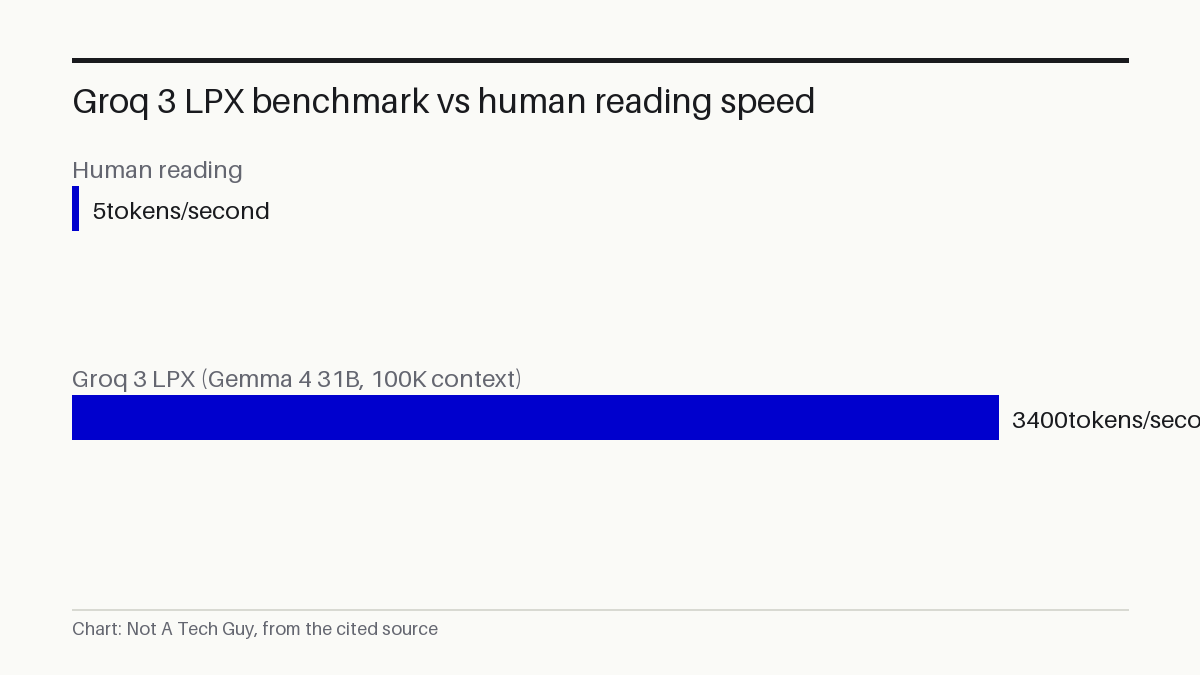
A person reads at roughly 5 tokens per second. Groq 3 LPX, running Gemma 4 31B, generated 3,400 S¹.
That gap is not academic. AI agents, the systems that chain multiple model calls to complete a task, are bottlenecked by latency at every step. An agent that reads a document, drafts a response, checks its own work, and revises might make a dozen model calls in sequence. At modest speeds, each call adds a perceptible wait. At 3,400 tokens per second, the entire chain can complete in the time it takes a user to lift their finger off the enter key.
The benchmark used a 100,000-token context S¹, roughly 75,000 words, or a thick novel's worth of background the model holds while generating. For agents that need to remember an entire conversation history, a codebase, or a stack of documents, context length is not a luxury. It is the difference between an agent that reasons about your actual problem and one that has forgotten half of it.
The trade-off NVIDIA says is now dead
NVIDIA's own product page frames the problem bluntly: older inference architectures forced a choice. You could have interactivity and intelligence, but at the cost of throughput. Or throughput and intelligence, but at the cost of interactivity P³. You could not have all three.
Groq 3 LPX is designed as a rack-scale accelerator co-engineered with the Vera Rubin NVL72 system P⁴, the platform NVIDIA pushed into full production in May 2026 P⁵. The pitch is that it extends Vera Rubin's inference performance by increasing token generation speed specifically for context-heavy, latency-sensitive workloads S¹. Jensen Huang called inference "the growth engine of AI" in the announcement S¹, framing this as the phase of AI where the money actually moves.
NVIDIA claims 4x faster responsiveness for agents and latency-sensitive workloads than the nearest alternative platform S¹. The company does not name that alternative in the release.
Who gets it first
Nebius, an AI cloud provider, is the first to adopt Groq 3 LPX S¹. The company plans to integrate it into Nebius Token Factory, its production inference platform S¹. No deployment date, pricing, or revenue terms are disclosed.
"Full production" describes NVIDIA's manufacturing status, not general market availability. Enterprises cannot buy a Groq 3 LPX rack today. The path to access runs through AI clouds like Nebius, and even there, the timeline is "plans to bring," not "available now."
What to do about it
Consider a customer support platform that routes tickets through an AI agent. The agent reads the ticket, searches a knowledge base, drafts a response, checks it against company policy, and sends it. Today, each step might take 2 to 5 seconds on a standard inference server. A complex ticket could mean 30 seconds of waiting before the customer sees anything. At 3,400 tokens per second, that same chain could complete in under a second, fast enough that the agent feels like a human typing in real time.
That is the threshold where agent UX changes. Sub-second response times let designers build agent interfaces that feel conversational rather than transactional. They let agents retry failed steps without the user noticing. They make multi-agent systems, where several agents talk to each other, viable instead of painfully slow.
If you are building agentic workflows, the practical move this week is to check whether your inference provider offers any Vera Rubin-based instances, and to benchmark your actual workload, not a vendor's model, against your current latency. The 3,400 figure is for Gemma 4 31B. Your model, your context length, and your traffic patterns will produce different numbers.
What we don't know yet
The 3,400 tokens/second benchmark and the 4x performance claim are vendor-announced, based on Artificial Analysis testing of a single model with a specific context length S¹. No independent media outlet has verified these figures. The release does not name the "nearest alternative platform" used for the 4x comparison.
Nebius has not given a deployment date for Groq 3 LPX on Token Factory S¹. No pricing is public. No other AI clouds beyond Nebius are named as adopters.
The name "Groq 3 LPX" may confuse readers who know Groq Inc., a separate AI inference hardware company. NVIDIA's sources do not address any relationship between the two.
The next signal: Nebius Token Factory's first Groq 3 LPX deployment, which the company has not yet dated but which will be the first real-world test of whether these benchmark numbers survive production traffic. When it lands, we will check the 3,400 tokens/second claim against it.
If you want to follow the inference speed race as it hits production, subscribe and we will keep tracking the numbers that actually matter.
Sources: S1 — NVIDIA Groq 3 LPX Now in Full Production With World-Class Speed for Ag · S2 — NVIDIA Groq 3 LPX Now in Full Production With World-Class Speed for Ag · P3 — AI Inference Accelerator | NVIDIA Groq 3 LPX · P4 — Inside NVIDIA Groq 3 LPX: The Low-Latency Inference Accelerator for th · P5 — NVIDIA Vera Rubin Ramps Into Full Production to Power Agentic AI Facto · P6 — How NVIDIA Groq 3 LPX Unlocks Ultrafast Interactivity at Long Context
More from Not A Tech Guy
- TokEval: tokenizer metrics predict AI model performance
- Vite still trending on GitHub with 82,454 stars
- Docling hits 65,000 stars, turns PDFs and video into AI-ready data
Generated from an audited evidence pack with primary-source research. Social-media items are discussion signals, not verified facts. Nothing here is financial, legal or medical advice.