
NVIDIA has invested $3.5 billion in convertible bonds issued by MediaTek, deepening a partnership that now spans AI data centres, consumer PCs and autonomous vehicles S¹. The move puts NVIDIA's architecture into markets it has never owned, from phone-class chips to car dashboards. The question is whether MediaTek can actually deliver custom silicon that plugs cleanly into NVIDIA's rack-scale AI factories, or whether this is a bet on a future that is still being designed.
My read: This is the largest single investment in a chip partner I've seen from NVIDIA, and it tells me Jensen Huang is not content to own the data centre alone. The convertible bond structure is smart: NVIDIA gets financial exposure to MediaTek's upside without an immediate equity stake, and MediaTek gets capital to build the SoC design and packaging capability that NVIDIA lacks. What I'm skeptical about is the timeline. Every claim in this announcement is forward-looking: "will adopt", "will continue", "will offer". None of it is shipping yet. The NVLink Fusion platform is described as "prevalidated" and "prequalified", but those are NVIDIA's own marketing terms for a product that, per this source, is not yet commercially deployed in live AI factories.
Three markets, one partnership
The announcement covers three distinct domains, and each one fills a gap in NVIDIA's current reach.
In AI infrastructure, MediaTek plans to build on NVIDIA's NVLink Fusion platform, which would let hyperscalers and frontier model developers create their own specialised AI processing units that slot into NVIDIA's rack-scale systems S¹. NVIDIA dominates GPU design but does not build custom silicon for individual cloud providers. MediaTek, with its expertise in custom silicon and system-on-chip design, becomes the bridge.
In consumer computing, the two companies plan to keep working together on successive generations of NVIDIA RTX Spark and DGX Spark PC chips, pairing NVIDIA GPUs with MediaTek SoCs for consumer PCs, developer workstations and enterprise machines S¹. These chips are not yet shipping to consumers, according to the announcement's own forward-looking language.
In automotive, MediaTek and NVIDIA will keep developing platforms for software-defined vehicles, what the announcement calls "the era of physical AI" S¹.
What NVLink Fusion actually does
NVLink Fusion is the technical heart of this deal. It is a design foundation for building custom AI accelerators that can talk to NVIDIA's existing infrastructure S¹.
The platform has three components. The NVLink Fusion chiplet is the piece that links bespoke XPUs into NVIDIA's NVLink scale-up fabric, supporting both optical and electrical interconnects S¹. NVLink-C2C handles the high-bandwidth, low-power connections between those XPUs, NVIDIA's Rosa CPUs and other compatible processors S¹. NVHBM brings customised memory capabilities into the mix S¹.
In plain terms: if you are a cloud provider that wants to design your own AI chip but still plug it into an NVIDIA-powered data centre, NVLink Fusion is supposed to give you the wiring diagram and the validated parts to do it. MediaTek's role is to help build those custom chips using the foundation.
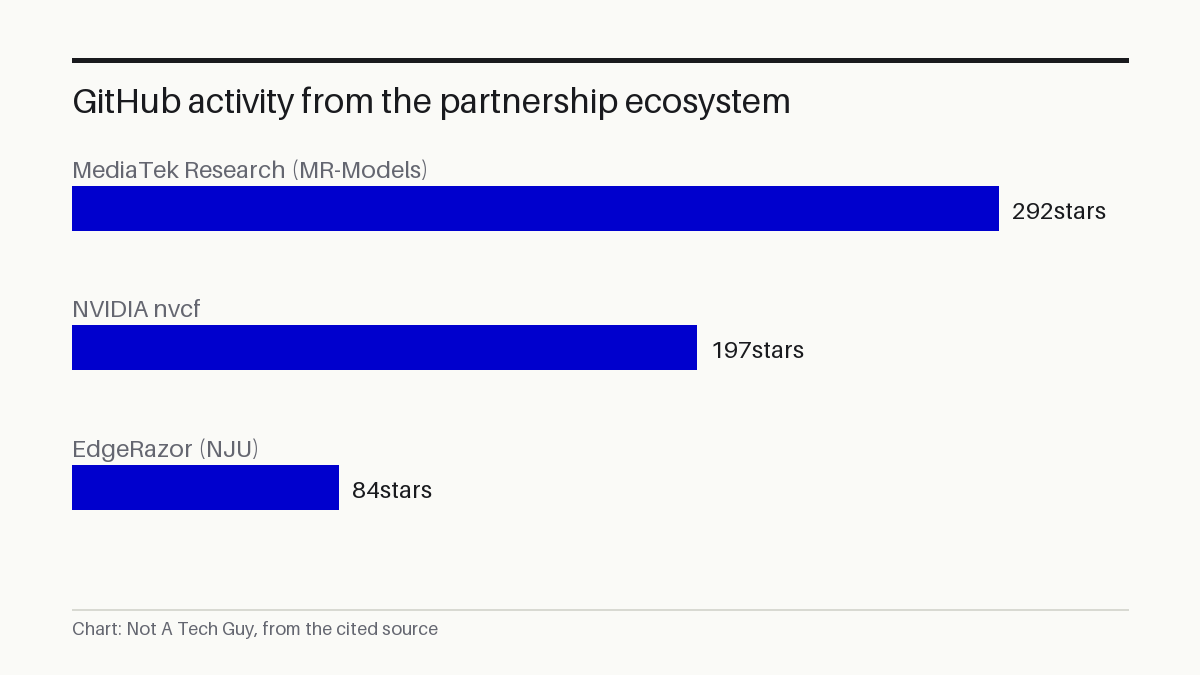
MediaTek Research, the company's AI research arm, has been publishing foundation models on GitHub since 2023, with a focus on Traditional Chinese language models P². That existing AI work gives MediaTek some credibility as a partner that understands both the software side and the silicon.
Why $3.5 billion matters more than the press release
The dollar figure is the part that separates this from a typical partnership announcement. NVIDIA is putting real capital behind MediaTek's ability to execute, beyond a typical memorandum of understanding.
Rick Tsai, MediaTek's CEO, said the investment strengthens a collaboration that spans cloud AI infrastructure, local AI computing and automotive S¹. Jensen Huang said AI is transforming every computing platform, from the largest AI factories to the PC and the car S¹.
Neither executive offered revenue forecasts, market share targets or exclusivity terms. The source is a unilateral NVIDIA press release, so the promotional positioning is expected. There is no independent verification of the technical claims, and no regulatory filing detail on the convertible bond terms, timing or conversion price.
What to do about it
If you run infrastructure at a company that buys or designs AI accelerators, this announcement signals that NVIDIA is opening a path for custom silicon inside its ecosystem, rather than insisting everyone buy NVIDIA GPUs exclusively. That could matter within 12 to 18 months if NVLink Fusion moves from announcement to shipping product.
Consider a mid-sized cloud provider that currently rents NVIDIA GPU capacity from AWS or Azure. If MediaTek can deliver a custom XPU on the NVLink Fusion foundation, that provider could build its own accelerator for a specific workload, say, inference (the cost of actually running a model) for a particular recommendation engine, while still connecting to NVIDIA's networking and memory architecture. The savings could be substantial if the custom chip is tuned for one task rather than being a general-purpose GPU.
For now, the practical move is to track NVLink Fusion's release schedule. NVIDIA's own deployment platform, nvcf, is already on GitHub with 197 stars and an Apache 2.0 licence, providing tooling for GPU-accelerated inference at scale P⁴. When NVLink Fusion documentation appears there, the platform is moving from press release to code.
What we don't know yet
The biggest gap is timing. The announcement says MediaTek "will adopt" NVLink Fusion and "will offer" it to customers, but gives no dates for when the first custom XPUs built on this foundation will appear in a data centre.
We also do not know the terms of the $3.5 billion convertible bond investment. Conversion price, maturity date and any governance rights NVIDIA receives are not disclosed in this source. Without those details, it is hard to assess how much control or upside NVIDIA actually has.
The technical claims about NVLink Fusion being "prevalidated" and "prequalified" are self-assessed. No third party has confirmed that custom XPUs built on this platform actually integrate smoothly with NVIDIA's rack-scale systems in production.
Separately, the academic community is already working on the edge AI problem from a different angle. EdgeRazor, a research project from Nanjing University, published a lightweight framework for compressing large language models through mixed-precision quantisation, with 84 stars on GitHub P³. That work targets the same edge deployment problem NVIDIA and MediaTek are chasing, but from a software compression approach rather than a silicon design approach.
The next signal: NVIDIA's next major product event, where NVLink Fusion is likely to move from press release to demonstrated hardware. We'll check whether MediaTek-built silicon actually appears on stage, or whether this stays a partnership on paper. If you want that follow-up in your inbox, the subscribe link is at the top of the page.
Sources: S1 — NVIDIA and MediaTek Deepen Long-Standing Partnership to Build AI Edge · P2 — mtkresearch/MR-Models · P3 — zhangsq-nju/EdgeRazor · P4 — NVIDIA/nvcf
More from Not A Tech Guy
- last30days skill hits 60,000 stars searching Reddit and X
- LLM security agents act but lack guardrails, review finds
- Osmantic ODS turns your PC into a private AI server
Generated from an audited evidence pack with primary-source research. Social-media items are discussion signals, not verified facts. Nothing here is financial, legal or medical advice.