Osmantic ODS, an open-source project that promises to turn any PC, Mac or Linux machine into a private AI server with a single command, landed on GitHub's daily trending list this week with 5,046 stars S¹. The pitch is simple: no cloud, no subscriptions, your prompts never leave your machine. But the repository also carries 1,062 open issues against fewer than 5,000 stars P⁵, and every feature claim comes from the maintainers' own README, not from any independent test. What is actually inside this bundle, and who should trust it?
My read: This is the first one-command local AI stack I have seen that tries to glue together this many moving parts: Ollama for model inference, Open WebUI for the chat interface, n8n for workflows, and ComfyUI for image generation. Each of those is a serious project on its own. Bundling them sounds convenient, but convenience and reliability pull in opposite directions when you are stitching four active codebases together with shell scripts. I do not buy the "just run one command" framing yet, because the 1,062 open issues suggest the edges are rough. And piping a remote script straight into bash is a security choice I would want to think hard about before running on a machine with real data on it.
What ODS actually bundles
The maintainers describe ODS as a complete local AI stack that installs and wires together several well-known open-source tools so users do not have to configure them individually [S1, S2]. The components include Ollama, the engine that runs large language models on your own hardware; Open WebUI, a ChatGPT-style web interface for talking to those models, which has its own academic backing as an extensible interface for AI interaction P⁴; n8n, a workflow automation tool that connects different services and APIs; ComfyUI, a node-based interface for generating images from local models; and privacy tools the README does not specify further [S1, S2].
On top of those, the maintainers claim ODS provides local model inference, a control dashboard, voice and agent capabilities, RAG (retrieval-augmented generation, which lets the AI search your own documents before answering), and local image generation [S1, S2]. The current stable release is version 2.6.0 [S1, S2], and the project carries an Apache 2.0 licence P⁵.
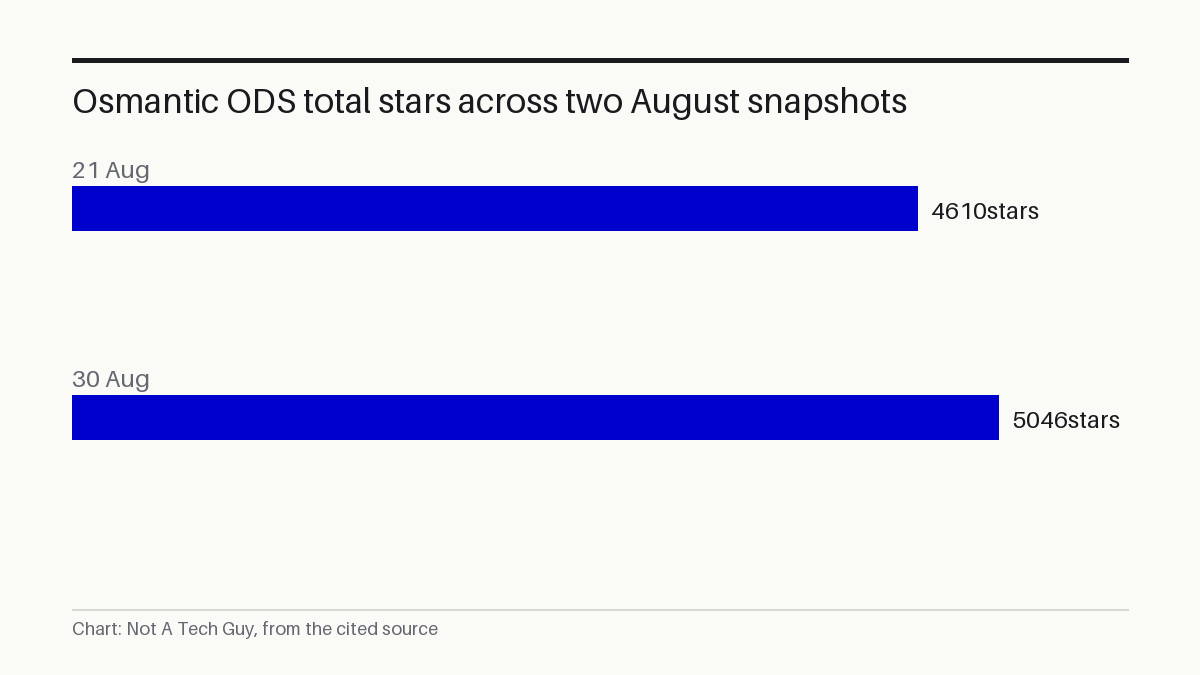
The repository was created on 9 February 2026 P⁵. Its first major release, v2.0.0 tagged "Strix Halo," came on 4 March 2026 with the tagline "One command to a full local AI stack" P³. In about six months it has climbed to roughly 5,000 stars, though the daily growth has been volatile. One snapshot on 21 August showed 162 new stars that day for a total of 4,610 S². A later snapshot on 30 August showed just 35 new stars for a total of 5,046 S¹.
The install is one command. Read it first.
The installation path is straightforward on paper. On Linux or macOS, you run a curl command that pipes a script from install.osmantic.com directly into bash [S1, S2]. On Windows, you run a PowerShell script, and you need Docker Desktop with the WSL2 backend enabled, running in a normal non-Administrator window [S1, S2].
Docker is the hard prerequisite. There is no evidence in the sources that ODS can run without it [S1, S2].
The curl-into-bash pattern is common in open-source projects, but it carries a real supply-chain risk. You are trusting that the script hosted at install.osmantic.com will do what the README says it does, and that the host will not be compromised. For a project that markets itself on privacy and keeping data local, the irony of trusting a remote script on first run is worth sitting with.
What to do about it
If you are a developer or a tinkerer who already runs Docker and wants to experiment with local AI without paying for cloud APIs, ODS is worth a look. The components it bundles are each legitimate: Ollama is widely used for local inference, Open WebUI has an arXiv paper describing its architecture P⁴, and ComfyUI is a standard tool in the image generation community.
But consider the position of a small law firm that wants to run a private chatbot over its own case files. The appeal is obvious: no client data leaves the building, no monthly per-seat subscription, full control. The risk is that ODS is a six-month-old project with over a thousand open issues and no independent security review P⁵. If the workflow breaks mid-query and leaks data to an external API through a misconfigured n8n node, the privacy promise evaporates.
The practical step: before running the installer, download the script and read it. The curl command fetches a shell file. Save it, open it in a text editor, and check what it actually does. If you are comfortable with what you see, run it. If you are not, the individual components can each be installed on their own with their own documentation.
What we don't know yet
Every feature description in this article comes from the maintainers' README. No source in the evidence pack cites an independent review, benchmark, or security audit of ODS itself [S1, S2]. The 1,062 open issues P⁵ are a signal, but we do not know how many are bug reports versus feature requests versus user questions.
We also do not know the project's funding model or long-term maintenance commitment. The sources show no venture backing, no commercial entity, and no governance structure beyond the maintainers operating under the name Lightheartdevs P³. Open-source projects that bundle other open-source projects can stall when any upstream component makes a breaking change.
The star counts are snapshots, not a growth rate. The project gained 162 stars in one day and 35 in another [S1, S2]. Whether that reflects sustained interest or a few viral days is unclear.
The next signal: watch the ODS release page for v2.7.0 or later. If the open issue count drops while the release cadence holds, the project is maturing. If issues keep climbing while releases slow, the bundle may be outgrowing the maintainers' capacity. We will check both against the next tagged release.
If you want more reporting like this, subscribe. It costs less than one month of the cloud AI subscription ODS is trying to replace.
Sources: S1 — Osmantic/ODS: Turn your PC, Mac, or Linux box into an AI server. LLM i · S2 — Osmantic/ODS: Turn your PC, Mac, or Linux box into an AI server. LLM i · P3 — Dream Server v2.0.0 — Strix Halo · P4 — Open WebUI: An Open, Extensible, and Usable Interface for AI Interacti · P5 — Osmantic/ODS · P6 — Open Deep Search and the Future of Reasoning Agents: A Comprehensive T
More from Not A Tech Guy
- GPT-4o leaks secrets 100% when prompt injection is reframed
- Addy Osmani's agent-skills hits 90,000 GitHub stars
- IBM Research open-sources AI policy schema for GenAI apps
Generated from an audited evidence pack with primary-source research. Social-media items are discussion signals, not verified facts. Nothing here is financial, legal or medical advice.