
The GeoCloak research team reduced AI geolocation accuracy from 41.2% to 9.9% across 576 cities while keeping protected photos visually intact, according to a 14 October arXiv preprint S¹. Vision language models can now work out where a photo was taken from the image alone, no metadata required, a threat CISPA Helmholtz Center researchers have separately documented P².
My read: This is the first geolocation-privacy system I've seen that attacks the problem at the semantic level, editing out the actual clues rather than just adding invisible noise. I don't buy the utility-preservation claim yet, because the paper is a preprint with no peer review and no independent benchmark, and "substantially superior" is the authors' own assessment against their own baselines. What I would watch is whether anyone can reproduce the 9.9% figure against a model the GeoCloak team did not test.
Your photos are leaking your location
The threat is simple. Large vision language models, the same family of AI systems that power image chatbots, have become accurate enough at geolocation inference that someone with black-box access to such a model can deduce a user's location from a single photo that carries no metadata S¹. Xinyu Zhang and colleagues at CISPA Helmholtz Center demonstrated this risk with LLM agents that extract geographic cues from ordinary social media images P². A street sign in the corner of a frame, a building's design in the background, the type of vegetation on a roadside: each is a clue a trained model can read.
Existing protection methods rely almost exclusively on adversarial perturbation, a technique that adds calculated noise to an image to confuse the model S¹. The noise is meant to be imperceptible, but in practice it introduces visible artifacts and degrades the image's usefulness. That trade-off has dogged this field. Synthetic data guarantees have proven equally fragile in other privacy domains.
GeoCloak targets location clues at the image periphery
The authors identify what they call a "visual-geolocation asymmetry": the elements that most strongly pin down a photo's location — street signs, road markings, architectural details, tend to appear at the edges of an image rather than its center S¹. Most adversarial-noise methods treat the whole image uniformly. GeoCloak takes a different path. It scans each image to find which elements carry geolocation signal, applies targeted semantic edits to remove those peripheral clues, and then layers adversarial perturbation only on residual features the edits did not catch S¹. The system runs iterative utility-aware checks, verifying after each round of edits that the image still looks correct.
This is an agentic approach, closer to the code-thinking agent frameworks gaining traction on GitHub, like HuggingFace's smolagents library with its 29,715 stars P³, than to a simple pixel-level filter. The semantic-editing idea also echoes work by Jiayi Zhu and colleagues at Xidian University, who explored typographic attacks for geo-privacy protection P⁴, and the broader study of semantic privacy attacks from the mie-lab research group P⁵.
Accuracy drops below one in ten cities
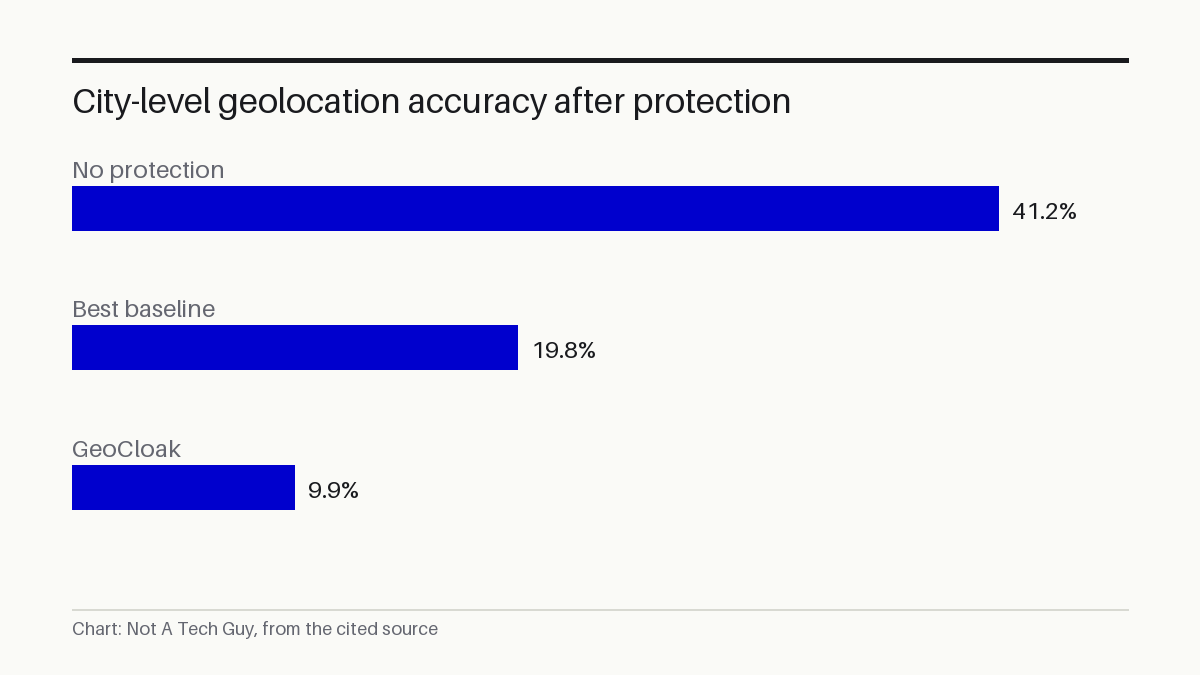
The authors evaluated GeoCloak on four datasets spanning 108 countries and 576 cities, testing against five vision language models and three inference methods S¹. City-level accuracy dropped from 41.2% with no protection to 9.9% with GeoCloak applied S¹ — a figure that has not been independently verified, carries no reported error bars, and comes with no released code for outside testing S¹. That 9.9% result is approximately half the accuracy of the best-performing baseline, roughly 19.8%, meaning the strongest existing approach still left models guessing correctly about one in five cities, while GeoCloak brought that below one in ten S¹. The authors report that GeoCloak preserved image utility better than all baselines, both in visual quality comparisons and quantitative metrics S¹, though this is the authors' own assessment against their own chosen baselines, not an external evaluation S¹.
The results remain unverified
The paper is an arXiv preprint in the cs.CR and q-fin.GN categories, posted on 14 October 2026 S¹. Every result, including the headline 41.2% to 9.9% reduction and the utility-preservation claim, comes from the authors' own evaluation protocol. No one outside the team has independently verified the figures, and the 9.9% accuracy was measured against five specific LVLMs and three inference methods, not against every possible geolocation system S¹. The utility-preservation claim is relative to the baselines the authors chose, not an absolute guarantee that images emerge untouched.
News desks and aid groups face the sharpest exposure
The most obvious early users are organisations that handle sensitive imagery. A photo editor at a news desk could run GeoCloak on images filed from a conflict zone before publication, stripping the street-sign and landmark clues that a hostile actor could use to trace a source's movements. For a photo desk editor, what changes on their desk is that an automated step would flag and suppress the specific peripheral elements — signs, markings, architecture, that vision language models read for geolocation, rather than leaving the editor to manually guess which details might reveal a source's location S¹. Domestic violence support services that share photos for case documentation, and aid workers operating in regions where location disclosure could endanger staff, face the same exposure. The agentic framework design means it could plug into existing image-processing pipelines, though anyone deploying it would need to test it against the specific models their adversaries are likely to use, beyond the five in the paper.
The preprint is available on arXiv for anyone to test against their own models. The 14 October 2026 posting date marks the earliest point at which independent verification could begin S¹.
Sources: S1 — GeoCloak: An Agentic Framework for Semantics-Preserving Geolocation Pr · P2 — GEO-Detective: Unveiling Location Privacy Risks in Images with LLM Age · P3 — huggingface/smolagents · P4 — Beyond Pixels: Semantic-aware Typographic Attack for Geo-Privacy Prote · P5 — mie-lab/semantic_privacy
Written from 5 sourced items, 4 of them primary.