
NVIDIA's September 10 blog post claims every major robotaxi program at commercial scale today runs on its technology stack S¹. The post lays out a three-computer architecture spanning training, simulation and in-vehicle driving, with an open 10-billion-parameter reasoning model already on GitHub P⁵. Whether one supplier owning that entire pipeline helps the industry move faster or quietly locks it in is the question the blog never asks.
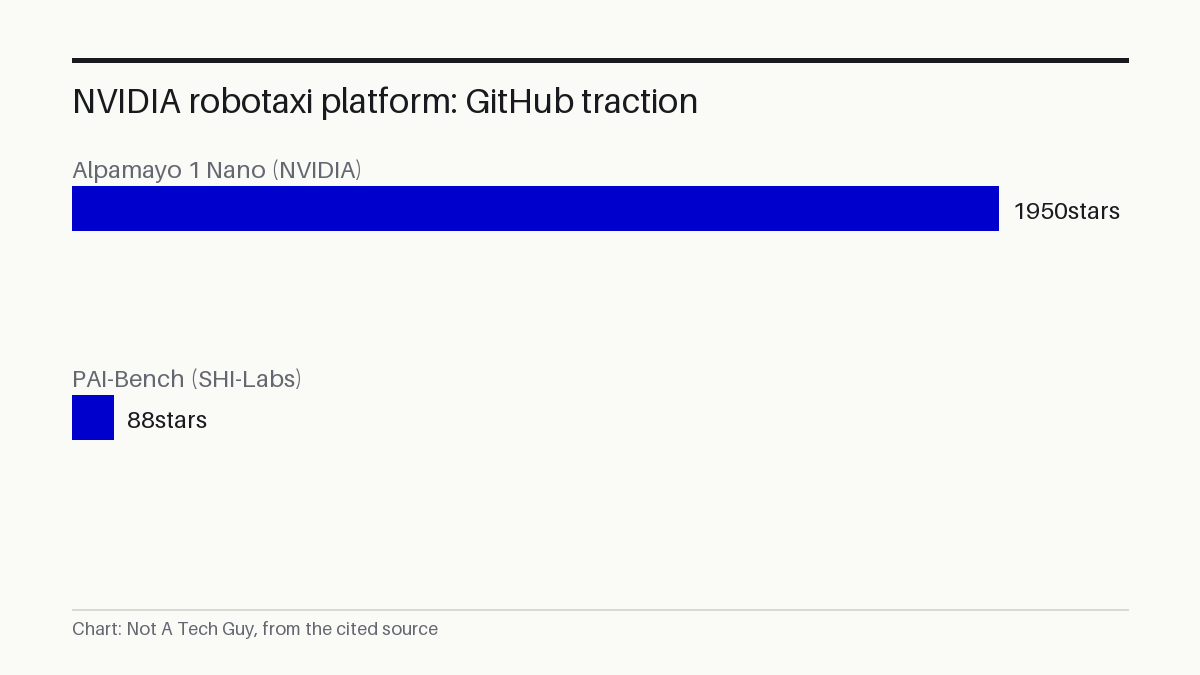
My read: This is the most explicit NVIDIA has been about owning the entire robotaxi technology chain, and I'm struck by how much of it is open. The Alpamayo 1 Nano model, a 10-billion-parameter reasoning model for autonomous driving, sits on GitHub under Apache 2.0 with 1,950 stars P⁵. That's not a company hoarding its IP. It's a company making its IP the default standard. I don't buy the $400 billion market projection yet because the blog doesn't name the analyst behind it, and I'd treat the "every major program" claim as self-reported until an independent operator confirms it. But the architecture, the partner list, and the open model all point in the same direction: NVIDIA wants to be to robotaxis what Android is to smartphones.
The three computers that make a robotaxi
A robotaxi needs three things to work. First, a training computer to teach the driving model from petabytes of real-world data. Second, a simulation computer to test that model against millions of scenarios it might never see on the road. Third, an in-vehicle computer to run the model in real time as the car moves through traffic S¹.
NVIDIA's blog describes this as a "three-computer solution" and says its platform covers all three S¹. Training happens on NVIDIA DGX systems in data centers. Simulation and validation run on NVIDIA RTX PRO Servers using Omniverse and Cosmos models. The in-vehicle side is DRIVE Hyperion, a modular compute and sensor architecture designed for level-4-ready robotaxis S¹.
The latest version, DRIVE Hyperion 10, pairs dual NVIDIA DRIVE AGX Thor systems S¹. NVIDIA's own press releases confirm that BYD, Geely, Isuzu and Nissan adopted DRIVE Hyperion for their level-4 vehicle programs as of March 2026 P⁴. Foxconn is working with NVIDIA to deploy level-4-ready robotaxi fleets in Taiwan starting in Kaohsiung, with plans to scale across Asia P².
Why reasoning models change the game
The hardest problem in autonomous driving isn't the easy 99% of miles. It's the long tail, the weird edge cases: a pedestrian stepping out from behind a truck, a construction zone with improvised signage, a child chasing a ball into the road.
NVIDIA's Alpamayo portfolio targets exactly this. Its reasoning models, called vision language action or VLA models, decompose difficult driving scenarios into discrete steps, evaluate each step individually, and then choose what NVIDIA considers the safest path forward S¹. The first public model, Alpamayo 1 Nano, is a 10-billion-parameter open model that pairs driving trajectories with what NVIDIA calls Chain-of-Causation reasoning P⁵. It's on GitHub under an Apache 2.0 licence with 1,950 stars and 325 forks P⁵.
This matters because traditional autonomous driving models react to patterns. Reasoning models think through situations. The difference is between a model that has seen a similar scenario before and one that can work through a novel scenario step by step.
NVIDIA also provides physical AI datasets and reinforcement learning blueprints, plus recipes for post-training and distillation. Developers use these to optimize models for their specific vehicles S¹.
Turning thousands of corner cases into millions
Simulation is where NVIDIA's platform gets particularly interesting. Two models work together. Omniverse NuRec takes raw sensor data and rebuilds real-world driving scenes so developers can replay what the vehicle's cameras and sensors originally captured S¹. Cosmos world foundation models then produce physically grounded remixes of those scenes, altering factors like traffic density, weather, time of day and sensor noise S¹.
The result: a developer who captured one tricky intersection at dusk can generate thousands of variations of that same intersection under different conditions, all without sending a car back to the street. Running on RTX PRO Servers, these models support closed-loop simulation. The driving model's decisions feed back into the scenario, so developers can test how the car would actually respond S¹.
The AlpaSim framework extends this further, training and evaluating reasoning-based driving models to identify weaknesses before deployment S¹.
What to do about it
If you're running a logistics company that operates 200 delivery vans across a major metro, this matters in a concrete way. The companies building the robotaxi systems that will eventually compete with your drivers are all buying from the same supplier. When BYD, Nissan, Geely and Isuzu all adopt the same in-vehicle compute architecture P⁴, and Foxconn builds robotaxi fleets on the same platform P², the cost of autonomous driving technology falls faster because software and simulation tools are shared across the ecosystem, along with models. Your fleet costs won't drop tomorrow. But the timeline for when autonomous delivery becomes commercially viable in your city just shortened.
If you're a developer or researcher, the Alpamayo 1 Nano model is on GitHub right now under Apache 2.0 P⁵. You can download it and inspect the Chain-of-Causation reasoning approach, then test it against your own driving data this week. The PAI-Bench benchmark for physical AI, a CVPR 2026 oral paper from SHI-Labs, is also public on GitHub under MIT licence P³. It offers an independent way to evaluate physical AI models against a standard set of tasks.
What we don't know yet
The $400 billion market projection and the 6 million vehicle figure cited in NVIDIA's blog are unattributed to any specific analyst or research firm S¹. Without knowing who produced these forecasts and what methodology they used, they're directional at best. NVIDIA's claim that every major robotaxi program at commercial scale runs on its stack is the company's own assertion, not independently verified S¹. Some operators may use NVIDIA for training but competitor chips for inference, or vice versa.
The blog describes DRIVE Hyperion 10 as pairing dual DRIVE AGX Thor systems but doesn't specify shipping timelines or volume production status S¹. The press releases confirm adoption announcements from BYD, Geely, Isuzu and Nissan P⁴ and Foxconn P², but none specify when level-4 vehicles will be commercially deployed at scale.
Whether Alpamayo models are already running in live commercial robotaxi fleets is unclear. The GitHub repository describes the model and its architecture but doesn't claim live deployment P⁵.
The next signal: Foxconn's robotaxi deployment in Kaohsiung, Taiwan, announced in June 2026 P², will be one of the first real-world tests of NVIDIA's full stack in a commercial setting. We'll check whether it launches on schedule and what the initial operating data shows. If you want to follow that thread, subscribe and we'll have the update when it happens.
Sources: S1 — Physical AI Takes the Wheel: How the World’s Robotaxi Leaders Are Buil · P2 — NVIDIA Corporation - NVIDIA DRIVE Hyperion Becomes the Global Platform · P3 — SHI-Labs/physical-ai-bench · P4 — NVIDIA Corporation - BYD, Geely, Isuzu and Nissan Adopt NVIDIA DRIVE H · P5 — NVlabs/alpamayo
More from Not A Tech Guy
- Paul Christiano joins OpenAI board and safety committee
- AI agents can probe neural networks but misread their own data
- AI agents don't know when they fail: new method reads internal signals
Generated from an audited evidence pack with primary-source research. Social-media items are discussion signals, not verified facts. Nothing here is financial, legal or medical advice.