
OpenAI has appointed Dali Rajic as Chief Revenue Officer, placing a dedicated commercial leader over its global revenue organization S¹. The company's own announcement frames the hire around one job: helping businesses "realize the full value of AI" S¹. For a company that released its first open-weight models just over a year ago P⁵ and is still negotiating AI safety rules with regulators in Europe and Washington, a CRO hire tells you where the priorities now sit. The question is what changes for the customers OpenAI is trying to reach, and what it reveals about the gap between building AI and selling it.
My read: This is the clearest signal I've seen from OpenAI that the company has moved past the "build it and they will come" phase. A CRO is a role you hire when you have a pipeline problem, not a product problem. The fact that the announcement leads with helping businesses "realize the full value of AI" S¹ tells me OpenAI knows its models are landing in companies that aren't yet converting enthusiasm into contracts. I'd watch whether Rajic's arrival coincides with a restructuring of OpenAI's enterprise pricing or packaging, because that's what a new revenue chief usually pushes for first.
Why a CRO hire is different from a CTO hire
A Chief Revenue Officer is not a sales VP with a grander title. The role owns the entire commercial engine: pricing, packaging, the sales team, partnerships, and the funnel that turns a free-tier user into a paying enterprise customer. OpenAI's announcement says Rajic will "lead its global revenue organization" S¹, which is corporate language for owning every dollar that comes in the door.
The timing matters. A CRO hire is about converting regulatory and technical progress into paying customers.
The open-weight context
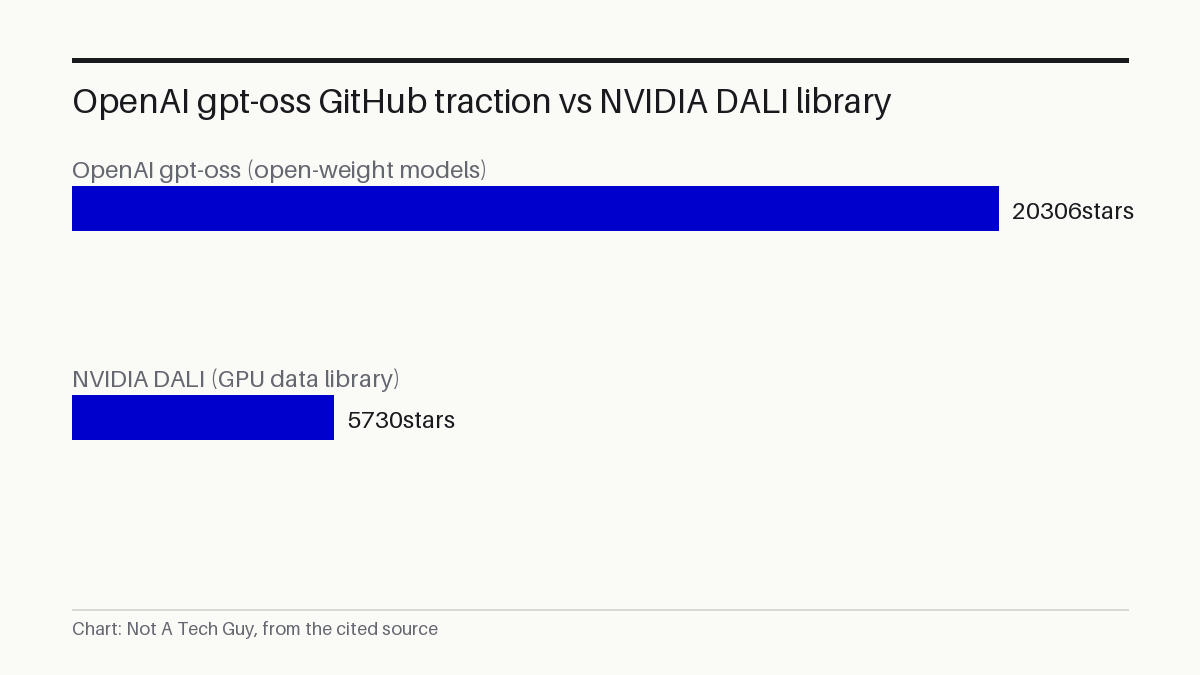
OpenAI released gpt-oss-120b and gpt-oss-20b, its first open-weight language models, in June 2025 P⁵. The repository has since drawn over 20,000 stars on GitHub P⁵. That points to strong developer interest in models that are free to download and run.
Open-weight models generate no direct revenue. They do generate something else: adoption, familiarity, and a pipeline of developers who might later upgrade to OpenAI's paid API. A CRO's job is to convert that pipeline. The open-weight strategy gives away the model. The revenue organization sells the service layer on top: enterprise support, fine-tuning, compliance guarantees. Rajic's hire suggests OpenAI thinks the pipeline is now big enough to need a dedicated converter.
What to do about it
If you run a business currently using OpenAI's API or evaluating GPT models for production, this hire likely means changes to how OpenAI sells to you. New CROs typically push for clearer enterprise tiers, volume-based pricing, and dedicated account management for larger customers.
Consider a mid-sized legal tech firm that has been running GPT-4 on a pay-per-token basis for contract review. A CRO arriving at OpenAI probably means that firm will soon hear from an account manager offering an annual contract with committed usage discounts. The question for that firm is whether the discount justifies locking in, or whether the open-weight gpt-oss models P⁵ offer enough capability to self-host and avoid the commercial relationship entirely.
One practical thing to check this week: compare your current OpenAI API spend against the cost of self-hosting gpt-oss-20b on cloud GPU instances. If the gap is narrow, you have negotiating power when OpenAI's new revenue team comes calling.
What we don't know yet
The announcement is thin on detail. OpenAI has not disclosed Rajic's previous employer, professional background, or start date S¹. We don't know whether this role replaces an existing executive or creates a new layer of leadership. No revenue figures, financial targets, or compensation terms were provided.
The deeper question is whether a CRO can close the gap between AI capability and business adoption. If the models aren't dependable enough for enterprise workloads, the revenue organization will be selling against the engineering team's own bug reports.
The next signal: watch for any restructuring of OpenAI's enterprise pricing tiers in the coming weeks. If Rajic's arrival is followed by a pricing change, that will confirm the hire is about conversion, not optics. We'll check this claim against OpenAI's next product or pricing announcement. Hit subscribe and you'll get that follow-up automatically.
Sources: S1 — OpenAI appoints Dali Rajic as Chief Revenue Officer · S2 — OpenAI appoints Dali Rajic as Chief Revenue Officer - OpenAI · P3 — NVIDIA/DALI · P4 — Lysandre Debut · P5 — openai/gpt-oss
More from Not A Tech Guy
- AI agents self-evolve security defenses in new HARD framework
- ICML 2026: 23% of papers have a falsified or contested claim
- AI agent runs vertical farm, cuts grow cycle 35%
Generated from an audited evidence pack with primary-source research. Social-media items are discussion signals, not verified facts. Nothing here is financial, legal or medical advice.