

An arXiv paper announced this month describes an LLM that runs a vertical farm's lighting on its own, cutting the production cycle by 35% and finding an energy-saving strategy nobody taught it S¹. The system reads 49 channels of plant sensor data every two hours and adjusts grow lights without a human in the loop. The most surprising number is buried in the third case study, and it raises a question the authors do not fully answer.
My read: This is the first closed-loop LLM system I have seen that moves from advising to physically actuating a biological environment. The 35% cycle reduction is impressive but benchmarked against the study's own periodic control, not a commercial baseline. What grabs me is the 67.9% energy saving from a dark-induced chlorophyll strategy the agents developed on their own. If that holds under peer review and replication, it changes the conversation about what LLMs can find in experimental biology. I am skeptical until someone else reproduces it, because every number here is self-reported from a single lab.
From answering questions to pulling levers
Most agricultural AI today sits on the advisory side. Digital Green's Farmer.Chat, built on OpenAI's API, lets farmers ask questions and get answers tailored to their local context P⁴. AgriChat, an open-source multimodal model, handles plant pathology questions with fine-grained image analysis P⁵. Both are chatbots. A farmer types or speaks, the model responds, and the farmer decides what to do.
The arXiv paper, authored by Serge Kernbach at CYBRES GmbH in Stuttgart P², crosses a different line. The LLM reads telemetry from a 49-channel phytosensor network covering multispectral, electrochemical, and dielectric signals, then decides what the grow lights should do next S¹. It triggers hardware actuators to optimise microclimates, run phenotyping protocols, or induce controlled stress on the plants S¹. The model evaluates plant physiology from the sensor stream and acts on what it finds.
The two-hour decision loop
In the production-scale case study, the LLM modulated full-spectrum, 450 nm, and 660 nm lighting at two-hour intervals S¹. Each decision balanced three competing objectives: biomass accumulation, chlorophyll content, and energy consumption S¹. The system also provided real-time natural-language interpretation, so a specialist could ask what the plants were doing and get a plain answer, while a non-expert could do the same S¹.
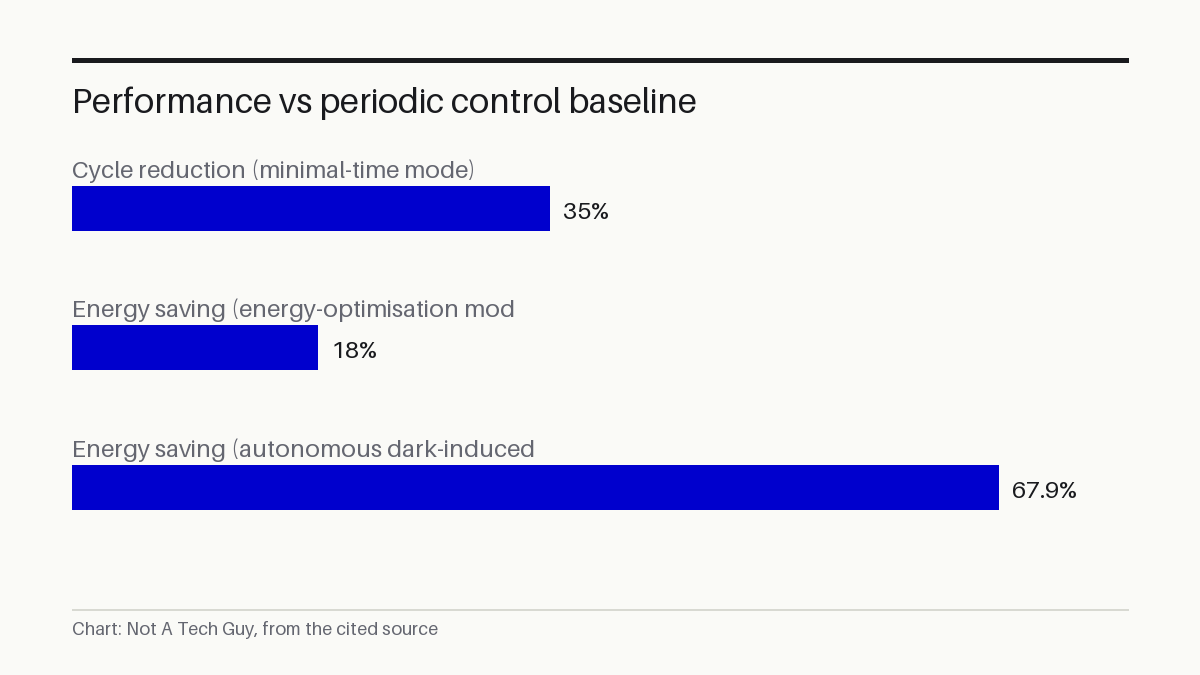
Two modes were tested. In minimal-time mode, the system prioritised growth speed and reduced the production cycle by 35% compared to periodic control S¹. In energy-optimisation mode, it cut energy use by 18% with only a marginal increase in cultivation time, exploiting what the paper calls 'physiological inertia' through light pulses S¹.
The strategy nobody taught it
The third case study is where the paper gets interesting. The agents autonomously developed a strategy the authors describe as 'dark-induced chlorophyll accumulation' S¹. The LLM found that it could withhold light in a pattern that caused the plants to concentrate chlorophyll, and this saved 67.9% of the energy compared to the baseline S¹.
The authors did not program this strategy. The LLM found it by exploring the sensor data and the plant responses. This is the transition the paper frames as its core advantage: from human-in-the-loop analysis to autonomous control S¹. The closed-loop architecture creates a direct interface between the AI and the biology, letting the model run experiments a human might not think to try S¹.
That autonomy is also the risk. A model that invents a lighting strategy is exciting in a vertical farm. A model that invents a strategy in a less forgiving environment, without guardrails, is a different problem.
What to do about it
Consider a vertical lettuce operation in Singapore growing 20,000 heads across stacked racks. The head agronomist used to walk the rows each morning, checking leaf colour and soil moisture, then adjusting the lighting schedule by hand. Under a system like this, she would still get the morning walk, but the LLM would have already read the overnight sensor data, adjusted the 450 nm and 660 nm channels at 2 am and 4 am, and left a natural-language note explaining what it changed and why. Her job shifts from turning dials to auditing the AI's reasoning.
That shift is real even without the actuator control. Any farm running a sensor network could pipe telemetry into an LLM API for natural-language interpretation today. The actuator side, where the model physically changes the environment, is where the regulatory and safety questions live. Nobody should hand a production farm's climate control to a preprint-stage system. But the interpretation layer, the part that turns 49 channels of sensor data into a sentence a grower can act on, is buildable now with existing APIs.
If you work in controlled-environment agriculture, one practical step this week: audit your sensor data pipeline and check whether your current vendor offers any natural-language query layer. If not, a basic prototype that feeds your sensor CSVs into an LLM API and returns daily summaries is a weekend project, not a capital expenditure.
What we don't know yet
Every number in this paper is self-reported. The study has not been peer-reviewed, and no third-party lab has replicated the findings S¹. The percentage improvements are benchmarked against the study's own periodic control, which may not reflect commercial baselines. The 'production-scale deployment' describes the experimental validation setup, not a market-ready product S¹. The paper does not specify which LLM model was used, how much compute it required, or what the inference cost per growing cycle amounted to. Without those numbers, the cost-to-value claim is hard to assess.
The arXiv listing carries a July 2026 submission date and an August 2026 announcement [S1, P2]. The author affiliation is CYBRES GmbH in Stuttgart, Germany P². No funding disclosures or geographic scope for the experiments are visible in the abstract.
The next signal: a revised version of this preprint on arXiv, which typically appears within weeks as authors respond to community feedback. We will check any v2 update against the energy-saving claims and report what changed.
Sources: S1 — Closed-Loop LLM Co-Pilots for Digital Agriculture · P2 — Closed-Loop LLM Co-Pilots for Digital Agriculture · P3 — closedloop-ai/claude-plugins · P4 — Building agricultural database for farmers | OpenAI · P5 — boudiafA/AgriChat
More from Not A Tech Guy
- OpenAI Ultrafast runs GPT-5.6 Sol at 14X speed on Cerebras
- GPT-5.6 builder guide pushes cheaper, faster AI agents
- Hardware monitor catches attacks software misses
Generated from an audited evidence pack with primary-source research. Social-media items are discussion signals, not verified facts. Nothing here is financial, legal or medical advice.