
OpenAI published "The builder's guide to GPT-5.6" on August 13 S¹, pitching startups on faster development and lower costs for AI agents through "smarter model selection" and new Responses API capabilities S¹. The guide is a promotional blurb with no benchmarks, no named customers, no pricing. But what OpenAI chooses to emphasise tells you where it thinks agent development is heading, and the answer is not what you'd expect.
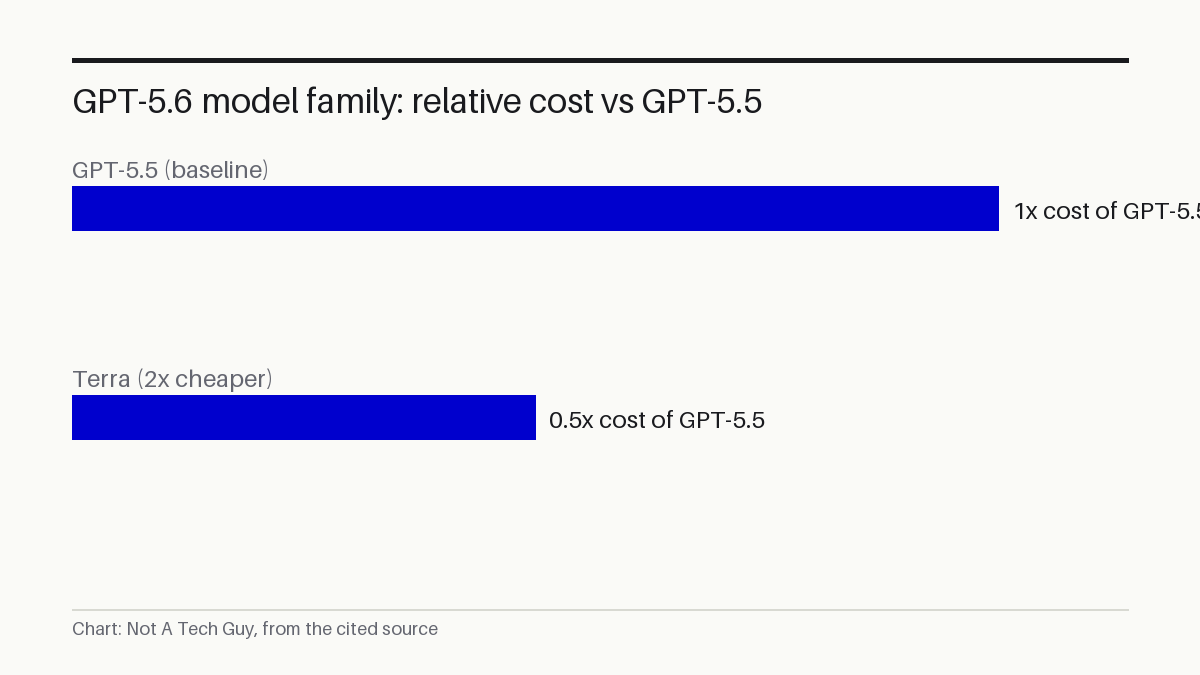
My read: I've read plenty of vendor "builder guides" and they're usually marketing dressed as documentation. This one is no different in form. But the phrase "smarter model selection" is the tell. OpenAI previewed GPT-5.6 on June 26 as a three-model family P²: Sol (flagship), Terra (balanced, 2x cheaper than GPT-5.5), and Luna (fast and affordable). The guide is pushing startups to let the platform pick which model handles which task. That is a routing play, not a raw-intelligence play. OpenAI wants to be the traffic controller, not the engine. I'm skeptical because the guide gives zero technical detail on how that routing works or whether it's automatic or developer-configured. But the strategy is clear.
What the guide actually says
Four claims, all self-reported S¹: startups can build AI agents faster, those agents are more cost-efficient, GPT-5.6 offers "smarter model selection," and there are "new Responses API capabilities." That is the entire substance. No benchmarks, no case studies, no named startups, no pricing comparisons. Every claim is OpenAI's own marketing language.
The "build faster" phrasing is ambiguous. It could mean faster development (less engineering time) or faster agents (lower latency at runtime). The guide does not clarify. The cost-efficiency claim connects to something concrete from the June 26 preview P²: Terra, the middle model, is 2x cheaper than GPT-5.5 with competitive performance. Luna is positioned as fast and affordable. So "more cost-efficient AI agents" probably means routing easy work to Luna or Terra and reserving Sol for the hard calls.
Why model selection is the real story
GPT-5.6's three-model structure changes how developers build. Instead of calling one model for everything, the platform can match each request to the cheapest model that handles it. A customer-support agent answering "what are your hours?" does not need Sol. A legal-research agent parsing case law probably does.
The "smarter model selection" phrase S¹ suggests OpenAI is building that routing into the platform itself, so developers do not have to hand-code it. If it works, it lowers the skill barrier for cost-conscious agent development. If it does not, it is a black box that sends simple queries to expensive models.
The Responses API is getting real traction
The guide highlights "new Responses API capabilities" S¹. OpenAI's developer documentation already lists GPT-5.6 Sol as a supported model P³, and the API changelog is actively maintained P⁴. Outside OpenAI's walls, Hugging Face has built an open-source implementation of the Responses API: a lightweight Express.js server that runs the Responses interface on top of standard Chat Completions, with 234 GitHub stars and an MIT license P⁵. That tells you the Responses API is gaining enough traction for the open-source community to mirror it.
Claude Sonnet was beating GPT-4.1 on cost despite a higher token price. OpenAI's response with GPT-5.6 appears to be: do not pick one model, let us pick for you.
What to do about it
If you are building agents on OpenAI's platform, the guide is a signal to start thinking in model tiers, not single models. A small freight forwarder in Brisbane handling 200 shipment queries a day could cut inference costs by sending "where's my container?" questions to Luna or Terra and reserving Sol for complex customs documentation parsing. The practical step this week: read the GPT-5.6 Sol model documentation on OpenAI's developer site P³, check whether the Responses API supports the tool-calling patterns your agent needs, and test the same query against Terra and Sol to see if the cheaper model gives you the same answer.
What we don't know yet
Every claim in the guide is OpenAI's own marketing language with no independent corroboration. There are no published benchmarks comparing GPT-5.6 agent performance to GPT-5.5 or to competitors like Claude. There are no named startups or case studies. There are no pricing figures, no quantitative efficiency metrics, and no technical detail on how "smarter model selection" actually routes queries. We do not know whether the model selection is automatic or developer-configured, or whether it works reliably across edge cases. The guide also does not clarify whether GPT-5.6 is fully shipping or still in the limited preview announced June 26 P².
The next signal: OpenAI's developer changelog P⁴ and any pricing page updates in September will show whether GPT-5.6 moves from preview to general availability. We'll check the changelog against the guide's claims when that happens. If you want that follow-up in your inbox, subscribe and we'll send it the day it drops.
Sources: S1 — The builder’s guide to GPT‑5.6 · P2 — Previewing GPT-5.6 Sol: a next-generation model | OpenAI · P3 — GPT-5.6 Sol Model | OpenAI API · P4 — Changelog | OpenAI API · P5 — huggingface/responses.js
More from Not A Tech Guy
- Hardware monitor catches attacks software misses
- Reinforcement learning cuts AI training power violations 89%
- AI image models fingerprinted without watermarks
Generated from an audited evidence pack with primary-source research. Social-media items are discussion signals, not verified facts. Nothing here is financial, legal or medical advice.