

OpenAI is currently testing a new API service level named Ultrafast, which operates its flagship GPT-5.6 Sol model at speeds up to 14 times quicker than standard processing, producing up to 750 output tokens per second S¹P³. The service relies on Cerebras rather than NVIDIA S¹P³. That pairing, a frontier model on non-NVIDIA silicon at speeds that change what agent workflows can do, opens a question the preview doesn't answer: what happens when inference is no longer the bottleneck?
My read: This is the first time I've seen OpenAI name a non-NVIDIA hardware partner for a production-facing service tier. The 14× figure is striking but it's "up to," which means real-world throughput will depend on prompt length, batch size and model configuration. What I'd watch is whether Cerebras can hold that speed under load, and whether OpenAI extends this to the cheaper Luna and Terra models. Sol is the obvious place to start, but the economics change when fast inference reaches the model everyone actually uses.
What 750 tokens per second feels like
A token is roughly three-quarters of a word. At 750 tokens per second, the model generates about 560 words every second S¹P³. That's a full page of text in about a second. A standard API call to a frontier model is fast enough for a chatbot. But chain multiple model calls together, reading a document, classifying it, searching a database, drafting a response, checking its own work, and you're waiting a minute or more for an answer that should feel instant.
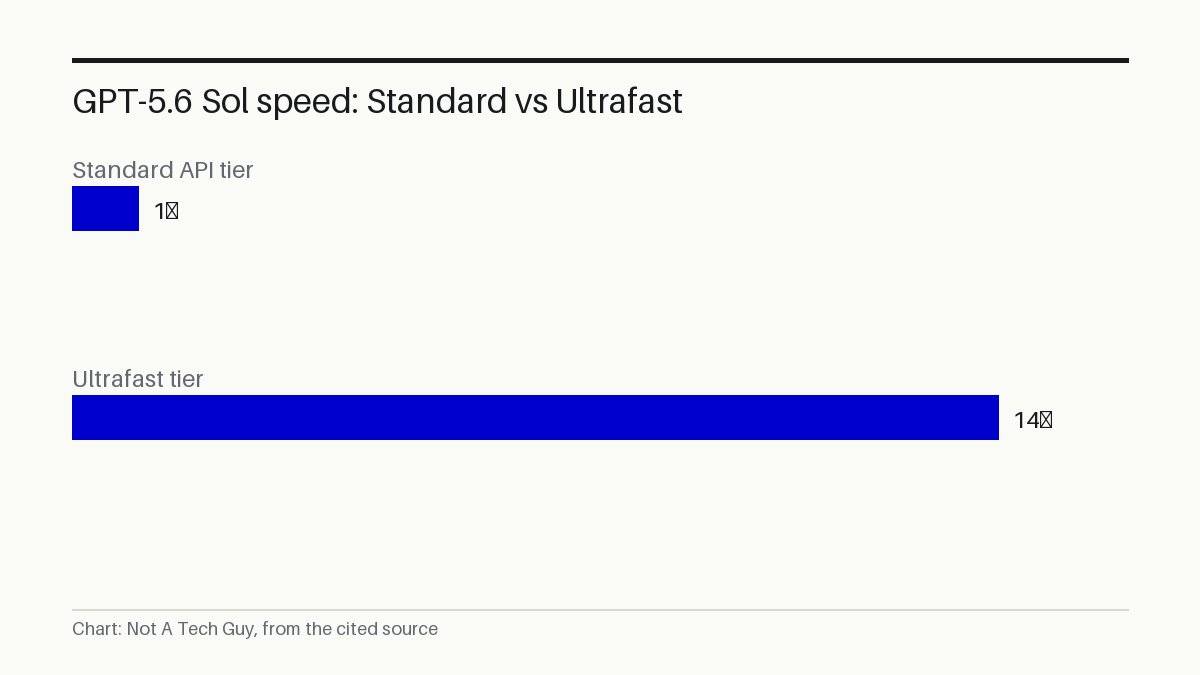
Ultrafast compresses that minute into roughly four seconds. For developers building agents that reason in steps, each step waiting on the previous one, the speedup compounds. A 10-step chain doesn't just finish 14 times faster overall. It runs 14 times faster at every step, which means the whole pipeline completes in a fraction of the time.
Why Cerebras, not NVIDIA
Hardware is the detail that matters most here. OpenAI's launch page indicates that the Ultrafast tier is driven by Cerebras P³. This is the first time OpenAI has named a non-NVIDIA chip partner for a production-facing service. Inference, the process of actually running a model to generate responses, has been an NVIDIA-dominated game. If OpenAI can get 14× speed from a different supplier, inference hardware becomes something OpenAI can shop around for, the same way it shops between model designs.
GPT-5.6 Sol was first previewed on June 26 as the top model in a three-model series alongside Terra and Luna P⁵. Now it's running on silicon that isn't NVIDIA.
What to do about it
If you build applications that chain multiple model calls, this is where the speed matters most. Consider a customer support automation startup that runs a five-step agent: read the incoming ticket, classify the issue, search the knowledge base for relevant articles, draft a response, then review that response for accuracy. At standard speeds, each step adds several seconds of generation time, and the full chain can stretch to 30 seconds or more. That's a "please wait" spinner. At 14× speed, the same chain finishes in two or three seconds. That's a response that feels live, fast enough that a customer-facing chat window can show the agent working in real time rather than making the user stare at a loading bar.
One practical step this week: if you have an OpenAI API account, check whether you have access to the Ultrafast preview. The service is in preview, not general availability S¹, so access is limited. If you do get in, benchmark your actual agent pipelines rather than trusting the 14× headline. Measure your real throughput with your real prompt lengths and batch sizes. The "up to" in "up to 14× faster" is doing a lot of work in that claim.
What we don't know yet
Several questions remain open. OpenAI has not published pricing for the Ultrafast tier S¹. The 750 tokens-per-second figure covers output tokens only; input processing speed and time-to-first-token, the delay before the model starts responding at all, are not mentioned S¹P³. The 14× comparison is against "Standard processing" P³, but OpenAI hasn't specified whether that means the same model on standard infrastructure or a different configuration entirely. And there's no timeline for when Ultrafast moves from preview to general availability, or whether it will extend to Terra and Luna.
The next signal: OpenAI moving Ultrafast from preview to general availability. We'll check the 14× speed and 750-tokens-per-second claims against independent developer benchmarks then. Subscribe to catch the next move in inference hardware before it hits the API changelog.
Sources: S1 — Previewing Ultrafast mode: GPT-5.6 Sol at up to 14X the speed · S2 — Previewing Ultrafast mode: GPT-5.6 Sol at up to 14X the speed - OpenAI · P3 — Previewing Ultrafast mode: GPT-5.6 Sol at up to 14X the speed · P4 — pbelcak/UltraFastBERT · P5 — Previewing GPT-5.6 Sol: a next-generation model | OpenAI · P6 — GPT-5.6 Sol Model | OpenAI API
More from Not A Tech Guy
- GPT-5.6 builder guide pushes cheaper, faster AI agents
- Hardware monitor catches attacks software misses
- Reinforcement learning cuts AI training power violations 89%
Generated from an audited evidence pack with primary-source research. Social-media items are discussion signals, not verified facts. Nothing here is financial, legal or medical advice.