

OpenAI launched GPT-6.1 Sol on September 29, 2026, a model it says delivers performance comparable to its flagship GPT-6 Astra at one-fifth of the API token cost S¹P⁴. The API lists Sol at $2 per million input tokens and $10 per million output tokens, which against the one-fifth claim implies Astra's rates sit near $10 and $50 on the same scale P²S¹. "Near-Astra" is OpenAI's own framing, and no independent benchmark has been published. OpenAI has not released benchmark code, error bars, or third-party evaluation data to support the comparability claim.
My read: This is the classic distillation play: take the big model's behaviour, compress it into something cheaper to run, and sell the savings. I don't doubt the price cut; I doubt the "comparable" claim until I see side-by-side results on a third-party benchmark. The system card P³ covers safety evaluations and challenging prompts, but the capability comparison lives in OpenAI's marketing, not in peer-reviewed data. What I'd watch is whether Sol holds up on long-horizon coding tasks, the kind where Astra reportedly halved research time and cost at Parallel. If Sol can do 80% of that work at 20% of the cost, it changes the economics of agent-based workflows overnight.
Sol targets coding, computer use, and professional workloads
OpenAI positions Sol for three workloads: coding, computer use (the model operating a desktop or browser on a user's behalf), and professional work like document analysis and research S¹. The API exposes a reasoning.effort parameter with five levels: low, medium (the default), high, xhigh, and max, letting developers trade thinking time for cost P². The two lowest settings, "none" and "minimal," are not supported, which means Sol always reasons at least a little P².
OpenAI published a system card addendum the same day, covering model data, training, and safety evaluations including challenging prompts and protections for users under 18 P³. It is an addendum to the GPT-6 Astra system card, not a standalone document, which fits Sol's position as a member of the GPT-6.1 family rather than a new architecture P⁴. Safety evaluations matter here because a model's safety card does not always predict how it behaves under adversarial pressure.
A five-fold token price gap reshapes agent economics
One-fifth of Astra's token price is the number that matters S¹.
For a team running thousands of agent loops per day, each one sending context, receiving reasoning, and acting on the output, inference cost (the price of actually running the model) is the line item that determines whether a pilot becomes a product. Sol at $2 and $10 per million tokens means a coding agent processing a 50,000-token context and generating 2,000 tokens of response costs roughly $0.12 per call. At Astra's implied $10 and $50, the same call costs $0.60.
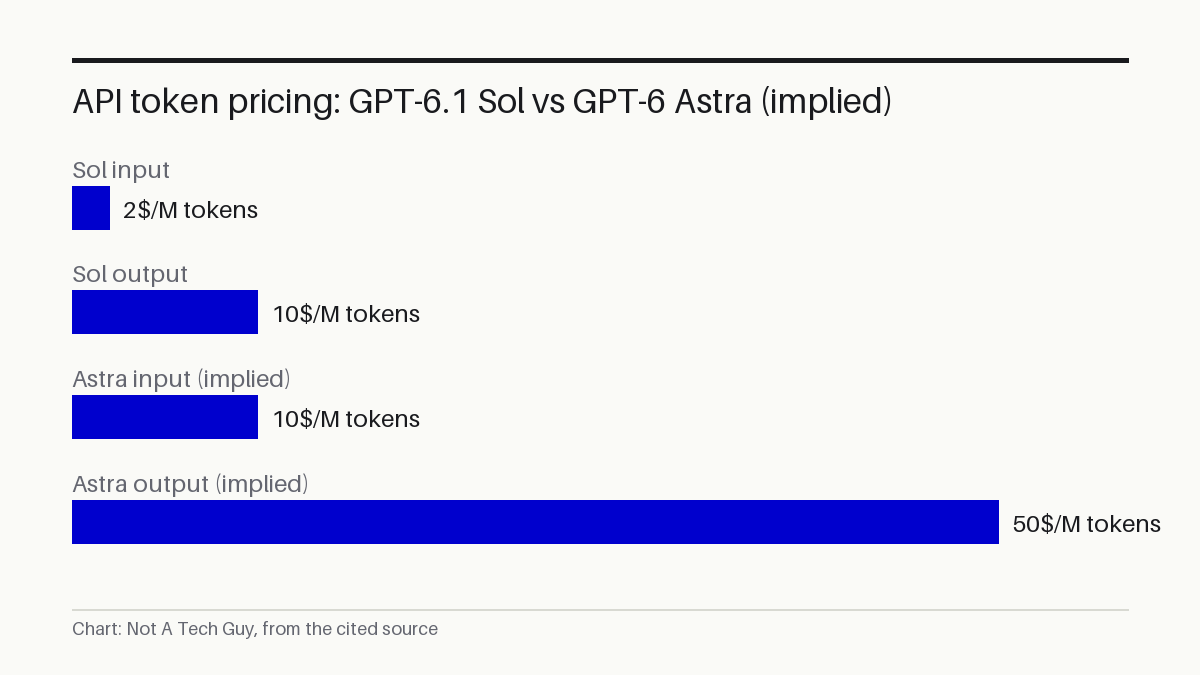
That five-fold gap is where the real question sits. OpenAI's own API documentation advises developers to test Sol against Astra on their own workloads to weigh quality against cost P², which is honest advice and also an admission that the tradeoff varies by workload. A model that is "near-Astra" on a coding benchmark may lag on multi-step computer use, where the cost of a wrong action is higher than the cost of a wrong answer. Model gains rarely transfer uniformly across architectures.
For a developer building a coding assistant or a computer-use agent, the practical move is to run Sol and Astra on the same task set and measure. OpenAI's pricing makes that experiment cheap. For a backend engineering team running automated code-review agents on pull requests, switching from Astra to Sol drops each 50,000-token review from $0.60 to $0.12, though operators will need to validate whether Sol's reasoning at the default medium effort matches Astra's output quality before trusting it in production.
The system card and deployment safety hub are live now P³P⁴, and the API is available through OpenAI's developer platform P².
Sources: S1 — Introducing GPT-6.1 Sol · P2 — GPT-6.1 Sol Model | OpenAI API · P3 — GPT-6.1 Sol System Card · P4 — Addendum to GPT-6 Astra System Card: GPT-6.1 Sol - OpenAI Deployment S · P5 — Addendum to GPT-6 Astra System Card: GPT-6.1 Sol - OpenAI Deployment S
Written from 5 sourced items, 5 of them primary.