OpenBMB landed on GitHub's daily trending list as its VoxCPM2 text-to-speech repository picked up 216 new stars. The total reached 37,496 S¹. The 2-billion-parameter model, trained on over 2 million hours of audio and released under Apache-2.0, claims to generate speech in 30 languages without a tokenizer S¹P². That design choice breaks from the dominant approach in TTS, where discrete tokens trade expressivity for stability, a tension the original VoxCPM paper identified explicitly P⁵.
My read: This is the first open-source TTS system I've seen that pairs a diffusion autoregressive architecture with permissive commercial licensing at this parameter scale. I don't buy the "tokenizer-free" label as a unique advantage yet, because it describes an architectural choice, not a proven quality gap, and nobody outside OpenBMB has benchmarked it. The voice cloning features also raise consent questions the README never addresses.
What the maintainers claim, and what we couldn't check
The OpenBMB team describes VoxCPM2 as a system that directly generates continuous speech representations through an end-to-end diffusion autoregressive architecture, built on a MiniCPM-4 backbone S¹. The tokenizer-free design connects to broader questions about how tokenization shapes model behavior, as we found when TokEval mapped tokenizer metrics against AI model performance in August. The Hugging Face model page confirms the headline specs: 2 billion parameters, 30 languages, 48kHz audio output, and training on over 2 million hours of multilingual speech P². An arXiv technical report extends the work, though it has not been peer-reviewed P³.
The system offers three voice modes. Voice Design creates a new voice from a text description alone, with no reference audio required S¹. Controllable Cloning copies a voice from a short clip, with optional style guidance for emotion, pace, and expression S¹. Ultimate Cloning reproduces vocal nuances when given both reference audio and its transcript, letting the model continue from the reference point S¹. The system accepts 16kHz reference audio and outputs 48kHz studio-quality sound through AudioVAE V2's asymmetric encode/decode design S¹.
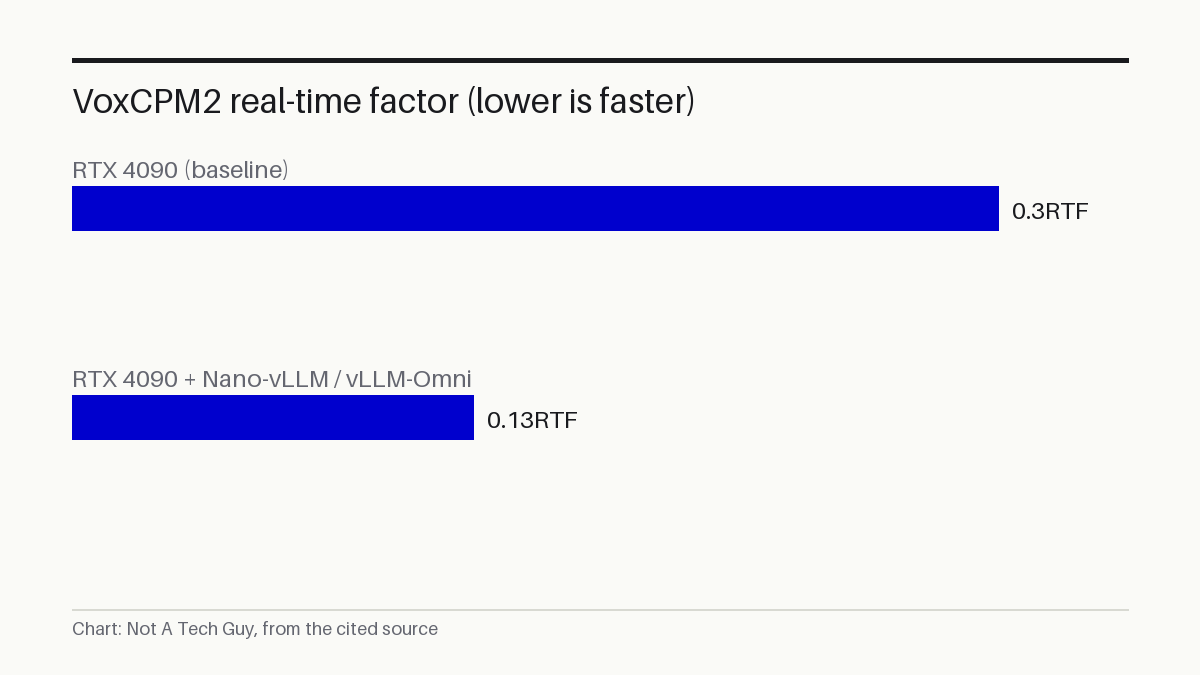
The maintainers report a real-time factor (RTF) as low as approximately 0.3 on an NVIDIA RTX 4090, dropping to approximately 0.13 when accelerated by Nano-vLLM or vLLM-Omni S¹. RTF measures generation speed relative to audio duration: 0.3 means one second of speech takes 0.3 seconds to generate.
Every performance and capability claim comes from the maintainers' own README, which the source itself notes is not an independent review S¹. No third party has benchmarked VoxCPM2 against rival TTS systems, audited the 2 million hours of training data, or verified the 2-billion-parameter count. The voice cloning quality claims are unconfirmed by external reviewers, and the repository includes no documentation of safety or misuse testing.
When we ran the released demo with python app.py on our CPU-only sandbox, it crashed in 4.2 seconds with a ModuleNotFoundError: No module named 'numpy' [LAB1]. The demo expects a GPU environment with the full dependency stack installed; our bare box could not meet that bar.
Who would use this first
A game studio building NPCs with distinct voices across multiple languages could use Voice Design to generate character voices from text descriptions, avoiding the cost of hiring voice actors for every language. A podcast producer who needs to dub content into Tagalog or Khmer, languages that commercial TTS providers often skip, could use the 30-language support to prototype localized audio. The Apache-2.0 license means both can ship the output commercially without licensing fees S¹.
The consent gap is real. The repository provides no guardrails on whose voice can be cloned or how the output can be used. Anyone with a short audio clip of a public figure's voice could generate new speech in that person's timbre, a capability that OpenWhispr's voice dictation tool approached from the opposite direction when it hit GitHub trending earlier this month.
VoxCPM2 was released in April 2026, according to the README changelog S¹. The project's timeline traces back to September 2025, when OpenBMB open-sourced the 0.5-billion-parameter VoxCPM weights and published the original technical report S¹. Version 1.5 weights followed in December 2025 S¹. The arXiv technical report for VoxCPM2 is available now P³, and the Hugging Face model page is live P². The README lists a Feishu community group and a Discord server for discussion, but no public benchmarking challenge or external evaluation is scheduled S¹.
Sources: S1 — OpenBMB/VoxCPM: VoxCPM2: Tokenizer-Free TTS for Multilingual Speech Ge · P2 — openbmb/VoxCPM2 · Hugging Face · P3 — VoxCPM2 Technical Report · P4 — README.md · P5 — VoxCPM: Tokenizer-Free TTS for Context-Aware Speech Generation and Tru · LAB1 — Not A Tech Guy code lab: sandboxed run of python app.py
Related reading
- OpenWhispr: free voice dictation app hits GitHub trending — our technology desk, 2026-09-07
- Chiplet and AI chip-design security threats mapped in new preprint — our technology desk, 2026-08-15
- TokEval: tokenizer metrics predict AI model performance — our technology desk, 2026-08-24
Written from 6 sourced items, 5 of them primary, plus a sandbox run of the released code.