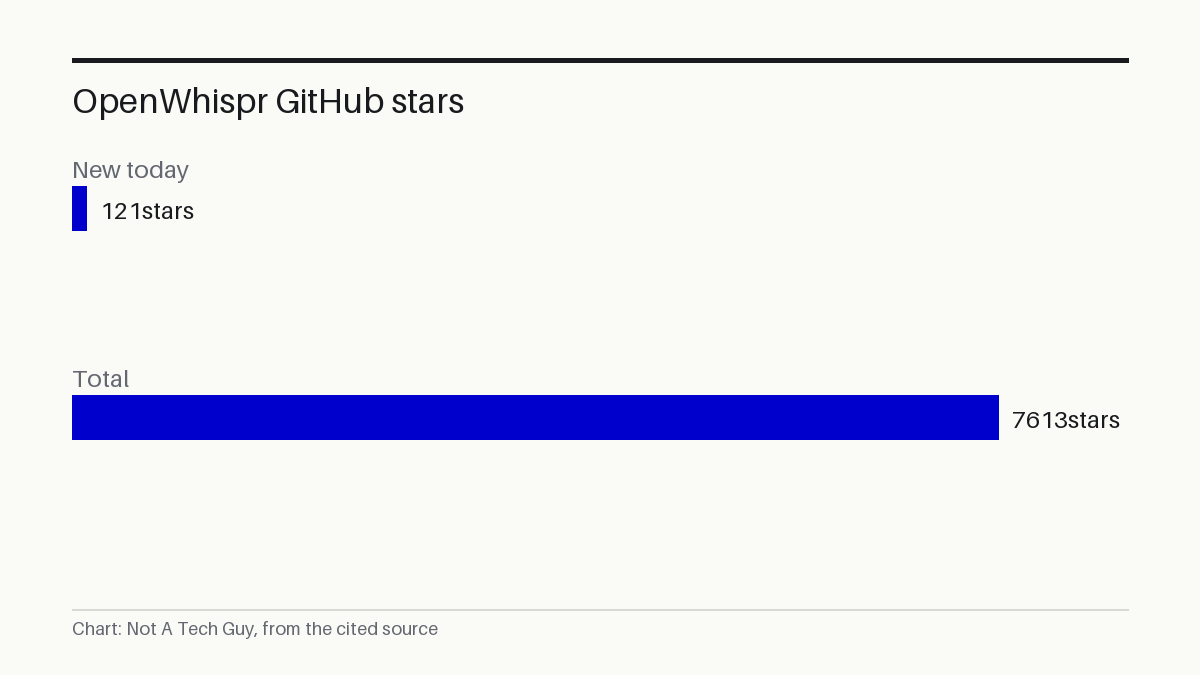

OpenWhispr, an open-source voice-to-text app that runs transcription locally on your own machine, landed on GitHub's daily trending list today with 121 new stars and 7,613 total S¹. The project, written in JavaScript and available for macOS, Windows, and Linux, positions itself as a free alternative to paid dictation tools like WisprFlow and Granola S¹. But the reason it is climbing now has less to do with features on paper and more to do with a question anyone who has ever dictated a sensitive email out loud is already asking: where does my voice actually go?
My read: This is the first local-first dictation tool I've seen that treats NVIDIA's Parakeet as a first-class citizen alongside Whisper, and the timing is no accident. Nvidia has been pushing its open-weight speech models hard this year. OpenWhispr's pull request to integrate the parakeet-unified-en-0.6b model merged back in May P², and the v1.9.0 release on 24 August unified the interface into a single dictation pill P⁴. The GitHub trending spike is the lagging indicator. What I'm skeptical of: the "no data collection, no telemetry" claim is a README assertion, not an audited guarantee. And the README's reference to "GPT-5" as an available agent is unverified and may refer to a model not yet generally available.
Why local transcription is having a moment
The core pitch is simple. Instead of sending your audio to a cloud server for transcription, OpenWhispr runs the speech-to-text engine on your own hardware. It supports two local engines: OpenAI's Whisper and NVIDIA's Parakeet S¹. The Parakeet integration is real and verifiable. Codebase changes from May 2026 confirm the integration, with a merged pull request modifying 13 files to include the parakeet-unified-en-0.6b model P². Nvidia provides the underlying parakeet-tdt-0.6b-v3 model, which is a 600-million-parameter system capable of recognizing 25 European languages, available via Hugging Face P³.
GPU owners can speed up local Whisper processing using Vulkan for AMD/Intel chips, CUDA for NVIDIA hardware, or Metal for Apple Silicon S¹. That matters because local transcription is only practical if it is fast enough to use in real time. Relying solely on a CPU to run Whisper might result in transcription times that exceed the actual length of the audio.
The cloud escape hatch
Local-first does not mean local-only. Users can also connect to external transcription services by supplying their own credentials for platforms such as Tinfoil, OpenRouter, or Groq S¹. According to the developers, whether you rely on cloud APIs or local processing, the software's primary functions, like semantic search, speaker separation, AI analysis, and text conversion, remain functional S¹.
Transcribed text can be forwarded to various artificial intelligence systems. The documentation mentions local models, Tinfoil, OpenRouter, Groq, Gemini, Claude, and GPT-5 as supported choices S¹. The GPT-5 reference should be treated cautiously. It is an unverified maintainer claim, and the model may not be generally available.
The software is capable of recognizing active calls on FaceTime, Teams, and Zoom to generate real-time transcripts that distinguish between different participants S¹. Users on Intel-based Macs will miss out on voice fingerprinting and speaker recognition features, a limitation caused by the discontinuation of macOS x86_64 binaries in ONNX Runtime 1.24 S¹.
What to do about it
If you work in a field where audio is sensitive, the appeal of a local transcription tool is obvious. A barrister dictating case notes about a client cannot send that audio to a third-party cloud. A GP recording consultation summaries needs the audio to stay on the practice's machine. OpenWhispr's pitch is that those users get modern speech-to-text quality without the data leaving their device.
The practical step this week: download the v1.9.0 release from the GitHub releases page, run it on a machine with a GPU if you have one, and test it against a short recording you already have. Compare the output quality and speed against whatever you currently use. The app is free and open source, so the only cost is your time. But treat the privacy claims as a starting point, not a guarantee. "No telemetry" is a README assertion that has not been independently audited. If you are handling genuinely sensitive audio, you would want to verify the claim yourself by inspecting network traffic or reading the source.
What we don't know yet
Every feature and privacy claim in this story comes from the maintainers' README S¹. No independent review has verified that the app collects no data, that the local models perform at the claimed quality, or that the cloud integration works as described across all listed providers. The GPT-5 reference is unverified. The star count and trending status reflect GitHub platform metrics, not code quality or security.
The project also has no mobile app. It is desktop-only: macOS, Windows, and Linux S¹. If your workflow involves dictating from a phone, this is not your tool yet.
The next signal: OpenWhispr's first release after v1.9.0, which shipped on 24 August P⁴. We'll check whether the privacy and feature claims hold up under independent testing. If you want that follow-up in your inbox, the subscribe button is right there.
Sources: S1 — OpenWhispr/openwhispr: Voice-to-text dictation app with local (Nvidia · P2 — feat(parakeet): add parakeet-unified-en-0.6b model · P3 — nvidia/parakeet-tdt-0.6b-v3 · Hugging Face · P4 — 1.9.0 · P5 — README.md
More from Not A Tech Guy
- Google Pics: AI image editing inside Docs and Slides
- Qwen, Mistral and Llama verify fake developer identity, study finds
- X For You feed algorithm open-sourced on GitHub
Generated from an audited evidence pack with primary-source research. Social-media items are discussion signals, not verified facts. Nothing here is financial, legal or medical advice.