

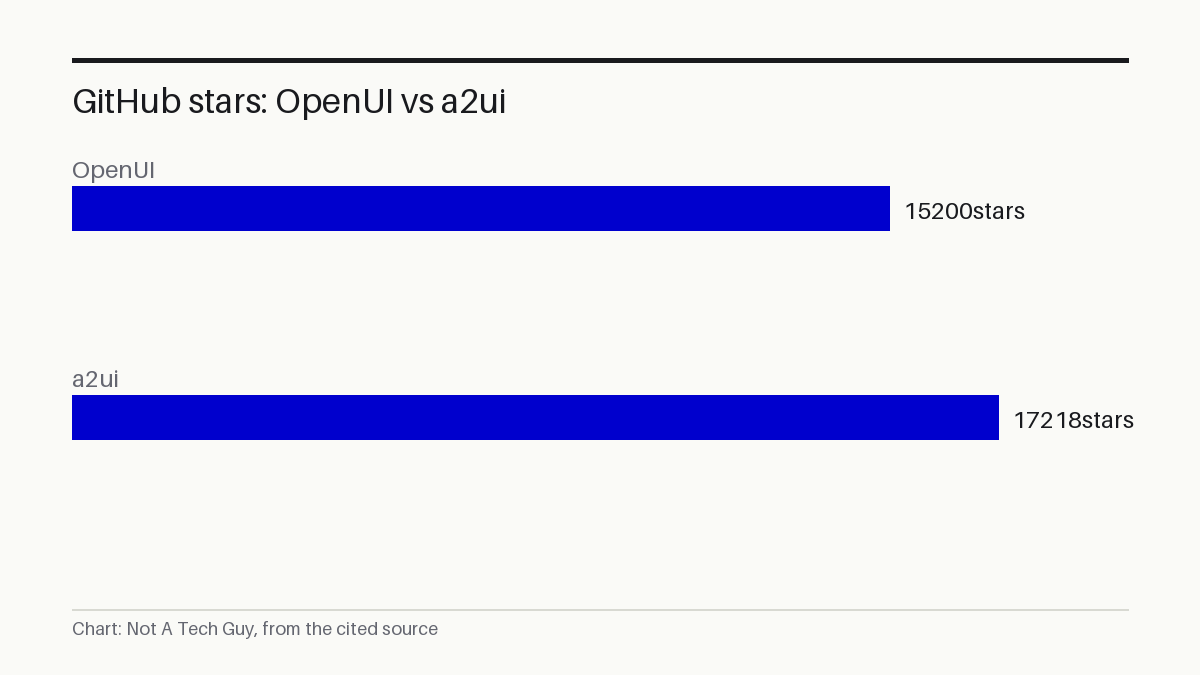
Thesysdev pushed its OpenUI framework onto GitHub's daily trending list this week with 15,200 stars, branding it "The Open Standard for Generative UI" S¹. That "open standard" label is the maintainers' own positioning, not recognition from any formal standards body, and every functional claim in the README comes from the project itself S¹.
My read: The number I would watch is the 67% token-reduction claim. It is the headline selling point and it has zero disclosed methodology. Until someone reproduces it against a real workload, I would treat it as marketing copy, not a benchmark. The framework-agnostic pitch across four front-end ecosystems is the more interesting structural claim, and the one a team could actually test in an afternoon.
The core idea: large language models produce interface descriptions in a compact syntax called OpenUI Lang, and a runtime converts those descriptions into native components for React, Vue, Svelte, or Angular S¹. The maintainers say OpenUI Lang uses up to 67% fewer tokens than JSON for the same output, which would directly cut inference costs, the per-request price of running the model, for any app that generates UI dynamically S¹. No one outside the project has measured that figure, and the README publishes no benchmark methodology, sample inputs, or comparison dataset S¹.
Five npm packages cover language core, LangChain, and React
The project publishes five npm packages: a language core, a LangChain integration, a React language binding, a headless React renderer, and a full React UI component set S¹. React is the most complete runtime, shipping built-in libraries for charts, forms, tables, and layouts, plus ready-to-use chat interfaces S¹. Vue, Svelte, and Angular get first-party runtimes but without the bundled component libraries S¹.
A developer can scaffold a project with one command: npx @openuidev/cli@latest create --name genui-chat-app S¹. The TypeScript codebase has accumulated 15,200 stars and added 35 on the day it trended S¹. This publication has not independently installed the packages, run the scaffold command, or verified the star count beyond GitHub's public display.
A competing framework, a2ui, holds more stars and targets more platforms
OpenUI is not alone in this space. The a2ui-project/a2ui repository, also open-source under Apache 2.0, has 17,218 stars and supports an even broader set of render targets including React, Angular, Lit, Flutter, SwiftUI, and Jetpack Compose P². It was created in September 2025 and carries 483 open issues P². These figures come from the repository's public GitHub page and have not been independently verified by this publication. OpenUI's README does not acknowledge or compare against any competing framework S¹.
This category, where AI agents stream layout data that apps render with native components, has been gathering momentum across open-source projects.
Buried in the README is a line unusual for a TypeScript framework: OpenUI has no official cryptocurrency, token, or coin, and any asset using the name is unaffiliated S¹. The disclaimer suggests someone has already tried to attach a token to the project's name.
Engineering teams can test token savings against their existing JSON pipeline
A small engineering team building an AI chat product could clone the repo, run the scaffold command, and wire the LangChain package to an existing model endpoint to see whether the streaming-first language actually produces usable React components at lower token cost than their current JSON approach. For a front-end engineer at a SaaS company, the shift would mean replacing hand-written JSON component schemas with model-generated OpenUI Lang strings, then checking that the rendered output matches design specs without manual fixes. The test that would tell them to stop: if the generated components require manual correction more often than their existing templating pipeline, the token savings do not matter.
The project's next checkpoint is whatever the maintainers push next. The README lists no roadmap, no release schedule, and no peer review.
Sources: S1 — thesysdev/openui: The Open Standard for Generative UI · P2 — a2ui-project/a2ui · P3 — Explore GitHub · GitHub · P4 — tarekmasryo/QuickStart
Written from 4 sourced items, 3 of them primary.