

The rust-lang/rust repository appeared on GitHub's daily trending list this week, holding 121,536 total stars after a 192-star gain in a single day S¹. The 192-star figure is GitHub's own platform count and has not been independently audited. That is an unusual pick for a codebase whose release history stretches back to version 1.0.0-alpha in January 2015 P⁵. The trending page typically highlights new projects, not the compiler of a decade-old language.
My read: The star count alone does not explain why Rust's main repo is trending now. The evidence gives no release event or announcement to account for the spike. The number I would watch is whether this coincides with a specific Rust edition release or ecosystem shift, because 192 daily stars on a 121,536-star repo is a small bump in percentage terms. That is a passing wave of attention rather than evidence of sustained adoption.
Compiler and tooling live in one repository
The rust-lang/rust repository serves as the central development hub for the Rust programming language, containing the compiler, standard library, and documentation under one roof S¹. The README highlights a tooling ecosystem that ships alongside the language: Cargo for package management and builds, rustfmt for automatic code formatting, Clippy as a linter, and rust-analyzer for editor integration S¹.
These are maintainer descriptions of their own project, not an independent review.
Rust's pitch, in the maintainers' words, centres on a type system and ownership model that enforces memory and thread safety at compile time S¹. Bugs are caught before code runs. The README also claims Rust is fast and memory-efficient, suited to critical services and embedded devices, and integrates with other languages S¹. No one outside the project has independently verified these performance or reliability claims against a benchmark; no released code or error bars accompany the assertions.
Dual licensing and a star count behind leading ML frameworks
The Rust project is dual-licensed under Apache 2.0 and MIT terms, with portions covered by BSD-like licenses, according to the repository's COPYRIGHT file P³. The Rust Foundation owns and protects the Rust and Cargo trademarks and logos S¹.
For scale, the repo's 121,536 stars S¹ place it among the more-starred repositories on GitHub, though well behind machine-learning frameworks like huggingface/transformers at 166,862 stars P⁴. The comparison is imperfect: transformers is a library developers add to a project, while rust-lang/rust is the language compiler itself. A backend team lead weighing Rust against Go or C++ for a new microservice would clone this repository, read the standard library source, and run Cargo against a small project to feel the compile-time safety checks the maintainers describe. The tooling is free under a permissive dual licence, with no commercial restriction on the code itself.
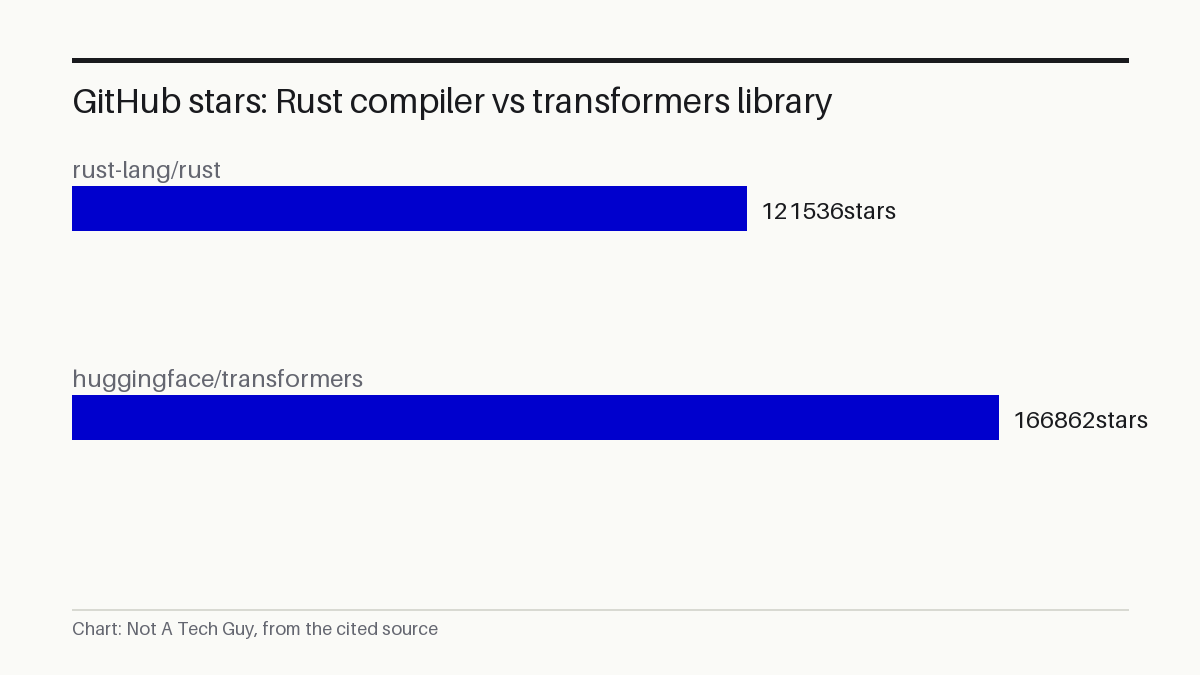
GitHub's trending list updates daily, and star counts shift with it. The repo's star count stood at 121,536 as of the snapshot captured for this article S¹.
Sources: S1 — rust-lang/rust: Empowering everyone to build reliable and efficient so · S2 — rust-lang/rust: Empowering everyone to build reliable and efficient so · P3 — COPYRIGHT at main · rust-lang/rust · P4 — huggingface/transformers · P5 — RELEASES.md at 692d9426e77757c976cfb841105c159af2385d36 · rust-lang/ru · P6 — inclusionAI/Ling-V2
Written from 6 sourced items, 4 of them primary.


