

SearchAuditor, a new framework posted to arXiv this week as paper 2608.05212, audits and repairs failures in AI search agents with a 32.3% end-to-end success rate S¹. That is the best result the authors report, and it still means the system fails to fix two-thirds of the broken agent runs it examines. The failures it tries to repair are not simple: each averages 73.1 messages and 65,100 tokens of conversation history S¹. What is going wrong inside these agents, and why is finding the answer so hard that the paper calls it beyond human capacity?
My read: This is the first benchmark I have seen that treats AI agent debugging as a structured, graded task rather than a vibes-based exercise. The 32.3% figure is honest and underwhelming, which is exactly what makes it credible. I am skeptical of the 5.7-percentage-point margin over the strongest baseline, because the authors do not name the eight open-weight models or the five benchmarks they drew from, which makes independent reproduction hard. What interests me more than the top-line number is the framing: if diagnosing these failures is genuinely beyond human capacity, then the question is not whether AI auditors are good enough, but whether anyone has a better idea.
Why a 73-message failure trace breaks human diagnosis
Deep search agents tackle hard questions by running long chains of web searches, reading pages and reasoning over results before deciding what to look up next S¹. The process is fragile. A small reasoning error early in the chain, say misreading a date or trusting an unreliable source, propagates through dozens of subsequent steps and surfaces as a fluent, confident, wrong answer S¹.
Diagnosing where things went wrong means reading the full execution trace. The average trace in SearchAuditBench runs 73.1 messages and 65,100 tokens S¹. That is roughly the length of a short novel in raw conversation logs. The paper states plainly that manual inspection of these traces could be beyond human capacity S¹. Cognitive gaps in long-horizon agent tasks are a known failure mode. This paper tries to build a systematic way to find and fix them.
What SearchAuditBench actually measures
The benchmark comprises 1,243 failed trajectories collected from eight open-weight models running on five deep-search benchmarks S¹. Each trajectory is expert-annotated with three things: the critical error step where things went wrong, a search-specific root cause explaining why, and a reference repair with grading rubrics S¹.
That annotation structure matters. It means the benchmark asks more than whether the auditor fixed it. It asks the auditor to locate the error and explain the cause, then produce a repair that works when the agent resumes S¹. The grading rubrics let the authors score each stage independently, so you can see whether an auditor is good at finding errors but bad at fixing them, or the other way around.
The 5.7-point gap that matters
The strongest baseline auditor, powered by a frontier model the paper identifies as GPT-5.5, achieves a 26.6% end-to-end pass rate S¹. SearchAuditor, the authors' proposed framework, reaches 32.3% S¹. That is a 5.7-percentage-point improvement.
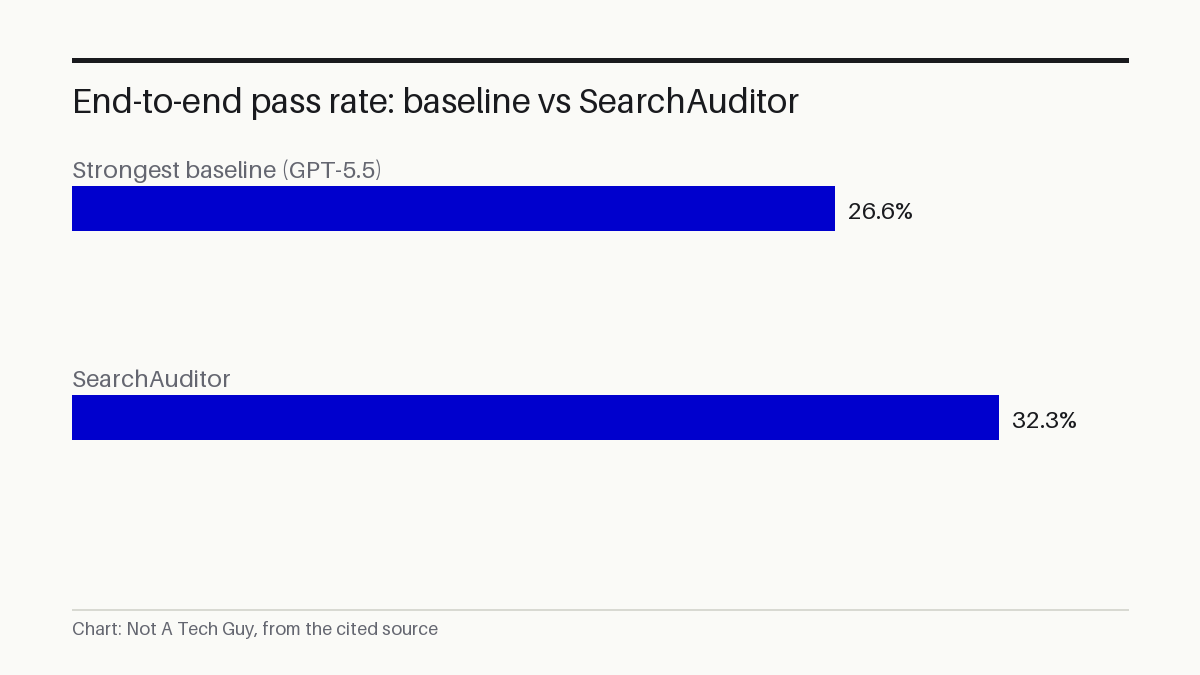
The authors describe SearchAuditor as a multi-perspective auditing framework that uses evidence-grounded adjudication to pinpoint failures and repair them S¹. In plain terms, it looks at the failure from multiple angles and weighs the evidence before deciding what went wrong and how to fix it. The paper reports that SearchAuditor consistently outperforms all baselines across different frontier models S¹, and that resuming failed runs with its repairs lets agents recover from errors better than baseline repairs do S¹.
A 32.3% success rate is modest. The paper does not claim otherwise. What it claims is that structured, multi-perspective auditing beats single-pass diagnosis, and that the gap, while small, is consistent.
What to do about it
If you run a team building search agents or any long-horizon AI pipeline, the practical takeaway is that you need automated failure diagnosis, but you should not trust it blindly. A 32.3% fix rate means the auditor will be wrong most of the time.
Consider a legal research team that deploys a search agent to compile case law summaries across multiple jurisdictions. When the agent returns a confidently wrong answer, someone has to read 73 messages of search logs to find where it went off track. SearchAuditBench suggests that even a frontier-model-powered auditor will correctly identify and fix the problem about a third of the time. The other two thirds, a human still needs to review. The value is in triaging: the auditor can flag the cases it is confident about, leaving the harder ones for manual inspection.
One thing you can do this week: pull the last 10 failed agent runs from your own logs and try asking a frontier model to identify the critical error step in each. Compare its answers to your own diagnosis. You will quickly learn whether your failure traces are simpler or harder than the ones in this benchmark.
What we don't know yet
The paper is an arXiv preprint, not peer-reviewed S¹. All benchmark statistics and performance numbers are author-reported. The abstract does not name the eight open-weight models or the five deep-search benchmarks used to collect trajectories, which limits reproducibility S¹. The reference to GPT-5.5 as a frontier model needs verification, as it may refer to a hypothetical or non-public model.
The 5.7-percentage-point improvement over the strongest baseline is consistent across frontier models but modest in absolute terms. Whether the multi-perspective approach scales to longer trajectories, or to closed-source agents, is not addressed.
Related work is emerging. A GitHub repository called TraceElephant, tied to an ACL 2026 paper on failure attribution in multi-agent systems P³, and another called REDSearcher, focused on cost-efficient long-horizon search agents P⁴, suggest this is an active research area. A separate repo, auditing-agents, hosts code for AuditBench, which evaluates alignment auditing P⁵. How these benchmarks overlap or compete with SearchAuditBench is unclear.
The next signal: whether the authors release SearchAuditBench's data and code publicly. If they do, independent teams can verify the 32.3% figure and test whether the eight unnamed models change the picture. We will check this claim against the release when it appears. If you want to follow this thread as it develops, subscribe and we will keep you posted.
Sources: S1 — SearchAuditor: Auditing and Attributing Failures in Long-Horizon Searc · P2 — SearchAuditor: Auditing and Attributing Failures in Long-Horizon Searc · P3 — TraceElephant/TraceElephant · P4 — RedSearchAgent/REDSearcher · P5 — safety-research/auditing-agents
More from Not A Tech Guy
- Federated learning privacy error scaling cut from 4^b to 2^b
- Chiplet and AI chip-design security threats mapped in new preprint
- OlmoEarth Studio exports AI embeddings as GeoTIFFs
Generated from an audited evidence pack with primary-source research. Social-media items are discussion signals, not verified facts. Nothing here is financial, legal or medical advice.


