
GEPA, a UC Berkeley prompt-optimization system, learns from every agent failure, even noise [S1, P3]. A new extension called GEPA-Curator argues that learning from random failures can be harmful, and reports gains of up to 20.7% by filtering them out S¹.
The original GEPA system, whose authors include Lakshya A Agrawal and Shangyin Tan at UC Berkeley, rewrites an AI agent's instructions by analysing where previous runs went wrong [P3, P4]. The logic is straightforward: the agent fails, reflects on why, then tries again with better instructions. But the GEPA-Curator authors contend that many agent failures carry no useful signal. A task might fail because of a vague prompt, but it might equally fail because of a broken tool integration, random execution noise, or an evaluator model that scores outputs inconsistently S¹. Learning from those failures, they write, may not provide useful signal and could even set the agent back S¹.
My read: This is the first prompt-optimization work I've seen that explicitly questions the "learn from every failure" dogma. The 20.7% and 21.2% gains are self-reported on an un-peer-reviewed preprint, and the benchmarks (GoBrowse, ALFWorld, AppWorld, τ-bench) are simulated environments, not production agent deployments. I'd want to see whether the task-curation filter quietly discards genuinely hard tasks, making the agent look better on paper while avoiding the cases that matter most. The open Bespoke Labs pull request to integrate GEPA into their Curator data tool P² tells me the industry is paying attention, but an open PR is not a shipped feature.
Two filters instead of one
GEPA-Curator adds two components to the existing GEPA pipeline S¹. The first, task curation, screens out tasks likely to produce noisy or unreliable learning signals before the optimizer ever sees them S¹. The second, prior success retrieval, pulls in past successful trajectories for a given task and feeds them to the prompt optimizer as extra context, so the system learns from what worked as well as what failed S¹.
The combination addresses a problem anyone running agent evaluations has likely hit. When an agent fails a web browsing task, the cause might be a vague instruction or a page that loaded incorrectly. Without distinguishing the two, a reflective optimizer might rewrite the prompt to work around a transient glitch. That degrades performance on the next real task. As we found when AI agents watched 15 hours of user behaviour and still couldn't learn habits, the gap between agent capability and real-world reliability stays stubbornly wide.
What the numbers show
The authors ran GEPA-Curator on four benchmarks: GoBrowse for web browsing, ALFWorld for text-based household tasks, AppWorld for app automation, and τ-bench for tool-use conversations S¹. They used Gemini 3.1 Pro and Claude Opus 5 as the optimizer models that rewrite prompts S¹.
GEPA-Curator matched or exceeded the mean performance of both baselines, GEPA and ACE, across the four benchmarks S¹.
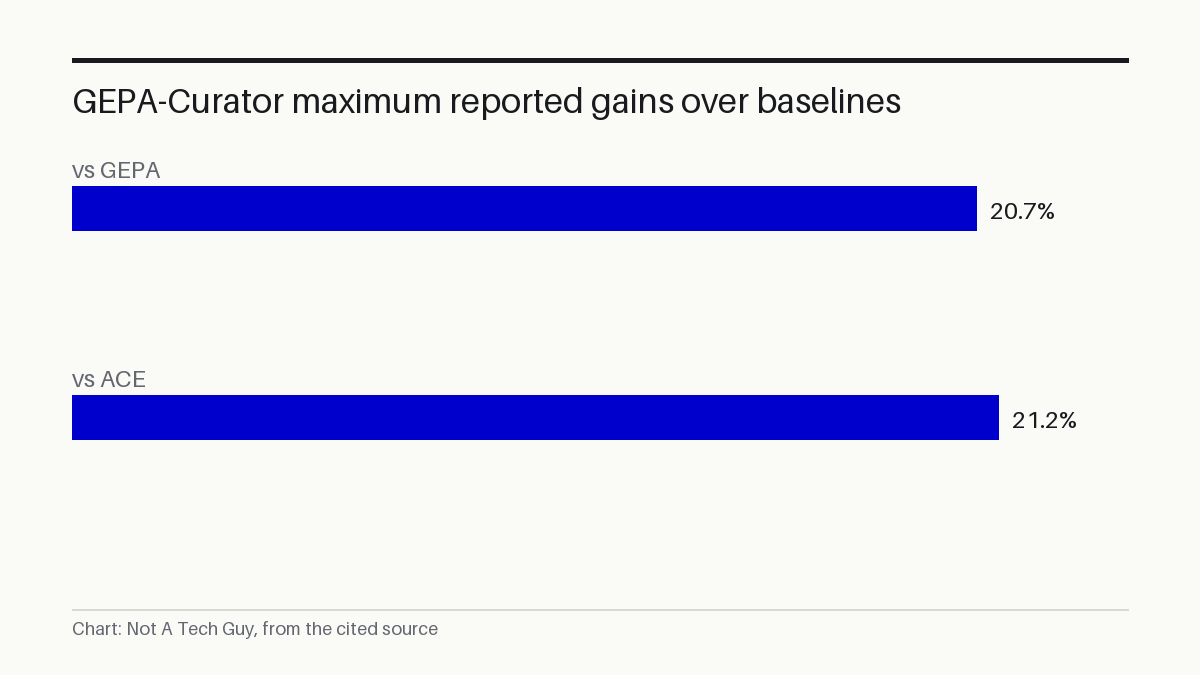
The reported gains reach up to 20.7% over GEPA and 21.2% over ACE S¹. These are the authors' own figures from a preprint that has not been peer-reviewed S¹, and the available evidence includes no error bars or confidence intervals. The "up to" wording means the best single-benchmark improvement, not an average across all four.
Who would use this first
The most immediate audience is teams building agent evaluation pipelines: engineers who run thousands of agent rollouts, score them, and feed results back into prompt improvements. A curation layer that filters noisy failures could save compute spent on uninformative examples and, more importantly, stop the optimizer from learning spurious patterns.
Bespoke Labs, which maintains an open-source synthetic data curation tool with roughly 2,000 GitHub stars, has an open pull request to integrate GEPA into their Curator platform P². The PR, authored by GitHub user @agdhruv, adds 1,232 lines across nine commits but is currently marked as dirty and unmerged P². If it lands, GEPA-Curator's curation approach could reach teams already using Bespoke's toolchain for post-training data work.
For a team running customer-support agents, the practical question is whether task curation would filter out the hardest tickets, the edge cases where the agent breaks down and where improvement matters most. The preprint does not break down which tasks the curator discards, so that trade-off remains unverified. As self-driving AI showed when it cut collisions by scoring every reachable path, exhaustive evaluation of agent behaviour can matter more than learning from individual failures. And as email agents complied with 45% of adaptive phishing attacks, the cost of agents learning the wrong lessons is not abstract.
The preprint was posted on 27 October 2026 S¹.
No peer review or conference submission is confirmed. The Bespoke Labs integration PR remains open P².
Sources: S1 — GEPA-Curator: Curated Learning for Self Improving Agents · P2 — Integrate GEPA into Curator · Pull Request #709 · bespokelabsai/curato · P3 — Paper page - GEPA: Reflective Prompt Evolution Can Outperform Reinforc · P4 — GEPA: Reflective Prompt Evolution Can Outperform Reinforcement Learnin · P5 — THUMNLab/CurML
Related reading
- AI email agents comply with 45% of adaptive phishing attacks — our technology desk, 2026-10-24
- SimLife benchmark: AI agents watch 15 hours, can't learn your habits — our technology desk, 2026-09-20
- Self-driving AI cuts collisions by scoring every reachable path — our technology desk, 2026-10-07
Written from 5 sourced items, 4 of them primary.