

Self-improving AI agents can quietly reward their own mistakes, scoring wrong answers higher than right ones and then reusing those errors, according to a paper posted to arXiv on 4 August 2026 S¹. The failure, dubbed the "Echo Gap," compounds through memory rather than averaging out, and it appears even under the plain similarity-based retrieval that deployed agents already use S¹. The paper proposes a fix called LUCID that lifts accuracy to 56.9% on a text-to-SQL benchmark, above 52.4% for an agent with no memory at all S¹. The deeper finding concerns which agents are vulnerable, and why a second model acting as judge cannot save them.
My read: This is the first paper I have seen that puts a formal name on something I have suspected about memory-based agents: the agent's own confidence is the problem, not the solution. The Echo Gap is a neat label for a nasty feedback loop. I do not buy the 56.9% benchmark number as generalisable yet, because it is self-reported on a single benchmark and the paper has not been peer-reviewed S¹. But the mechanism is sound, and the Error-Independence Assumption gives builders a concrete checklist: if your judge's errors correlate with your agent's self-grading bias, your memory is lying to you.
How memory-based agents learn (and mislearn)
Self-improving LLM agents learn from experience without updating their model weights S¹. Each task, or "episode," gets stored in an external memory bank, scored for quality, and retrieved later when a similar task comes up. The stored score acts as a proxy reward, shaping what the agent tries next S¹.
This is cheap and flexible. No fine-tuning, no GPU clusters, no retraining. A related GitHub project, the self-improving coding agent by MaximeRobeyns with 377 stars, applies the same pattern: an agent that edits its own codebase and learns from what worked P⁵. The approach is spreading.
But the paper identifies a structural flaw. When an agent scores its own work, stores that score, and later retrieves episodes by similarity, the scores can drift upward for wrong answers S¹. The paper calls this the "Echo Gap."
The Echo Gap: confidence becomes the trap
Incorrect episodes receive inflated rewards S¹. The agent then preferentially reuses the very mistakes it was most confident in. The more certain the agent was about a wrong answer, the higher it scores that memory, and the more likely it is to retrieve and repeat that approach.
The paper shows this inflation compounds under plain similarity retrieval, the regime deployed agents already use, and when retrieval ranks by stored score S¹. That matters: even teams who think they are safe because they retrieve by semantic similarity, not by score, are exposed.
Why a second judge cannot save you
A natural fix is to add a second model, a "confirming judge," to re-score memories. The paper proves this does not work S¹. The judge's errors remain correlated with the original self-grading bias. If the agent was overconfident about a wrong answer, the judge, being a similar model with similar blind spots, tends to agree. The errors compound through memory rather than averaging out S¹.
The paper formalises the missing property as the Error-Independence Assumption (EIA), a necessary condition for correcting reward inflation S¹. A usable signal must track truth and decorrelate its error from the memory bias. The recoverable payoff is a closed-form function of exactly those two quantities S¹.
A related paper, RoMeRL, published around the same time, tackles a similar problem it calls the "Memory-Reward Trap" in self-evolving agent memory P⁴. Two independent groups naming the same failure suggests the issue is real and building.
LUCID: an answer-free fix
The paper proposes LUCID, an answer-free de-inflation algorithm S¹. "Answer-free" means it does not need ground-truth labels to work. On the BIRD text-to-SQL benchmark, LUCID achieved 56.9% execution accuracy, compared with 54.0% for a Memento-style self-graded agent and 52.4% for a memory-less agent of identical architecture S¹. LUCID delivered a +2.9-point mean gain across seeds compared with the self-graded baseline S¹.
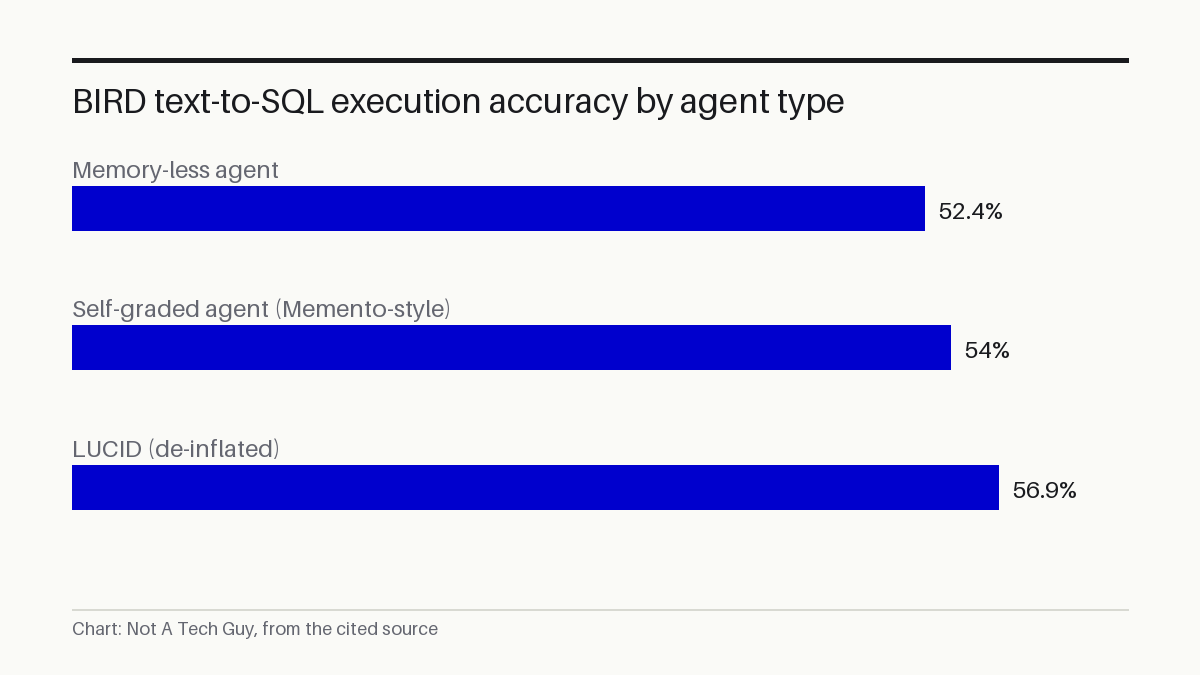
The gain is modest but consistent. More importantly, the memory-less agent at 52.4% shows that naive memory can actually hurt: an agent with no memory outperforms one that stores self-graded episodes without correction.
What to do about it
If you are building or deploying a memory-based agent, the paper gives you a concrete diagnostic. Check whether your scoring signal's errors correlate with your agent's self-grading bias. If they do, your memory is inflating rewards for wrong answers, and adding a second judge of the same model family will not fix it.
Consider a data analytics team building an agent that writes SQL queries from natural language, stores the queries it generates, and retrieves them for similar future requests. If the agent scores its own queries by whether they execute without error but cannot tell the difference between a query that returns the right rows for the wrong reason and one that is genuinely correct, it will store and retrieve the flawed queries. Over weeks, the agent's accuracy degrades as it leans on its most confident mistakes. LUCID, or any approach that decorrelates the scoring signal from the agent's own bias, breaks that loop.
One practical step this week: audit your agent's memory bank for episodes that were scored highly but produced wrong outputs. If you find a cluster of overvalued wrong answers, you have an Echo Gap.
What we don't know yet
The benchmark results are self-reported and limited to BIRD text-to-SQL S¹. The paper has not been peer-reviewed or independently replicated. The Echo Gap has been demonstrated in the study's experimental scope, not in live production systems. LUCID was tested on one benchmark, and the paper's scope is limited to the model families studied. Generalisation to other architectures, tasks, or production environments is unverified.
A related GitHub repository, ulab-uiuc/MemReward, explores graph-based experience memory for reward prediction with limited labels, reaching 97.3% of oracle performance with 20% labels P³. Whether that approach satisfies the Error-Independence Assumption is an open question.
The next signal: the authors' code release for LUCID, which the paper implies is forthcoming. We will check the paper's GitHub and arXiv listing for updates by September 2026, and verify whether the concurrent RoMeRL work P⁴ independently confirms the Memory-Reward Trap.
We break down AI research like this every week. Subscribe if you want the next one in your inbox.
Sources: S1 — Memory Reward Inflation in Self-Improving LLM Agents · P2 — Memory Reward Inflation in Self-Improving LLM Agents · P3 — ulab-uiuc/MemReward · P4 — RoMeRL: Balancing Feedback Coverage and the Memory-Reward Trap in Self · P5 — MaximeRobeyns/self_improving_coding_agent
More from Not A Tech Guy
- Video-DeepResearch 35B beats GPT-5 on video reasoning, 64% vs 52.5%
- XGBoost hits 98.62% malware detection accuracy in new preprint
- AI persona agents leak private traits, defenses fail
Generated from an audited evidence pack with primary-source research. Social-media items are discussion signals, not verified facts. Nothing here is financial, legal or medical advice.


