
A Rust command-line tool called agent-browser, hosted under Vercel Labs, landed on GitHub's daily trending list this week with 41,827 stars and 102 new stars in a single day S¹. It lets AI agents open web pages, click buttons, fill forms, and grab screenshots through Chrome, with no Node.js or Playwright running in the background S¹. For anyone building agents that need to actually use the web, that architecture choice raises a question the rest of the field has been quietly dodging.
My read: This is the first browser-automation tool I've seen that treats the agent's runtime as a systems problem, not a JavaScript problem. A Rust daemon means you can ship a browser agent in a container without bundling Node.js, which cuts image size and cold-start time. I don't buy the "fast" claim yet, because the README ships no benchmarks. But the design choices, detecting existing Chrome and Playwright installs automatically, tell me the maintainers know the pain points firsthand.
Why dropping Node.js from the daemon matters
Browser automation for AI agents has a dirty secret: most of the popular tools, Playwright, Puppeteer, Selenium, run on Node.js or Python. That means every agent that needs to browse the web drags along a full JavaScript runtime, a package manager, and a tangle of dependencies. In a containerised world where agents spin up and tear down in seconds, that overhead is real. It inflates image sizes, slows cold starts, and adds failure surfaces.
Agent-browser takes a different path. The maintainers describe it as a "fast native Rust CLI" S¹, and the architecture backs that up: the daemon, the long-running process that actually controls the browser, needs neither Playwright nor Node.js S¹. You install it through npm, Homebrew, or Cargo, run a single command to download Chrome from Chrome for Testing, and the tool detects any existing Chrome, Brave, Playwright, or Puppeteer installations on your machine S¹. Rust and Node.js 24+ are only required if you build from source S¹.
The command set is deliberately small: open, snapshot, click, fill, get text, screenshot, close S¹. That is the vocabulary an AI agent needs to work through a web page. The maintainers have also baked in details that suggest real-world testing. Clicks fail early when another element covers the target's click point, rather than silently clicking the wrong thing S¹. Headless Chromium screenshots hide native scrollbars by default for consistent image output S¹, which matters when an agent is comparing screenshots to decide its next move.
The browser-agent wave is cresting
This tool arrives in a crowded and active field. Researchers have built WebMCP-Phalanx to block prompt injection attacks in browser agents, a security layer for exactly the kind of autonomous web browsing agent-browser enables. Alibaba's Wuying browser agent completed 65% of 38-step web tasks. And DreamGuard showed it could stop risky AI agent actions in 25 milliseconds.
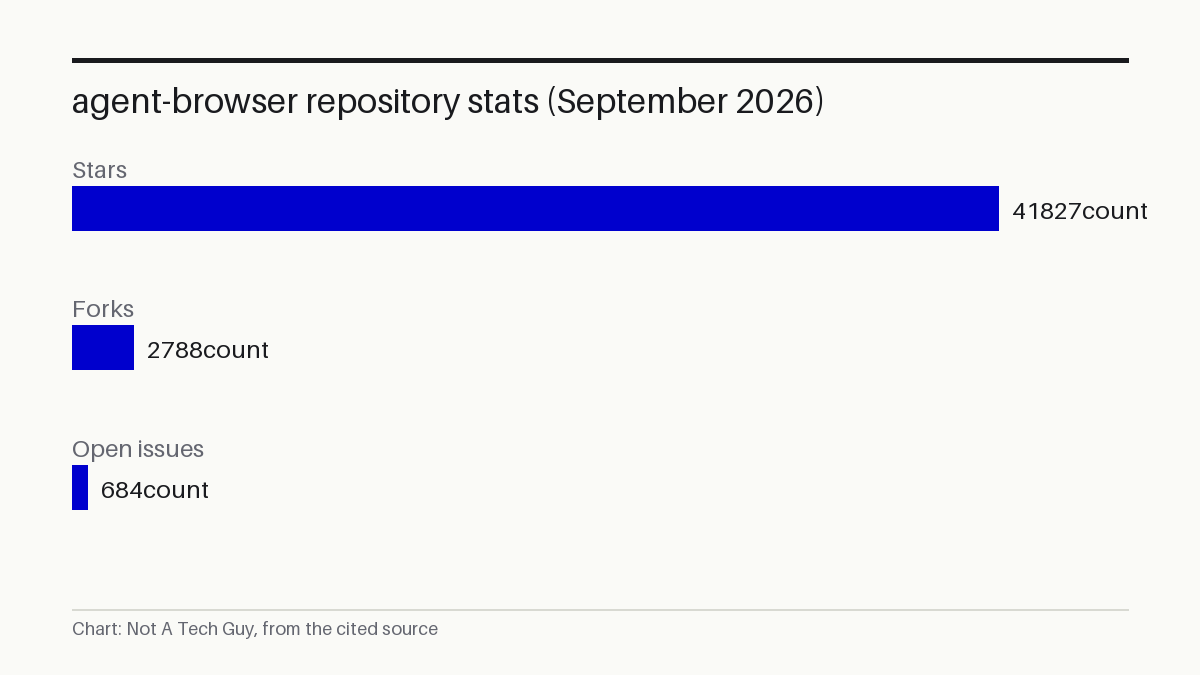
The difference: those projects are about making browser agents smarter or safer. Agent-browser is about making them cheaper to run. The 41,800 stars suggest developers have noticed. The repository, created on January 11, 2026 P², has accumulated 2,788 forks and 684 open issues under an Apache 2.0 licence P². The top contributor, ctate, has 392 commits P². The project lives at agent-browser.dev P².
But the star count also warrants caution. The repository sits under the vercel-labs GitHub organisation, which is Vercel's experimental arm, not its product catalogue. The evidence does not confirm that Vercel Inc. has officially productised this or committed to maintaining it as a corporate offering. It could be a serious project. It could also be a lab experiment that gains stars because of the Vercel name and then stalls.
What to do about it
If you are building AI agents that need to interact with web pages, the practical appeal is clear. A Rust binary that controls Chrome without Node.js means smaller container images and fewer dependencies to break. Consider a price-comparison agent that spins up in a serverless function, opens a retailer's page, fills a search box, reads the results, and shuts down. With a Node.js-based tool, that function needs a full JavaScript runtime bundled in. With agent-browser, it needs a single binary and a Chrome install.
The one practical thing to check this week: run agent-browser install on a clean machine and time how long it takes to go from install to first screenshot. That cold-start measurement will tell you more about whether the Rust architecture actually pays off than any README claim.
What we don't know yet
Every functional claim in this story comes from the maintainers' README S¹. There are no independent benchmarks, no published performance comparisons against Playwright or Puppeteer, and no third-party reviews. The "fast" label is a self-description, not a measured result. The 684 open issues P² could indicate an active community filing bugs, or they could signal stability problems. We cannot tell from the evidence available.
The star count and trending status are point-in-time snapshots from a single day S¹. GitHub trending is volatile, and the numbers will have shifted by the time you read this.
The next signal: watch the open-issues count and the commit cadence over the next 30 days. If issues close faster than they open and ctate keeps committing, this is a real project. If the issue count climbs and commits stall, it is a lab toy. We will check both against the repository's October activity. If you want that follow-up in your inbox, subscribe now and we will send it the moment the data lands.
Sources: S1 — vercel-labs/agent-browser: Browser automation CLI for AI agents · P2 — vercel-labs/agent-browser · P3 — nktkt/hf-paper-lens · P4 — vercel-labs/agent-browser · P5 — TIGER-AI-Lab/BrowserAgent
More from Not A Tech Guy
- Voice agents drop 9.7% when instructions are merely implied
- When to trust LLM recommendations: four-tier framework
- New technique cuts AI agent wait time up to 45%
Generated from an audited evidence pack with primary-source research. Social-media items are discussion signals, not verified facts. Nothing here is financial, legal or medical advice.