

A new arXiv preprint proposes ACToR, a retrieval framework that lifts AI code generation by 8.4% on RepoExec and 15.4% on CoderEval over state-of-the-art methods S¹. The gains come from a counterintuitive idea: instead of feeding the model a pile of repository context before generation starts, ACToR watches the model write code token by token and pulls in context only at the precise moments where a single wrong decision would derail everything downstream. What those moments are, and why identifying them changes the economics of code retrieval, is where this gets interesting.
My read: This is the first code-generation retrieval system I have seen that treats context as a just-in-time resource rather than a bulk dump. The 15.4% relative gain on CoderEval is the headline number, but I do not fully trust it yet, because relative improvements on benchmarks with low baselines can look dramatic in percentage terms while being modest in absolute terms. The preprint has no peer review, no independent reproduction, and no evidence it works on production-scale repositories. What I find genuinely compelling is the framing: the authors claim errors concentrate at a small number of decisive positions, and they say they have quantified that. If that holds up under review, it changes how every retrieval-augmented code tool should be built.
Why bulk retrieval fails at the token level
Most repository-level code generation today uses retrieval-augmented generation, or RAG, to pull relevant files and feed them to the model as task-level context before generation begins S¹. The model gets a batch of repository snippets and has to make do with whatever was retrieved. The problem the ACToR authors identify is that this approach never asks which specific tokens during generation actually need that context S¹. A model writing a function call needs to know the exact signature of the function it is calling, but it does not need the entire repository to decide what variable name to use next. Feeding everything at once wastes context window capacity on tokens that do not need help and starves the tokens that do.
The tokens that break everything
The authors use the term "critical tokens" for the specific points in the generation sequence where mistakes are most likely to cascade into a broken function S¹. A single wrong token at one of these junctures can push the model down a semantically incorrect path, and every subsequent token compounds the error. The authors report that they measured this effect and found these positions account for a disproportionate share of generation failures S¹. The analogy is a golf swing: one wrong angle at the moment of contact sends the ball into the trees, no matter how good the rest of your form looks.
How ACToR retrieves only when it matters
ACToR identifies critical tokens during generation and triggers targeted retrieval on demand, pulling in repository context at those decisive positions rather than upfront S¹. The framework also introduces a position-aware weighting method for dense retrievers, which prioritises context that is more informative for generation based on where in the code it appears S¹. Think of a mechanic who does not read the entire manual before starting work, but reaches for the specific page the moment a particular bolt needs a specific torque spec.
The approach sits alongside other recent work on repository-level code generation. Microsoft's RPG-ZeroRepo project, accepted at ICLR 2026, uses a repository planning graph for codebase generation and has gathered 595 stars on GitHub since November 2025 P⁵. A separate paper on partial dependency graphs for repository-level code retrieval will be presented at the ASE 2026 conference in October P⁴. ACToR's contribution is narrower and more targeted: it does not try to model the whole repository, just the moments where the model needs help.
What the benchmarks show
The authors evaluated ACToR on two repository-level benchmarks, RepoExec and CoderEval, and report relative improvements of 8.4% and 15.4% respectively over state-of-the-art methods S¹.
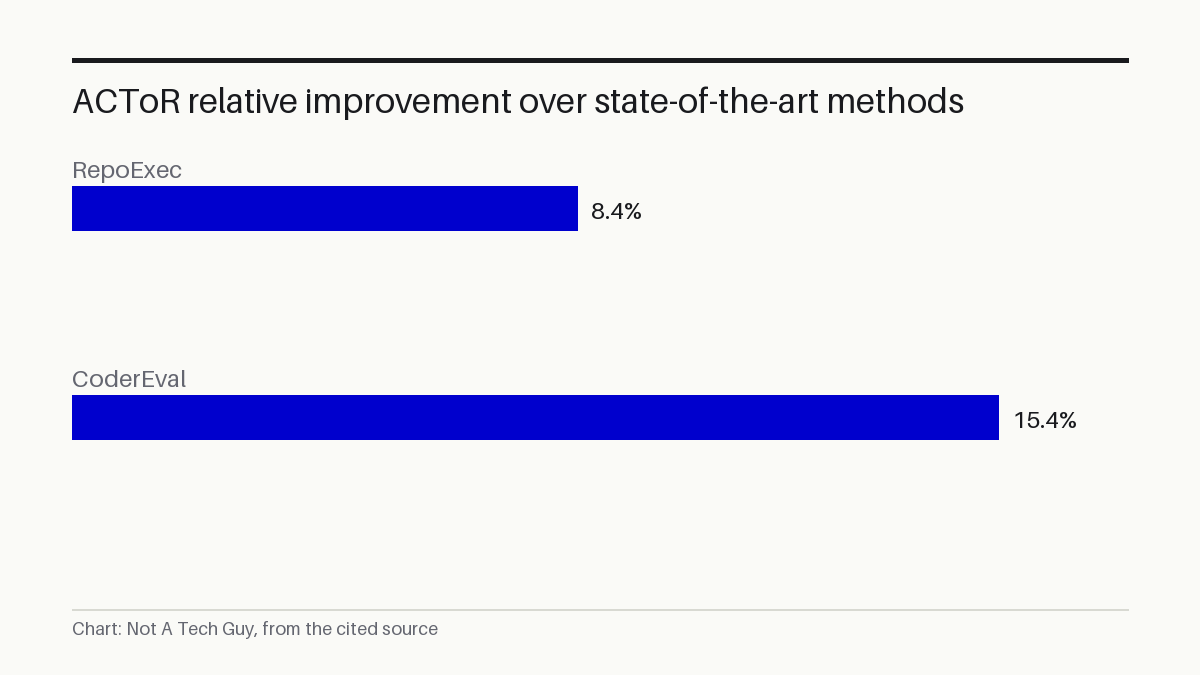
These are relative improvements, not absolute percentage points. If a baseline scores 40% on CoderEval, a 15.4% relative gain lifts it to roughly 46.2%. The authors provide code and data at github.com/DeepSoftwareAnalysis/ACToR S¹, though the evidence pack does not confirm the repository is publicly accessible or contains a full replication package.
What to do about it
Consider a backend engineering team at a logistics startup working with a 200,000-line Go monolith. Their AI coding assistant reads the current file and a few retrieved snippets, then generates a function that calls an internal service. It gets the service interface wrong because the relevant protobuf definition was not in the retrieved context. The function compiles, passes unit tests, and fails in staging. ACToR's approach would mean the assistant detects that the model is about to generate a token that depends on that protobuf definition, pulls in exactly that file at that moment, and gets the interface right. The team's staging environment sees fewer phantom failures, and the developers spend less time debugging AI-generated code that looks correct but is not.
For engineering teams evaluating AI coding tools today, the practical question is whether your assistant retrieves context once at the start or continuously during generation. If it is the former, the ACToR paper is worth reading as a blueprint for what the next generation of these tools should do. The code is at github.com/DeepSoftwareAnalysis/ACToR, and the paper is on arXiv S¹. Check whether the repository is accessible and whether the benchmarks are relevant to your stack before investing time in reproduction.
What we don't know yet
The paper is a preprint and has not been peer-reviewed S¹. The 8.4% and 15.4% figures are author-reported with no independent verification or reproduction cited. The benchmarks, RepoExec and CoderEval, may not reflect the complexity of real-world industrial repositories with millions of lines, cross-language dependencies, and evolving APIs. The GitHub repository's accessibility and completeness are unconfirmed. There is no external expert commentary or competing perspective in the evidence pack.
The next signal: the ASE 2026 conference, October 12 to 16, where the partial dependency graph paper on repository-level code retrieval will be presented P⁴. That work offers a direct comparison point for ACToR's approach, and the conference discussions should surface whether the critical-token hypothesis holds up against alternative retrieval strategies. We will check ACToR's claims against any reproduction results that emerge. If you want that follow-up, subscribe and we will send it to you.
Sources: S1 — Adaptive Critical Token-Aware Retrieval for Repository-Level Code Gene · P2 — Adaptive Critical Token-Aware Retrieval for Repository-Level Code Gene · P3 — megagonlabs/adaptive-k-retrieval · P4 — Effective and Efficient Context Retrieval via Partial Dependency Graph · P5 — microsoft/RPG-ZeroRepo
More from Not A Tech Guy
- AI agents learn your standards, up to 20.9% better
- LoopX adds durable memory to Claude Code and Codex agents
- GPT-6 Astra: OpenAI's first model to hit Critical cyber level
Generated from an audited evidence pack with primary-source research. Social-media items are discussion signals, not verified facts. Nothing here is financial, legal or medical advice.