

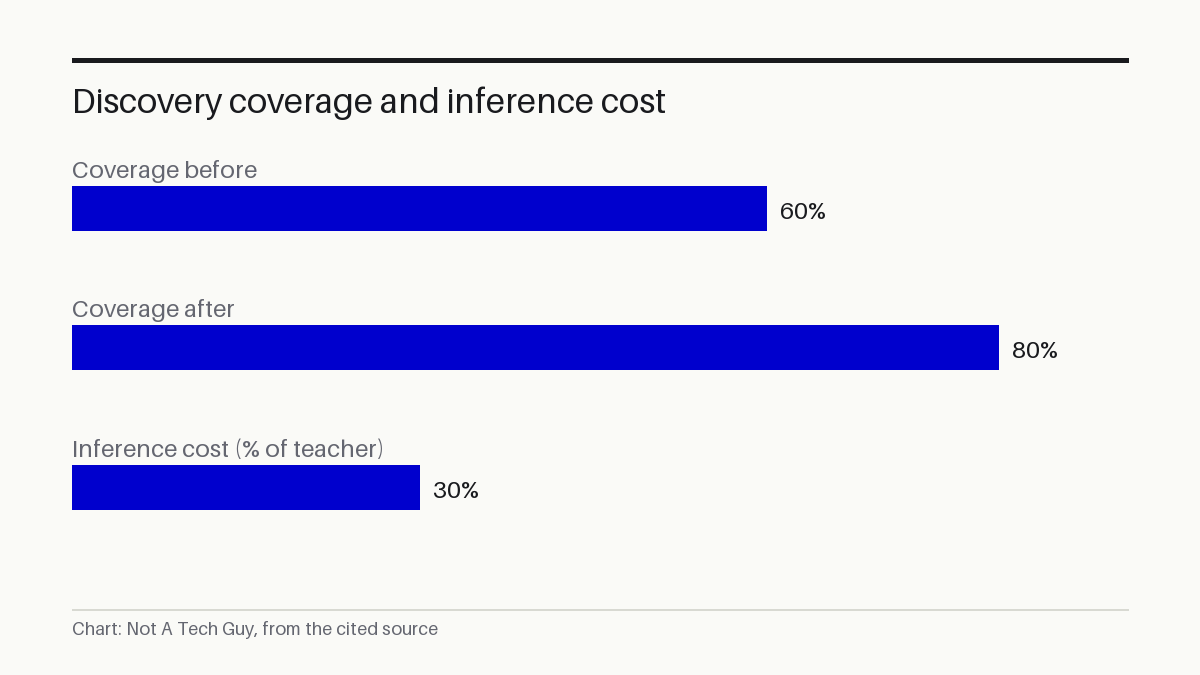
A new arXiv preprint claims a hybrid AI search architecture expanded e-commerce discovery coverage from around 60% to 80% of all search traffic, while spending only about 30% of what the full-size model costs to run S¹. The paper, posted on 29 July and not yet peer-reviewed, targets a frustration every online shopper has felt: you type something specific, the engine shows exactly that, and nothing you didn't think to ask for S¹. Whether that 20-point jump survives outside grocery is the question nobody can answer yet.
My read: This is the first e-commerce search paper I've seen that splits the workload by query frequency and uses distillation as a cost lever rather than a quality play. The 30% cost figure is self-reported and almost certainly excludes training, infrastructure, and the closed-weight API fees for head queries. I'd want to see full total cost of ownership before calling this economical. The LLM-as-a-judge evaluation, even validated against human preferences, is a known weak spot. The abstract names no specific marketplace or baseline system, which makes independent verification hard. The marketplace-balancing claim, that this helps long-tail sellers get found, is the most interesting idea in the paper and the least validated one.
Why precision-only search leaves money on the table
Traditional search engines are built to find what you asked for. Type "gluten-free pasta" and you get gluten-free pasta, ranked by relevance. The authors argue this precision-first approach leaves a huge amount of inventory invisible S¹. If a shopper searches for "gluten-free pasta" and the system never surfaces the rice noodles, the chickpea spirals, or the new brand that launched last week, those products might as well not exist. The paper frames this as a recall problem: the system is good at returning exact matches but poor at surfacing items the shopper would have wanted if they'd known to search for them S¹.
This matters most in grocery, where the paper focuses S¹. Catalogues are enormous, product turnover is high, and shoppers often don't know the exact name of what they want. A related-intent system tries to bridge that gap by generating alternative search intents from the original query, then retrieving items against those expanded intents.
The two-stage trick: big model for common, small model for rare
The architecture is the interesting part. The system routes queries through two paths depending on how common they are S¹.
Head queries, the high-traffic searches like "milk" or "bread", go to closed-weight large language models. These are the expensive, proprietary models from major AI labs. Because head queries are predictable and finite in number, the cost of running a big model on them is manageable.
Tail queries, the long, specific, infrequent searches like "dairy-free protein bars under 200 calories", go to a finetuned small language model. The authors trained this smaller model using LoRA adapters, a technique that updates only a small slice of the model's parameters, and teacher-student distillation, where the small model learns to mimic the outputs of the larger one S¹. The result is a cheaper model that handles the long tail of infrequent queries where running the full LLM would be uneconomical.
This split is what drives the cost number. Instead of running an expensive LLM on every query, the system pays full price only for common searches and uses the distilled small model for everything else.
The competitive backdrop
This isn't happening in a vacuum. Google Cloud sells AI Commerce Search as a managed service, pitched as a way to "turn search into sales" with personalised, AI-first shopping experiences P³. On the open-source side, a self-hosted product search project trained on 427,000 real Amazon relevance judgments appeared on GitHub in late July, running on CPU with no per-query fees P⁴. A separate SIGIR 2026 short paper, ItemRAG, takes an item-based retrieval-augmented generation approach to the same problem P². The space is crowded, which makes the absence of a named baseline in this preprint more frustrating.
What to do about it
Consider a mid-sized online specialty food retailer with 8,000 SKUs, half of which appear in search results for fewer than 5% of queries. Their long-tail products, the imported Spanish olive oils, the small-batch hot sauces, the seasonal baking kits, are effectively invisible. A related-intent system could expand what "olive oil" surfaces to include infused variants, gift sets, and complementary products like balsamic vinegar that a shopper might not have searched for directly.
The practical move this week is simpler than deploying a new architecture. Pull your search logs and calculate what percentage of your catalogue appears in results for any query in the past 30 days. If that number is below 70%, you have a recall problem, and the cost of fixing it, whether through intent expansion or a hybrid approach like the one in this paper, is likely lower than the revenue you're losing from invisible inventory.
What we don't know yet
The preprint names no specific marketplace, dataset, or baseline system S¹. Coverage and cost ratios are self-reported with no external validation: the 60% to 80% figure and the 30% cost number come from the authors alone S¹. Even with calibration against human preferences, the LLM-as-a-judge evaluation carries known biases that may not reflect real shopping behaviour. Authors themselves describe the marketplace-balancing claim as speculative. The idea that this gives long-tail sellers a fair shot at exposure is not directly validated by the session-level purchase analysis S¹.
The coverage gain is measured in grocery. Whether it generalises beyond grocery to other retail categories is unknown. The paper has not been peer-reviewed, and no independent replication exists S¹.
The next signal: watch the arXiv listing for this paper over the next 30 days. A v2 with named baselines or production deployment data would change the picture significantly. We'll check it against any updates. If you want to catch that, subscribe and we'll have it covered.
Sources: S1 — Improving Item Discoverability in e-Commerce Search via Related Intent · P2 — kswoo97/ItemRAG · P3 — AI Commerce Search | Google Cloud · P4 — albertobarnabo/product-search-embeddings · P5 — AI Guided Accelerator For Search Experience
Related reading
- NVIDIA connects AI agents to creative tools via MCP at SIGGRAPH — our technology desk, 2026-07-20
- Self-improving AI agents: survey maps how agents edit themselves — our technology desk, 2026-07-16
- MCP server security: taint flaws mitigated via tool descriptions — our technology desk, 2026-07-09
Generated from an audited evidence pack with primary-source research. Social-media items are discussion signals, not verified facts. Nothing here is financial, legal or medical advice.


