DBMol, posted as an arXiv preprint on 21 July 2026, proposes a framework that uses AI structure prediction models to design small drug molecules from scratch S¹. The authors report strong predicted binding affinity and target specificity. But every result is a computational prediction, not a lab measurement, and the paper has not been peer-reviewed S¹. Whether structure prediction models are accurate enough to guide real drug design, or whether the whole approach inherits their blind spots, is the question this preprint leaves open.
My read: This is the first framework I've seen that uses structure prediction models like AlphaFold-3 and Boltz-2 as the optimization signal for molecule design, rather than as an evaluation tool alone S¹. The idea is sound: if these models can predict how well a molecule binds to a protein pocket, you can use that prediction to improve the molecule. But I don't buy the "high-affinity" framing in the title yet. Every affinity number comes from the same class of model that guided the design. The authors acknowledge this risk and try to mitigate it with held-out AlphaFold-3 evaluation S¹, which is the right instinct. Until someone synthesises these molecules and measures binding in a wet lab, "high-affinity" means "the computer thinks so."
How the two-stage loop works
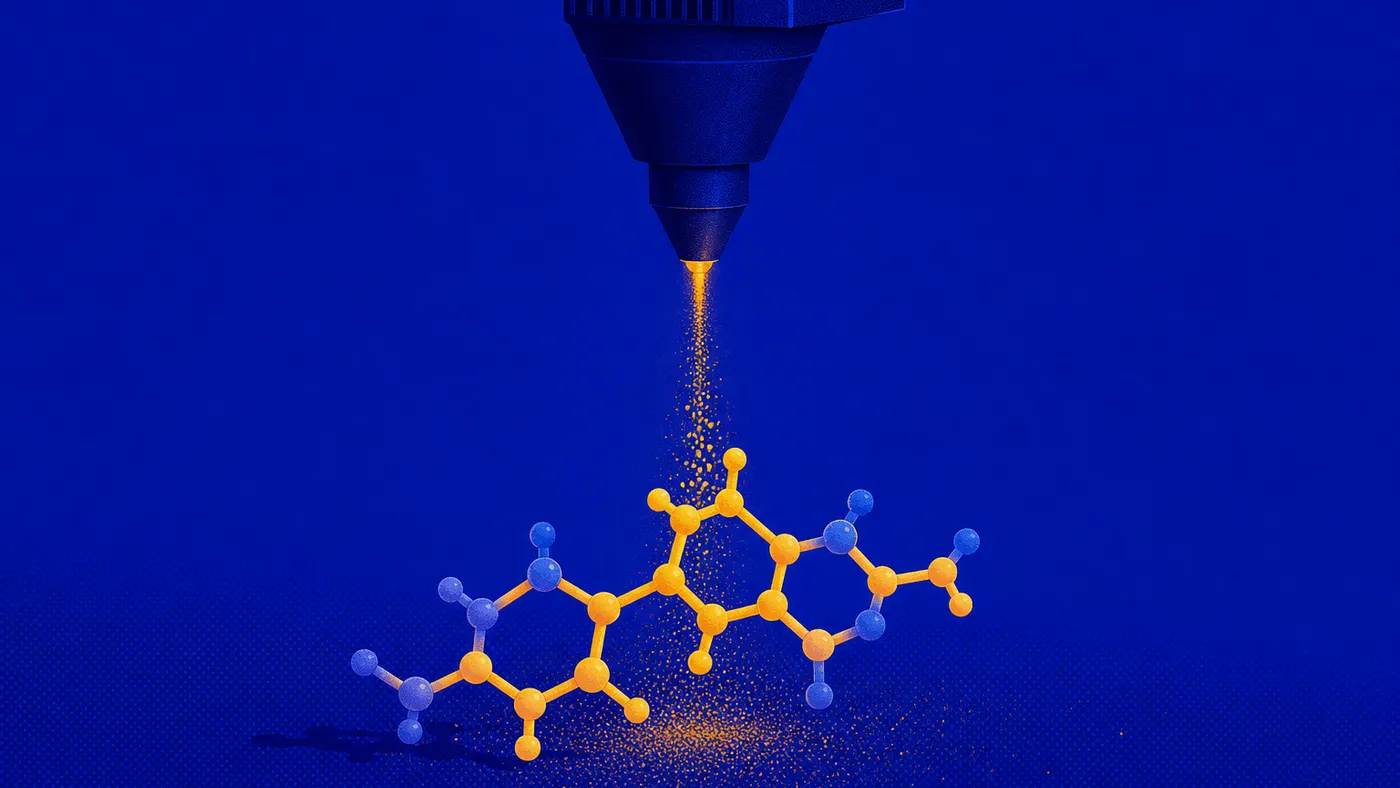
DBMol runs an alternating process with two stages S¹. In the optimization stage, it starts from an initial molecule and uses gradient-based optimization to sharpen pocket-specific interactions and lift predicted binding affinity, guided by a structure prediction model S¹. Think of it as hill-climbing: the model tells you which direction to push the molecule to fit the protein pocket better.
In the projection stage, a flow-matching model converts the optimized molecular graph into discrete, chemically valid molecules S¹. This is where the continuous optimization gets snapped back to real chemistry. You can't keep tweaking atoms in continuous space; you need actual molecules with valid bonds and sensible structures.
The two stages alternate. Optimize, project, optimize again. Each cycle tightens the fit while keeping the molecule chemically real.
Why grading your own homework is the real test
The authors use Boltz-2 as their primary affinity proxy for both optimization and evaluation S¹. That creates a circular risk: if you optimise for what Boltz-2 likes and then score with Boltz-2, you are grading your own homework. The authors acknowledge this explicitly and add held-out evaluation using AlphaFold-3, a different structure prediction model, to check whether the results hold up under a different lens S¹.
They report that DBMol remains competitive when scored by the held-out model, and that it reaches more of the target pocket while keeping a broader range of distinct molecules than baseline generation methods, without requiring a known ligand as a starting template S¹. That last point matters. Most structure-based drug design methods need a known ligand in the protein pocket as a starting template. DBMol does not.
But AlphaFold-3 and Boltz-2 are both deep learning models trained on overlapping protein structure data. They may share systematic biases. A molecule that fools one could fool both.
What to do about it
For a computational chemistry team at a mid-size biotech, DBMol is worth tracking as a candidate-generation tool, not a replacement for experimental validation. Consider a team working on a novel protein target where no reference ligand exists. Traditional structure-based design stalls because there is no template to start from. DBMol's claim of not needing reference-ligand supervision S¹ could open targets that were previously unreachable by template-dependent methods.
The practical workflow: use DBMol to generate candidate molecules, run them through independent docking software (not Boltz-2 or AlphaFold-3) for a second opinion, then send the top hits to the wet lab for binding assays. Treat every affinity number from DBMol as a hypothesis, not a result.
One thing to check this week: the DBMol preprint is on arXiv at 2607.19237 S¹. Read the held-out evaluation section carefully. If the AlphaFold-3-based metrics are only marginally better than baselines, the self-confirmation bias concern is real.
What we don't know yet
No molecule designed by DBMol has been synthesised, tested in a binding assay, or put through any experimental validation S¹. Every claim about affinity, specificity, and pocket coverage is a computational prediction. The paper is an unreviewed preprint S¹.
When we tried to run code from a repository surfaced during our research (python main.py on the affinity_attention repo), it crashed within ten seconds with a missing torch dependency [LAB1]. That repo is not DBMol's own code, and DBMol's authors have not yet released a public code repository. Independent reproduction will need the actual DBMol codebase and a GPU environment.
We also don't know whether DBMol's generated molecules are synthetically accessible. Chemical validity (correct bonds, valid atoms) is not the same as synthesizability (can a chemist actually make this in a lab). The paper claims chemical validity through the flow-matching projection stage S¹, but no chemist has examined the outputs.
The next signal: a public code release or peer-reviewed publication from the DBMol authors. If an independent group reproduces the held-out evaluation with a third structure prediction model, that would address the circular-evaluation concern. We'll check this claim against it when the code or paper appears.
If you want to follow the next chapter in AI-designed drug molecules, subscribe and we'll keep you posted.
Sources: S1 — DBMol: Design of High-Affinity, Target-Specific Small Molecules throug · P2 — DBMol: Design of High-Affinity, Target-Specific Small Molecules throug · P3 — Hosseinadeli/affinity_attention · P4 — guanjq/targetdiff · P5 — ByteDance-Seed/par-protein · LAB1 — Not A Tech Guy code lab: sandboxed run of python main.py
More from Not A Tech Guy
- AI safety paper: the quiet failures nobody measures
- Text-prompted visual similarity metric exposes AI blind spot
- MAR-12 AI detects harmful humor in memes at 80.3% accuracy
Generated from an audited evidence pack with primary-source research. Social-media items are discussion signals, not verified facts. Nothing here is financial, legal or medical advice.