

An unreviewed preprint posted on arXiv on 2 August 2026 claims a new AI text detector called DeBERTa-Sentinel achieves 98.21% validation accuracy on text generated by GPT, LLaMA, and Claude S¹. Unlike commercial tools that return a bare verdict, this one shows you exactly which words triggered its judgement. The gap between a clean benchmark number and a tool you can trust in the wild is where this gets uncomfortable.
My read: This is the first AI text detector I've seen that treats transparency as a design goal rather than a liability. The token-level explanations are the real contribution, not the accuracy figure. I don't buy the 98% as a deployment-ready number yet, because the dataset covers only three model families and the paper itself admits existing detectors fail to generalise. A 0.665% false negative rate means roughly 1 in 150 AI-generated texts still slips through undetected S¹. That sounds small until you're a university running 10,000 essays through it.
How disentangled attention works here
DeBERTa-v3 is Microsoft's evolution of the BERT architecture, originally released in 2020 and now sitting at 2,240 stars on GitHub under an MIT licence P³. Its signature feature is disentangled attention, which means the model tracks the relationship between each word and its position in a sentence rather than processing words in isolation. That structural sensitivity lets it notice when prose feels mechanically regular instead of humanly messy S¹.
The authors argue that existing transformer-based detectors like GPT-Sentinel fail to generalise across different models and can be fooled by paraphrasing S¹. Their pitch is that DeBERTa-v3's attention to structure catches what those models miss.
What the numbers say
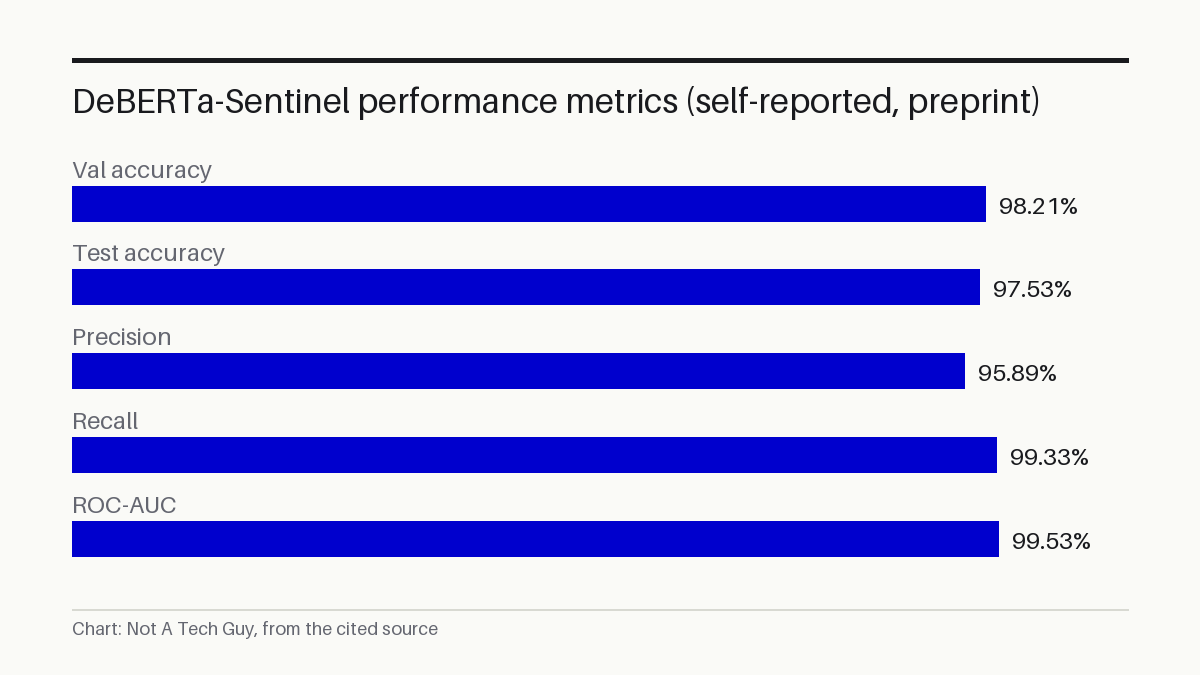
The authors trained and tested on the GLC-AIText dataset, which contains 28,057 human and AI-generated samples from GPT, LLaMA as well as Claude, split 60-20-20 for training, validation, then testing S¹. They report 98.21% validation accuracy, 97.53% test accuracy, 95.89% precision, 99.33% recall, and 99.53% ROC-AUC, while holding a false negative rate of 0.665% S¹.
The model reportedly surpassed the RoBERTa-Sentinel baseline from NeurIPS 2025 S¹, though that baseline's independent verification status is unclear.
The transparency angle
Commercial AI text detectors, the kind built into learning management systems and content platforms, typically return a single score: 87% likely AI-generated. You cannot see why. DeBERTa-Sentinel exposes token-level explanations. It flags the specific words and phrases that drove its decision S¹.
The interpretability feature reveals linguistic markers the model associates with synthetic text: academic phrasing and formal transitions, the connective tissue that language models produce more consistently than humans do S¹. A teacher who sees the detector flag "furthermore" and "in conclusion" in a student's essay can make a far more informed judgement than one staring at an opaque confidence score.
The intended users are journalists and educators as well as platform trust and safety teams who need to review or question detection results, or add context to them S¹. The code and dataset are public on GitHub S¹.
What to do about it
Consider a first-year sociology tutor marking 200 essays in a week. She has already seen the pattern: paragraphs that read like textbook summaries, transitions too clean, vocabulary slightly above the student's usual register. A detector that flags those specific tokens rather than returning a blunt percentage lets her cross-reference the flagged phrases against the student's earlier work. That is a fundamentally different workflow from the current one, where a platform says "AI-detected" and the tutor has no way to verify or challenge the claim.
The practical move this week: the code is on GitHub S¹. If you work in academic integrity or editorial quality control, clone the repository and run it against your own corpus. The dataset only covers GPT, LLaMA as well as Claude, so test it against text from other models your users actually encounter. The gap between benchmark accuracy and real-world performance is where every AI detector has historically broken.
What we don't know yet
Everything in this article comes from a single preprint that has not been peer-reviewed S¹. The performance numbers are self-reported. No independent lab has replicated them. The dataset covers three model families, so behaviour against Gemini or Mistral, or future model releases, is unknown. The NeurIPS 2025 baseline comparison may not be independently verifiable. The authors acknowledge that generalisation and paraphrasing attacks remain hard problems, but they do not claim to have fully solved them S¹.
The paper is scheduled for presentation at the CLEAR-AI 2026 workshop, co-located with IJCAI-ECAI 2026 in Bremen on 16 August 2026 P². That is the first opportunity for peer scrutiny. The next real test: whether an independent lab can reproduce the 98% accuracy on a different dataset. We will check this claim against any replication results that emerge after the Bremen workshop.
If you want this kind of grounded, no-hype analysis of AI research landing each week, subscribe to keep reading.
Sources: S1 — DeBERTa-Sentinel: Toward Transparent and Trustworthy Detection of AI-G · P2 — DeBERTa-Sentinel: Toward Transparent and Trustworthy Detection of AI-G · P3 — microsoft/DeBERTa · P4 — Show, Don't TELL: Explainable AI-Generated Text Detection · P5 — LLM360: Towards Fully Transparent Open-Source LLMs
Related reading
- Text-to-video jailbreak gains 18.6% over closest rival — our technology desk, 2026-07-21
- HilEnT turns malware into images for AI detection — our technology desk, 2026-07-08
- Visual pretraining outperforms text-only for language AI — our technology desk, 2026-07-13
Generated from an audited evidence pack with primary-source research. Social-media items are discussion signals, not verified facts. Nothing here is financial, legal or medical advice.


