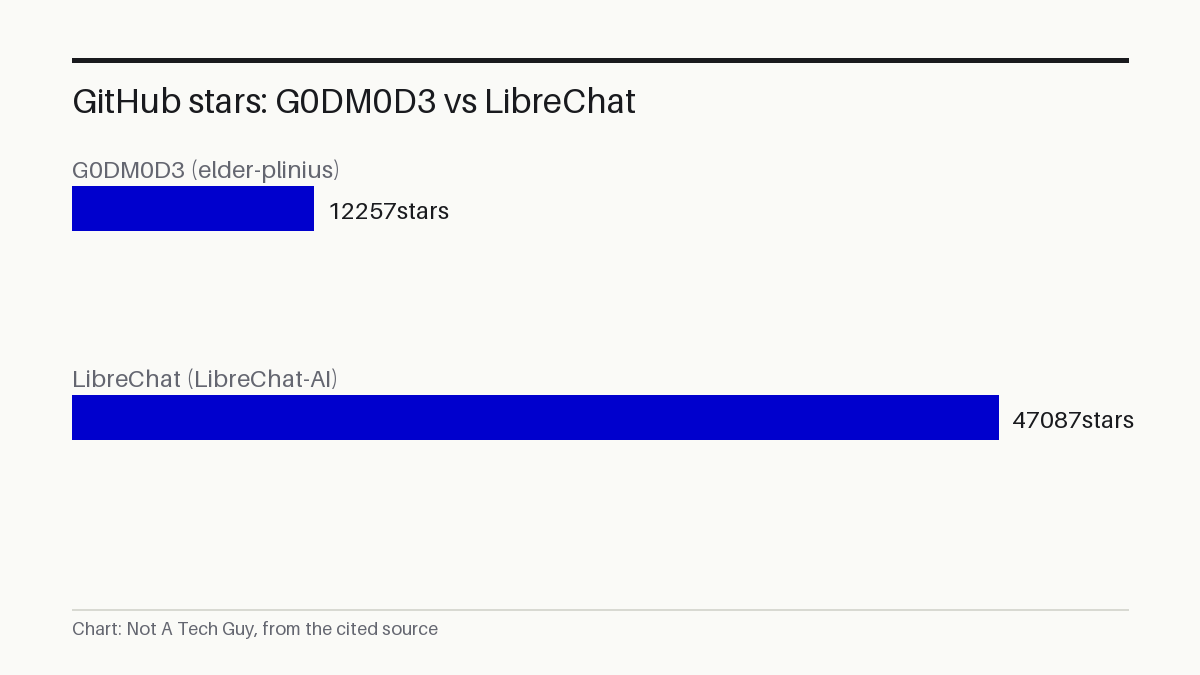

Maintainer elder-plinius landed G0DM0D3, a self-styled "liberated AI" chat interface, on GitHub's daily trending list with 12,257 stars and 2,857 forks S¹P⁴. The repository brands itself around "cognition without control" and red-teaming, but every capability and privacy claim comes from the maintainer's own README, with no independent security audit S¹.
My read: The star count tells you this repo has found an audience, but 12,000 stars on a README that nobody outside the project has verified is a weak signal of actual capability. The feature I would watch is "Parseltongue," the 33-technique input perturbation engine, because that is the part that implies active guardrail testing rather than just a chat frontend. Until someone independent reproduces what those techniques actually do against a named model, this is a tool description, not a tested tool.
What the tool actually is
G0DM0D3 is a TypeScript chat interface, created on 25 March 2026 and released under the GNU Affero General Public License v3.0 P⁴. The maintainer describes it as a "fully open-source, privacy-transparent, multi-model chat interface" for red teaming and what he calls "liberated AI interaction" S¹. In practice, that means a frontend that routes prompts to existing model APIs: 60 listed OpenRouter models and up to 44 Venice models, according to the README S¹. It also supports local model runners including Ollama, LM Studio, llama.cpp, and vLLM, with a Local-only mode that the maintainer says excludes all external API calls S¹.
The hosted version lives in a single index.html file, with a separate Cloudflare Pages Function handling telemetry S¹. Conversations and settings stay in browser storage, with export and import support S¹.
This puts G0DM0D3 in the same category as LibreChat, a more established open-source chat frontend with 47,087 stars P⁵, though G0DM0D3's red-teaming focus and "liberated AI" branding set it apart. Where LibreChat emphasises multi-user auth and broad model support, G0DM0D3 leans hard into prompt manipulation and guardrail testing. The broader chat-interface space has been moving toward productivity features, as we found when the Gemini app added PDF and document editing inside chat, but G0DM0D3 goes the opposite direction.
The red-teaming features nobody has checked
The README describes three headline features. "GODMODE CLASSIC" runs five prompt-and-model combinations in parallel S¹. "ULTRAPLINIAN" is a multi-model evaluation engine across five tiers S¹. "Parseltongue" is an input perturbation engine with 33 techniques across three intensity tiers, designed for red-teaming S¹.
None of these features have been independently tested. The README publishes no benchmark results, no error bars, and no record of which models were tested or what happened. The 12,257 stars reflect GitHub attention, not verified capability S¹.
The maintainer also publishes a related dataset on Hugging Face under the name pliny-the-prompter, verified three months ago and marked "Safe" by the platform P³. The dataset's contents beyond its existence are not detailed in the available evidence.
Privacy claims to treat as claims
The README states that metadata-only app telemetry is on by default and can be disabled through No-Log or Local-only mode S¹. No one outside the project has confirmed that the telemetry is metadata-only, or audited what the Cloudflare Pages Function actually transmits S¹. The repository is not affiliated with OpenRouter, Venice, or any model provider, despite integrating with their APIs S¹.
A developer considering self-hosting should read the index.html and the Cloudflare Function code before pointing the tool at any model API that logs or charges for usage. The AGPL v3.0 licence means derivative deployments must publish their source P⁴. This matters more than it would for a standard chat wrapper, as the Gemini document-editing feature showed: when a chat tool touches external services, the data path is the story.
The repository has 88 open issues and 2,857 forks as of the trending listing P⁴. The next checkable signal is whether any of those forks or issues contain independent reproductions of the Parseltongue techniques against named models, which would move this from a README claim into something a second party has actually confirmed.
Sources: S1 — elder-plinius/G0DM0D3: LIBERATED AI CHAT · P2 — README.md · P3 — pliny-the-prompter/g0dm0d3 at main · P4 — elder-plinius/G0DM0D3 · P5 — LibreChat-AI/LibreChat
Related reading
- Gemini app now edits PDFs and docs inside chat — our technology desk, 2026-10-29
Written from 5 sourced items, 4 of them primary.