

Google DeepMind published Gemini 4 Carbon as its next frontier model, posting a score of 59 to claim first place on the Artificial Analysis Intelligence Index v5.0 S¹. The model ships first to a subset of cyber defenders, not the general public, because its standout results are in finding and exploiting software vulnerabilities S¹.
My read: This is the first frontier model I've seen where the gating mechanism is offensive security capability rather than general intelligence risk. Google is explicitly saying the model's vulnerability-finding and exploitation scores are the reason for a phased rollout. The benchmarks were run without guardrails, so the numbers represent raw capability with safety filters off. I'd want independent verification of the Chrome team's "10X better" claim before treating it as settled, and the internal "2x uplift" over Argon is self-reported with no published methodology.
Security benchmarks run without guardrails
Carbon's most striking numbers are in offensive security. On SEC-bench Pro, a benchmark for finding vulnerabilities, it scored 88.2% S¹. On ExploitGym, which measures exploitation, it reached 54.8% S¹. On CWE-bench, which tests patching, it scored 71.0% S¹. Google states all three were evaluated without guardrails, meaning the safety filters that would normally block harmful outputs were disabled for testing S¹.
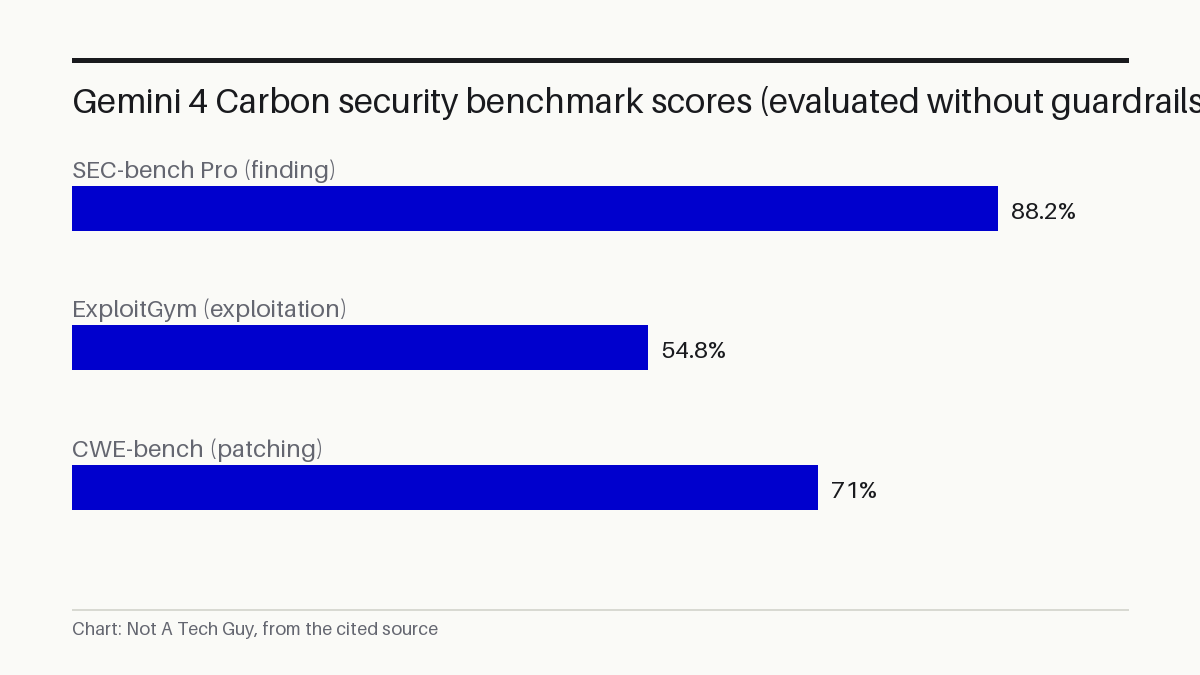
Those numbers explain the gated release. Starting this week, Google is making Carbon available to a subset of cyber defenders, then gradually extending access to trusted partners through what it calls the Fairwind Program S¹.
No general availability date for developers, businesses, or consumers has been set.
Built on Argon, priced the same
Carbon builds on Gemini 4 Argon, which Google launched two weeks ago at $2 per million input tokens and $10 per million output tokens S¹. Carbon inherits that introductory pricing, with cached input tokens discounted 95% off the input rate S¹. As we found when Google launched Argon at $2 per million tokens, that price point put Google in direct competition with other frontier model providers on cost per token.
On WebDev Arena, Carbon jumped 89 Elo points to rank fourth with a score of 1769 S¹. Google's internal benchmarks show more than a 2x improvement over Argon in generating secure code, though this is self-reported and nobody outside Google has checked the methodology S¹.
Self-reported claims from inside Google
The Chrome team reported that Carbon performed more than 10X better than "another lab's large frontier model" at generating high-quality patches S¹. Google does not name the competitor or publish the test conditions. Wiz, Google's cloud security platform, separately observes Carbon leading on benchmarks for web penetration testing S¹.
Both claims are attributed to Google's own teams rather than independent evaluators.
Internally, Google says its teams have seen Carbon run for days, persisting through dead ends to complete complex multi-step engineering tasks S¹. The company is also engaged in the U.S. government's voluntary process for pre-release model testing S¹.
What a security team should check
A penetration testing firm getting early access through the Fairwind Program could test Carbon against a known vulnerable codebase and compare its vulnerability discovery rate against their existing tooling. The 88.2% SEC-bench Pro score suggests the model can find bugs that static analysis tools miss, but the no-guardrails caveat means production deployments would need their own safety filtering layer.
Google announced Carbon the day after DeepMind unveiled Genie 4, its real-time world simulation model, marking a busy week for the lab. The next checkpoint is the Fairwind Program's phased expansion to additional trusted partners, though Google has not published a timeline for that rollout.
Sources: S1 — Gemini 4 Carbon: Our next frontier model · S2 — Gemini 4 Carbon: our next frontier model - blog.google · P3 — Official Gemini news and updates | Google Blog · P4 — cheercheung/awesome-gemini-4-carbon-guide-and-use-cases · P5 — Models & research · P6 — google-deepmind/deepmind-research
Related reading
- Google DeepMind announces Genie 4 world model — our technology desk, 2026-10-27
- Google DeepMind's Gemini 3.8 TTS clones a voice from 30 seconds — our technology desk, 2026-09-23
- Google launches Gemini 4 Argon at $2 per million tokens — our technology desk, 2026-10-13
Written from 6 sourced items, 5 of them primary.


