
Google launched the Gemini Decisions API today, a model that scores bounded options in a single forward pass and returns answers in 150 to 250 milliseconds S¹. That turns the standard LLM pattern on its head: instead of generating text token by token to arrive at a choice, the new model, Gemini Decision 1, evaluates candidate answers directly and returns a probability for each S¹.
My read: The architecture shift here is real and interesting. Scoring options in one forward pass, rather than autoregressive generation, is the right tool for decisions that don't need prose attached. But the benchmark leadership and 5x cost claims are Google's own, measured on Google's own suite, and nobody outside the company has reproduced them. The number I would watch is the 150 to 250 millisecond end-to-end latency under real production load, because Google's own spec notes that figure applies to contexts up to 16K tokens, not the full 256K input ceiling S¹.
What the API actually does
The Decisions API, available through the Gemini API in Google AI Studio S¹, handles three question types. "Noul" estimates the probability that a yes/no condition holds. "Choice" picks from 2 to 255 options. "Score" grades inputs against an ordered rubric S¹. Every answer carries a confidence score from 0 to 1 S¹.
The input accepts text, images, audio, video, and PDFs in a single multimodal request, up to 256,000 tokens, and you can batch up to 1,000 independent questions in one call S¹. Latency stays nearly flat from 1 to 100 questions per request, according to Google S¹. The input format matches the existing Interactions API's Content block, so teams already calling Gemini can swap endpoints without restructuring their payloads S¹.
The use cases Google names are the ones where a full LLM is overkill: routing a user query to the right tool, checking whether a response violates policy, deciding which model should handle a request, or grading whether retrieved context is relevant S¹. These are decisions that today get bolted onto a text-generating model, paying for output tokens and waiting for generation when all you need is a label.
Price and performance, with caveats
Google prices the Decisions API at $0.10 per 1 million input tokens, with zero output tokens billed S¹. That output-token exemption makes sense: the model doesn't generate text. Google claims the API is nearly 5x cheaper across its shared benchmark suite than Gemini 3.5 Flash-Lite running through the Interactions API S¹, but that comparison is self-reported and the benchmark suite is Google's own. No third party has verified it.
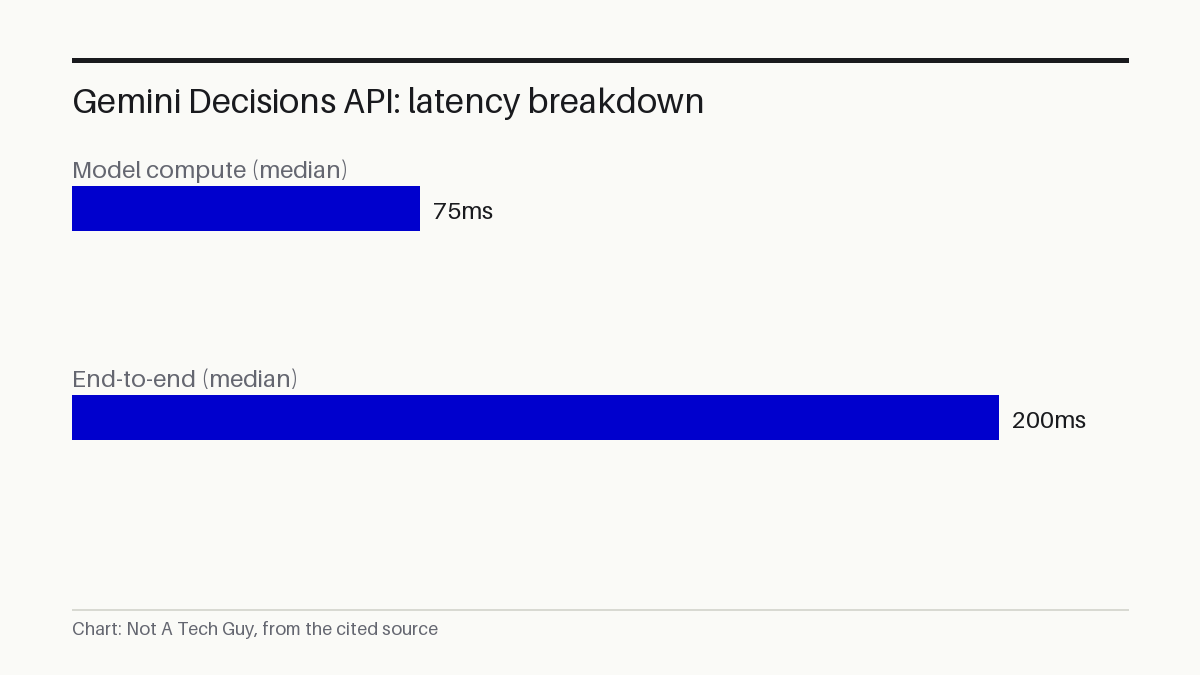
The latency figures carry the same asterisk. Google reports 50 to 100 milliseconds of model compute and 150 to 250 milliseconds end-to-end S¹, but those numbers reflect Google's test conditions and apply to contexts up to 16K tokens. Push the full 256K input and the picture may change. Google also claims Gemini Decision 1 leads its benchmark suite spanning agent routing, reasoning, ranking, and multimodal understanding, with the lowest calibration error S¹. Again, self-measured, and the confidence scores have not been validated against external calibration datasets.
Hugging Face published a blog post on decision models the day before Google's announcement P⁵. The post signals that the broader ML community is converging on the idea that not every task needs a text generator. This follows Google's recent push to cover every tier of the inference market, from Gemini 4 Argon at $2 per million tokens to the Carbon model that topped the AI safety index. Within hours of the Decisions API launch, a pull request appeared in the LiteLLM repository from developer mateo-berri adding support for gemini-decision-1 P⁴. The open-source proxy layer is already moving to support the new endpoint.
Who should try it, and what to check first
Any team running an LLM solely to make a routing, classification, or policy decision is paying for generation they don't need. A content moderation pipeline that currently sends each user message to a full LLM to get a "safe" or "unsafe" verdict could swap to the noul question type, send the same multimodal input, and get a probability back in under 250 milliseconds with no output-token cost. The same logic applies to model routing in agent stacks, an area where OpenAI's recent API additions also signal growing demand for finer-grained control over inference pipelines.
The single thing to check first: run your existing decision workload against the Decisions API with the same inputs you use today, and compare both latency and accuracy on your own data, not Google's benchmark suite. If the confidence scores correlate well with your ground truth, the cost drop is real. If they don't, the calibration claim doesn't hold for your domain, and no benchmark suite will tell you that.
Google has not announced a date for general availability beyond Google AI Studio, and the latency and pricing figures are drawn from Google's own testing conditions S¹.
Sources: S1 — Gemini Decisions API: Fast, calibrated multimodal decisions · S2 — Google launches Gemini Decisions API for fast multimodal choices - Cry · S3 — Gemini Decisions API: Fast, calibrated multimodal decisions - blog.goo · P4 — feat(gemini): support gemini-decision-1 on /v1/decisions and /v1/syste · P5 — Decision Models in Hugging Face
Related reading
- OpenAI Images 2.6 adds GIFs, faster generation, API controls — our technology desk, 2026-11-05
- Gemini 4 Carbon tops AI index at 59, gated to defenders — our technology desk, 2026-10-28
- Google launches Gemini 4 Argon at $2 per million tokens — our technology desk, 2026-10-13
Written from 5 sourced items, 3 of them primary.