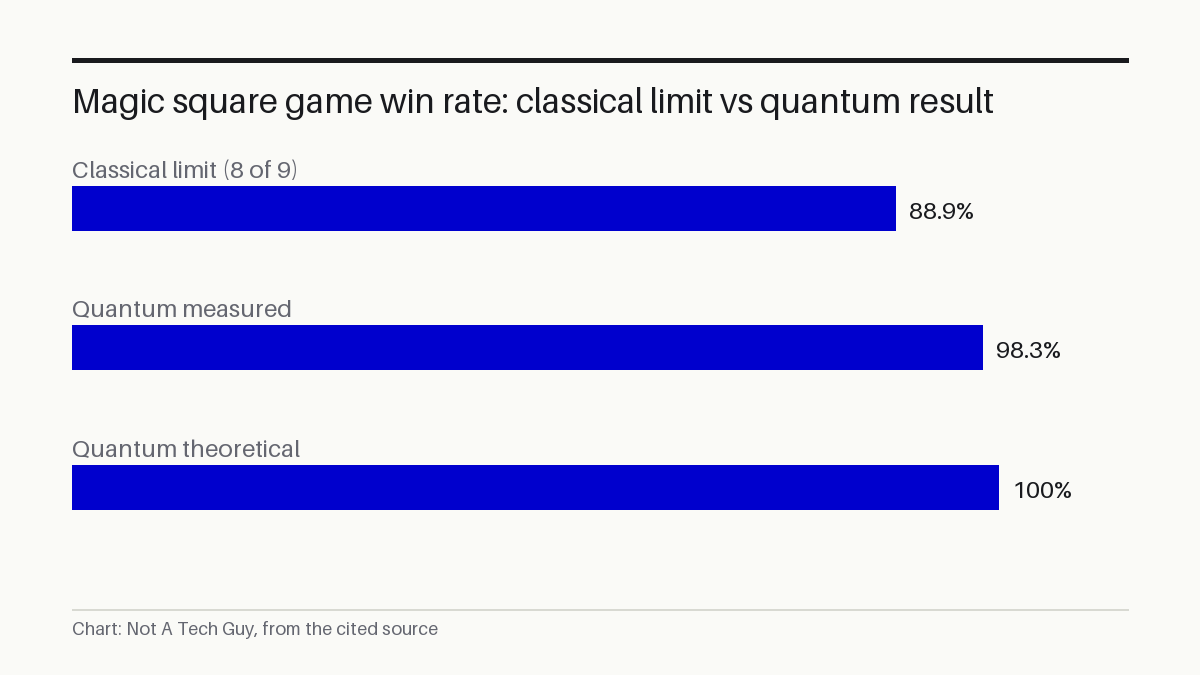
Google Quantum AI researchers Shashwat Kumar and Rodrigo Cortiñas won a game that is mathematically impossible to win 98.3% of the time, using a 105-qubit superconducting processor S¹. No classical strategy can win more than 8 of 9 rounds. The result, published on the cover of Science on 19 November 2026, is the first evidence that a quantum property called contextuality survives in hardware large enough to matter S¹ P². That 98.3% figure is Google's own measurement on its own hardware; no independent group has reproduced it, and the blog post does not report error bars S¹.
My read: The number I would watch is the 1.7% gap between the measured 98.3% and the 100% that quantum theory allows in principle. That gap is the noise floor of a real processor, and it tells you how far the hardware sits from ideal. I do not doubt the separation, because the classical ceiling of 88.9% is a mathematical limit, not a benchmark someone could tune. What I am less sure about is the blog post's claim that contextuality is "the deeper resource" powering quantum algorithms S¹. That theory is building but still contested, and one experiment on one processor does not settle it.
A game built on a contradiction
The magic square game starts with a 3×3 grid. Two players, Alice and Bob, must fill every cell with either +1 or -1. The rules require that multiplying the three entries in any row yields +1, while multiplying the three entries in any column yields -1 S¹.
The problem is arithmetic. If you multiply the three row products together, the result is +1. If you multiply the three column products together, the result is -1. Both calculations traverse the same nine cells, so they should match. They cannot. The grid is a contradiction on paper.
In the game version, a referee assigns Alice a row and Bob a column. They fill in their three cells without seeing each other's choices. Any strategy the players agree in advance is just a fixed lookup table, which caps their win rate at 8 of 9 rounds S¹. A quantum computer changes the mathematics. It does not fill in the impossible grid, but in principle it lets Alice and Bob win every round S¹.
Contextuality holds up across 105 qubits
Einstein once asked whether the moon is there when nobody looks. He insisted that physical properties should exist whether or not anyone measures them S¹. Contextuality is the experimentally testable counter-claim: in quantum systems, at least some measurable properties do not have definite values sitting there waiting to be read off S¹.
Until now, contextuality had been demonstrated almost exclusively in small systems of a few particles S¹. Whether it survived in the many-body systems that real quantum computers are built from was an open question S¹. The Google team answered it on their superconducting processors, scaling to 105 qubits and outperforming every classical strategy S¹. The qubits won 98.3% of rounds, clearing the 88.9% classical ceiling and approaching the 100% that quantum theory permits.
The paper, also available on arXiv P⁴, is peer-reviewed, published in Science. Google's quantum software stack, maintained under the quantumlib organisation on GitHub P⁵, includes Cirq, a Python framework for designing and running the kind of quantum circuits this experiment required.
Algorithm designers get a scalable diagnostic
Quantum algorithm designers are the immediate audience. Theory suggests contextuality is the resource that powers certain quantum algorithms past their classical counterparts S¹, and a scalable way to measure it gives those theorists a benchmark to test against. That theoretical link between contextuality and algorithmic speedup has not been independently verified and remains debated in the literature.
For a quantum hardware team, the magic square game becomes a diagnostic. Run it on your processor, measure the win rate, and compare it to the 88.9% classical floor and the 100% quantum ceiling. The closer you sit to 100%, the more of the quantum advantage your hardware preserves. A superconducting-qubit calibration engineer can now add the magic square protocol to their daily benchmarking suite alongside randomized benchmarking, getting a single number that captures how much quantum coherence the processor preserves across all qubits simultaneously rather than one qubit at a time.
While classical computing keeps finding workarounds, from GPU pooling tools like Mesh-LLM to distributed inference, the magic square result points to a ceiling no amount of conventional hardware can break. Google's research output this quarter has ranged from educational games for children to fundamental physics, but this is the result that touches the foundations of what computers can and cannot do.
The next checkpoint is whether other groups, on different hardware architectures such as trapped ions or neutral atoms, can reproduce the separation. Google's result is a single-processor demonstration with no independent corroboration yet S¹.
Sources: S1 — A game you cannot win unless you have a quantum computer · P2 — Testing quantum contextuality at scale on Google processors · P3 — Shashwat Kumar · P4 — Quantum–Classical Separation in Bounded-Resource Tasks Arising from Me · P5 — Quantumlib
Written from 5 sourced items, 5 of them primary.