
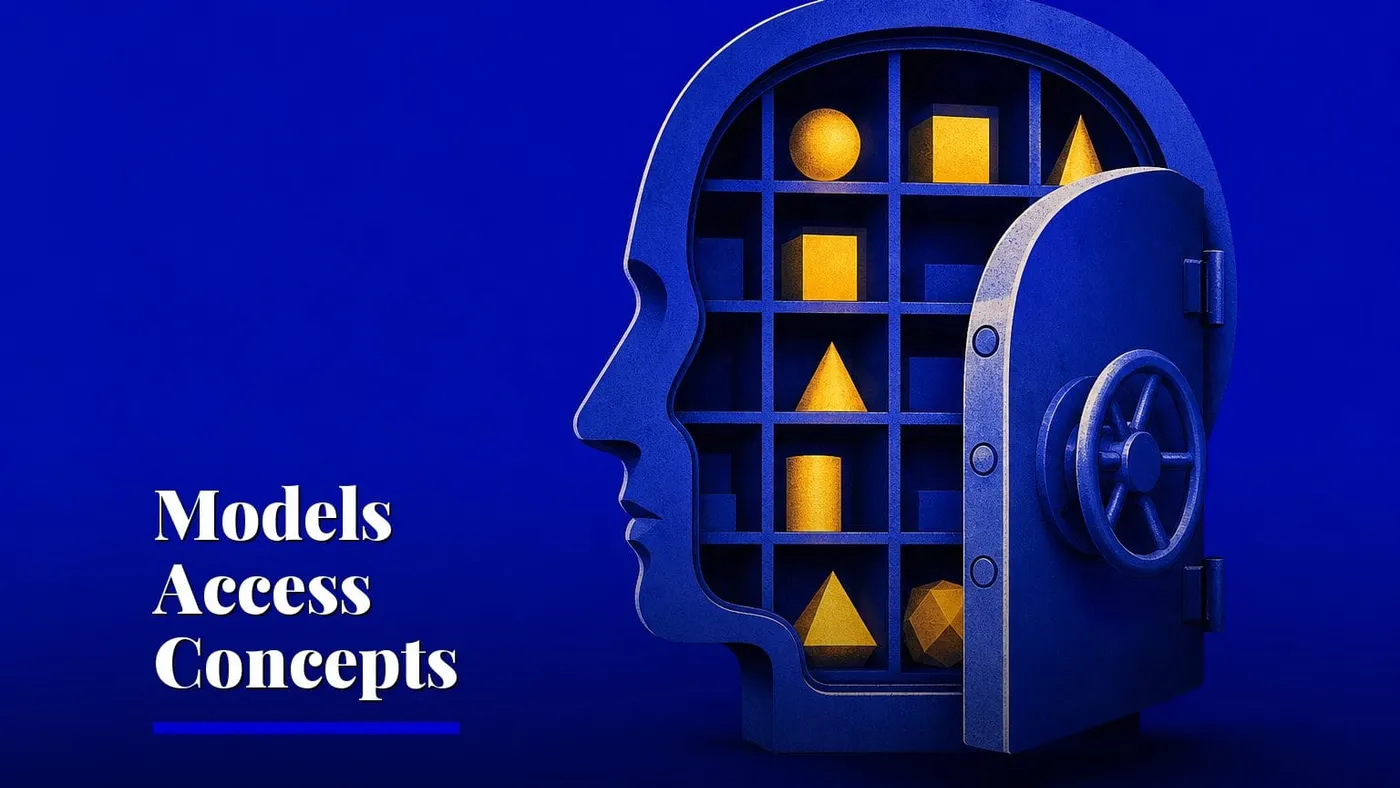
Jiahao Huang and Jun Wang published a preprint on arXiv on November 19, 2026, showing that vision-language models carry readable concept information in their intermediate states and selectively access it depending on the task S¹P⁴. That cuts against the common assumption that a VLM's text output is the only window into what it knows about an image. The models' internal layers hold structured concept representations that the final answer never fully exposes S¹.
My read: The word "conscious" in the title is doing heavy lifting and the authors know it. They explicitly state they are studying functional properties associated with conscious access in global workspace theory, not claiming machine consciousness P². The finding I find most credible is the training-order result: reliable selective access develops later than basic concept accessibility S¹. That is a concrete, checkable claim about how these models learn. The J-space metric comparison is limited to their controlled training setup and may not generalise beyond it.
What the tool actually does
The paper introduces the Multimodal Concept Lens, or MC-Lens, a Jacobian-based analysis tool that probes intermediate states inside a vision-language model S¹. Jacobian lenses measure how small changes to a model's internal states affect its output, revealing which concepts are active at each layer. MC-Lens uses two components: a vision encoder lens and a language decoder lens, both mapping intermediate states into a shared semantic space defined by the decoder's output vocabulary S¹. This lets the researchers compare which concepts a model can access through its visual pathway versus its text pathway, on the same scale.
MC-Lens also supports concept interventions, where the researchers modify a concept representation inside the model and watch how the change propagates to the output S¹. This is closer to the weight-editing approach we saw when AI models scored 53% editing neural network weights directly, but applied to concepts rather than raw parameters.
Selective access, not simultaneous emergence
The central finding is twofold. First, multimodal concept information is readable in the models' intermediate states S¹. Second, that information is selectively accessible: the model pulls in the concepts a specific task requires, rather than broadcasting everything it knows S¹. Counterfactual experiments confirm that the accessed concepts actually participate in downstream reasoning rather than sitting idle S¹.
The training experiments add a temporal dimension. The authors developed two J-space metrics to track how cross-modal concept alignment develops during controlled VLM training, and report these metrics track alignment more clearly than the standard hidden state cosine similarity S¹. The key result: reliable selective access develops later than basic concept accessibility S¹. A concept is present in a model before the model can selectively call on it.
Across different VLM families and model sizes, the authors report shared patterns of concept accessibility, query-dependent selectivity, and cross-task intervention effects, despite differences in how each model organises its internals S¹.
What this does not claim
The paper is not peer-reviewed, and all findings are provisional S¹. The title's use of "conscious" refers to functional properties from global workspace theory, a framework from cognitive neuroscience that describes how the brain selects information from parallel processes and integrates it in a shared workspace S¹P². The authors state explicitly that they do not claim these models possess consciousness or subjective experience P².
The analogy between global workspace theory and AI internal mechanics is interpretive. The J-space metric superiority claim is bounded to the paper's controlled training setup S¹. Whether these patterns hold across the broader range of multimodal architectures in production use remains untested.
For teams building or auditing vision-language models, the practical question is whether MC-Lens-style probing could surface concept gaps before deployment, the way tiling recovered 14 points on small-object detection in a different corner of the same problem space. The paper does not release a public tool for that yet. The GitHub repository at yjr530/MCT-Lens is a separate project about gravitational lens detection, not the code for this paper P³.
The preprint is open for review on arXiv at 2611.26590 S¹.
Sources: S1 — Probing the "Conscious" Mind: Selective Access and Global Workspace in · P2 — Probing the “Conscious” Mind: Selective Access and Global Workspace in · P3 — yjr530/MCT-Lens · P4 — Paper page - Probing the "Conscious" Mind: Selective Access and Global · P5 — Transformers with Selective Access to Early Representations
Related reading
- AI vision models miss small objects, tiling recovers 14 points — our technology desk, 2026-11-18
- AI models bend advice to serve the boss's bonus — our technology desk, 2026-11-13
- AI models score 53% editing neural network weights directly — our technology desk, 2026-11-16
Written from 5 sourced items, 4 of them primary.