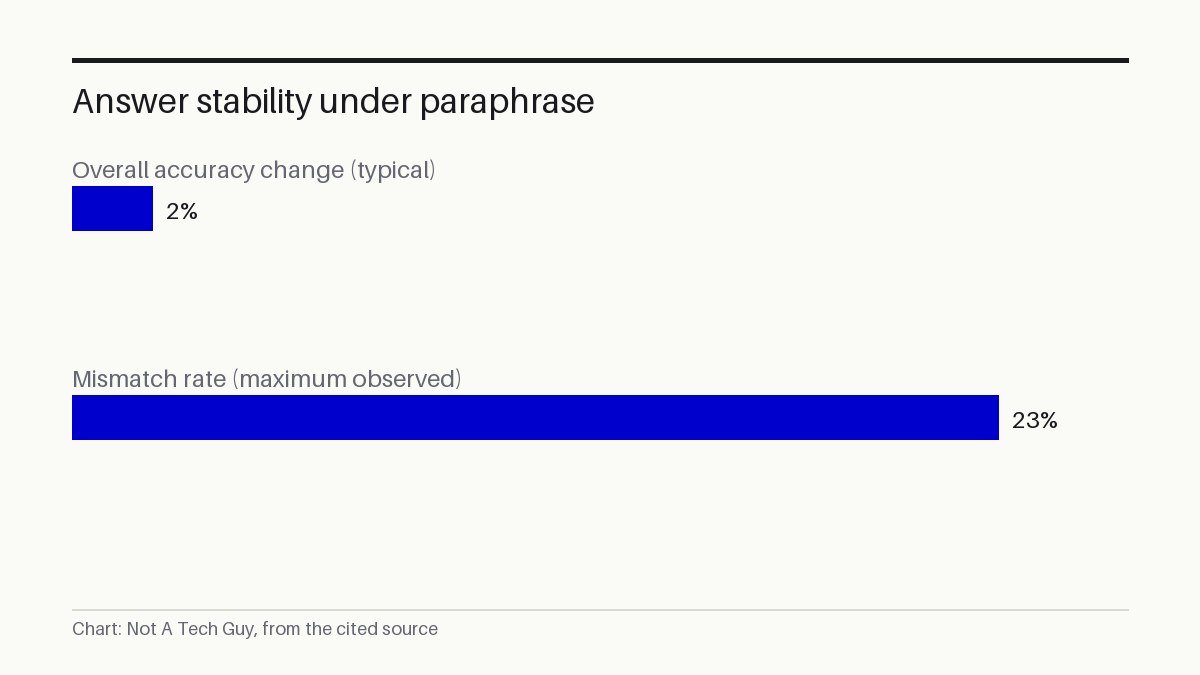

According to a July 28 arXiv paper by University of Maryland researchers, rephrasing a question without altering its meaning causes large language models to change their answers in over 23% of cases S¹. While overall accuracy remains largely unchanged across the 13 models and four benchmarks evaluated, specific responses vary significantly. What that means for anyone building on top of these models, and why the fix might be simpler than the problem, is just below the line.
My read: This is the third signal in two weeks pointing at the same structural blind spot in how we grade AI. This paper adds a sharper edge: the instability is baked into how models respond to their own input wording, and is not noise from outside context. I am skeptical of the self-paraphrasing fix until I see it tested outside the authors' own benchmarks, but the core finding, that a model can hold knowledge and still fail to surface it consistently, matches what I hear from developers shipping production systems.
The number that accuracy hides
Kazem Faghih and Soheil Feizi from the University of Maryland evaluated 13 different models using four benchmarks focused on math reasoning and factual question answering S¹P². They created paraphrases that maintained the original meaning for every question, presenting the same inquiry in different ways to observe the models' behavior.
Aggregate accuracy shifted only slightly. For instance, a model achieving 85% with the initial wording might achieve 83% or 84% with a paraphrase. This appears stable on leaderboards, suggesting the model has grasped the content.
However, examining individual questions reveals a different reality. In over 23% of instances, a model provided a correct answer for one phrasing but an incorrect one for another, or the reverse S¹. The overall score remained steady despite this underlying instability in responses.
Why getting it right once means nothing
The study suggests that a correct response to a single prompt is a poor indicator of dependability S¹. Answering correctly once demonstrates capability, but not consistency when users inevitably alter the wording of the same inquiry.
The team observed that models frequently generate a correct response for at least one variation of a query S¹. The information exists within the model, but the retrieval mechanism is unstable, relying on the specific wording of the prompt instead of its underlying meaning.
When analyzing only the questions answered correctly in their original form, the failure rate increased. The proportion of cases where a correct answer became incorrect after paraphrasing was higher than the general mismatch rate S¹. Getting it right the first time made the second-time flip more visible, not less.
What to do about it
Picture a legal tech startup that uses an LLM to answer questions about contract clauses. A lawyer asks "Does this agreement cap liability at $500,000?" and the model says yes. The same lawyer rephrases in a meeting note: "Is the liability ceiling in this contract set at half a million?" and the model says no. Both questions mean the same thing. The model knows the answer, as the paper suggests, but it surfaces inconsistently. The startup's accuracy dashboard shows 92% on the benchmark. Nobody flags the 23% of cases where the answer depends on phrasing.
The authors suggest a straightforward inference-time solution: instruct the model to paraphrase its input, respond to multiple versions, and then reconcile the outputs S¹. They state that this self-paraphrasing approach helps retrieve hidden knowledge and boosts performance. This is not a retraining method; it operates during inference, adding latency and computational cost without requiring modifications to the model itself.
For teams deploying LLMs in production, the practical step this week is to test your own system. Take 50 real user queries, paraphrase each one three ways, and run all four versions through your model. If any answers flip, you have found the gap this paper describes. The fix, or at least the awareness, starts there.
What we don't know yet
The study is an arXiv preprint and has not yet undergone peer review S¹. The 23% rate represents the highest mismatch observed, rather than an average across the 13 models or four benchmarks S¹. The paper does not provide a breakdown of results by model name or architecture in its abstract and announcement, so it is unclear which models performed best or worst.
The proposed self-paraphrasing method is detailed by the researchers but lacks independent verification S¹. It remains unknown how much latency or cost this adds in a production environment, or if the improvements persist on tasks beyond factual QA and math reasoning, like code generation or open-ended summarisation.
The next signal: a revised version of this preprint on arXiv, which for papers generating discussion typically appears within four to six weeks. We will check the model-level breakdown and self-paraphrasing cost analysis against it. If you want that follow-up in your inbox, subscribe and we will send it.
Sources: S1 — Same Question, Different Answers: Evaluating LLM Reliability Beyond Ac · P2 — Same Question, Different Answers: Evaluating LLM Reliability Beyond Ac · P3 — taesiri/ArXivQA · P4 — [2211.05853] Measuring Reliability of Large Language Models through Se · P5 — au-clan/Diverge
More from Not A Tech Guy
- OpenAI field report: AI agents accelerate genomics research
- Gemini API agents get execution hooks and 3.6 Flash default
- MIT preprint: fluid search cuts autonomous AI research cost
Generated from an audited evidence pack with primary-source research. Social-media items are discussion signals, not verified facts. Nothing here is financial, legal or medical advice.