

A new arXiv paper released on 2 August 2026 reports that training language models on intermediate clinical decisions rather than final diagnosis lifted next-step accuracy by 11.5 percentage points for a 27-billion-parameter model S¹. The framework, called MedUPS, converts 5,535 real case reports into 21,874 decision points where a clinician must pick the next test, imaging study, or specialist consultation S¹. The result that should make hospital IT directors pay attention: smaller aligned models beat larger frontier models on this task S¹. Why that happens, and what it means for clinical AI that helps rather than just scores well, is the story worth subscribing for.
My read: This is the first medical AI paper I've seen that explicitly rejects the "guess the diagnosis" framing and instead trains models on the sequential reality of clinical work. The 11-point jump is real but measured on case reports, not live patients. I'm skeptical of the LLM-as-a-Judge reward signal because it creates a circular dependency: another model decides what counts as "right," and that model carries its own blind spots. What I'd watch is whether the next-step accuracy holds when the input is a noisy emergency department handover with missing vitals rather than a tidy published case report.
Why final-diagnosis benchmarks miss the point
Most medical AI benchmarks work like a quiz show. Show the model a patient description, ask "what's the diagnosis?", score the answer S¹. Real clinical care rarely works that way. A doctor facing an uncommon case makes a series of decisions: which blood panel to order, whether to image, which specialist to involve, what differential to pursue S¹. Each decision narrows or redirects the path. Getting the final label right matters, but getting the next step wrong can cost hours or worse.
Benchmarks that score only the final diagnosis push models to optimise for that final label, even when the useful work happens upstream.
MedUPS builds its training data around those upstream decision points. The team split 5,535 free-text case reports into time-ordered, progressively expanding segments of clinical information S¹. At each segment, the model faces a question: what should happen next? That yielded 21,874 mid-stream decision points S¹.
How the alignment works
The method has two moving parts. First, the dataset: MedUPSQA, those 21,874 decision points, each tied to a real case report and a verified next step S¹. Second, the training: the authors use GRPO, a reinforcement learning technique, with an external LLM acting as judge to score whether the model's proposed next step is appropriate S¹. GRPO (Group Relative Policy Optimization) is the same family of methods used to align models through trial-and-error reward signals rather than supervised imitation.
The team also trained supervised fine-tuning baselines on the same mid-stream task. Those improved all backbone models above their base performance, but the reinforcement learning alignment went further S¹.
Smaller models, bigger gains
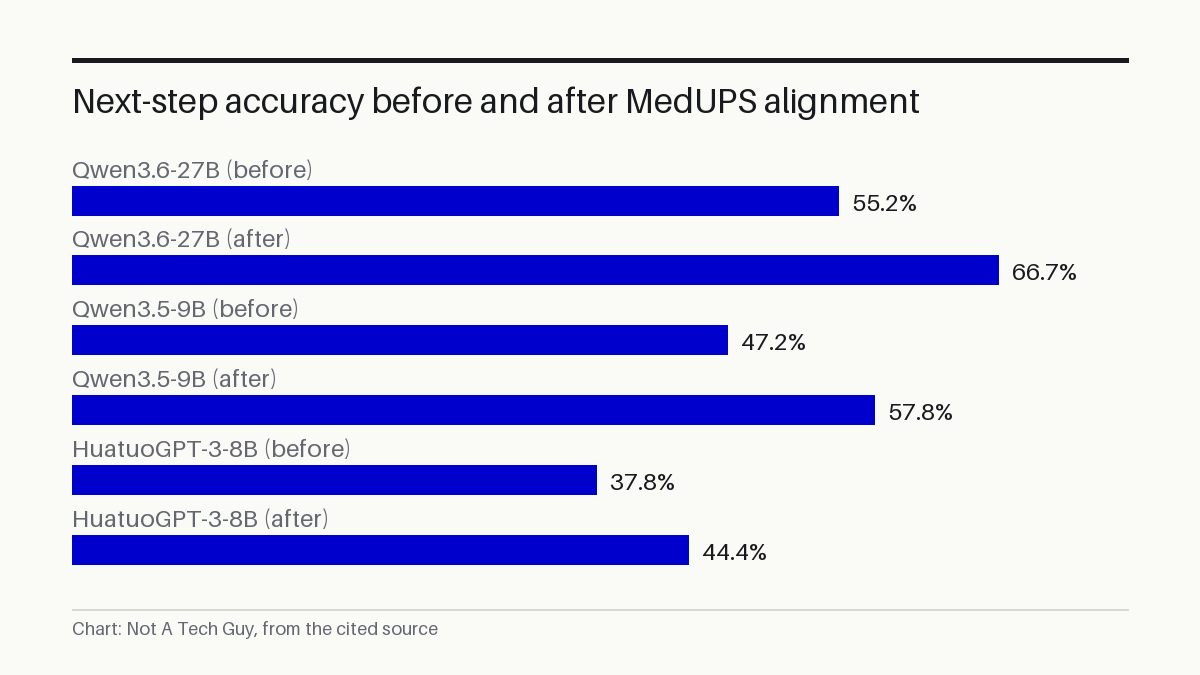
The accuracy numbers tell a clear story across three model scales. Qwen3.6-27B, part of Alibaba's Qwen3 series P³, jumped from 55.2% to 66.7%, a gain of 11.5 points. Qwen3.5-9B rose from 47.2% to 57.8%, a gain of 10.6 points. HuatuoGPT-3-8B, a Chinese medical-focused model, went from 37.8% to 44.4%, a gain of 6.6 points. All figures come with 95% confidence intervals S¹.
The authors observe that across the model sizes they examined, aligning on the mid-stream objective boosted accuracy more than simply adding parameters, with smaller aligned models outperforming larger unaligned ones they tested S¹. That finding, if it holds under peer review, matters because inference cost scales with parameter count. A 9-billion-parameter model costs roughly a third as much to run as a 27-billion one. If alignment on the right task beats raw scale, hospitals get better decision support for less compute.
What to do about it
A regional pathology lab running an AI assistant to flag unusual cases for senior review currently gets a final-diagnosis guess and little else. With a mid-stream approach, the same system could suggest the next stain to order, the molecular test to request, or the tumour board to escalate to. The shift is from "here's my best guess at the answer" to "here's what to do next," which is the question clinicians actually ask.
The dataset, code, and aligned checkpoints are all public S¹. A clinical AI team can download MedUPSQA today and benchmark their own models on next-step accuracy rather than final-diagnosis accuracy. The practical step this week: pull the dataset from the released repository and run a baseline evaluation on your existing model. If it scores 40% on next-step accuracy, you now have a concrete number to improve against, rather than a vague sense that it "sometimes helps."
What we don't know yet
This is an arXiv preprint that has not been peer-reviewed S¹. The accuracy gains are measured on case reports, which are retrospective, curated, and far cleaner than real-time clinical data. The LLM-as-a-Judge reward signal depends on the judge model's own biases, and the paper does not yet show that better next-step accuracy translates to better patient outcomes. The dataset is built from case reports, not electronic health records or prospective clinical trials.
The next signal: whether a peer-reviewed version appears or a clinical group reports a prospective trial using MedUPSQA. We'll check the 66.7% next-step accuracy claim against whichever lands first.
We'll be tracking whether mid-stream alignment becomes the new default for medical AI. Subscribe and you'll read it here first.
Sources: S1 — MedUPS: Towards Diagnostic Assistance in Uncommon Medical Cases with L · P2 — MedUPS: Towards Diagnostic Assistance in Uncommon Medical Cases with L · P3 — QwenLM/Qwen3 · P4 — nadavlab/CUPCase · P5 — YGswu/Dr.-Assistant
More from Not A Tech Guy
- RAG study tests LLaMA, Mistral and Qwen to cut AI hallucinations
- Chained RLM architecture restarts LLM reasoning with fresh context
- GPT-5.6 Sol improved, free ChatGPT access expanded
Generated from an audited evidence pack with primary-source research. Social-media items are discussion signals, not verified facts. Nothing here is financial, legal or medical advice.