

Microsoft has grown its open-source VibeVoice voice AI to 56,285 GitHub stars, but the project's text-to-speech code is gone from the repo S¹. The maintainers pulled it in September 2025 after finding it was "used in ways inconsistent with its stated intent" S¹.
The repository landed on GitHub's daily trending list this week, driven by a streaming speech recognition release on 3 September 2026 S¹.
My read: The star count tells you developers are watching, but the TTS removal is the detail that matters. Microsoft open-sourced a model capable of generating 90 minutes of multi-speaker speech, then pulled it when people used it in ways the team did not intend. That is the tension in open-weight voice AI: the capability is powerful and the misuse risk is obvious. A licence alone cannot draw the line between them. The number I would watch is the fork count, 6,226 P², because every fork of the original TTS code still exists somewhere on GitHub.
What remains in the repository
The repo, created on 25 August 2025 under an MIT licence, according to its GitHub page P², now centres on VibeVoice-ASR, a speech-to-text system the maintainers describe as handling 60-minute audio in a single pass and producing structured output with speaker labels, timestamps, and content S¹. The maintainers say it supports over 50 languages S¹. Yan Xia, writing on Microsoft's Azure AI Foundry blog P⁴, introduced VibeVoice ASR as a tool for long-form, structured speech recognition at scale, addressing the gap where most systems struggle with real-world audio like long meetings and multi-speaker conversations.
VibeVoice-ASR-Streaming, the most recent release, arrived on 3 September 2026. The maintainers describe it as a unified streaming model that transcribes "who said what" as speech arrives, with custom hotword support and 10 languages S¹. That release pushed the repo back onto GitHub's trending list S¹, the same list where Cline's open-source coding agent hit 70,000 stars in October.
On 23 July 2026, the team released VibeVoice-ASR-BitNet, an edge CPU inference engine that uses heterogeneous quantisation, a technique that stores different parts of the model at different precision levels, to compress the model from 4.62 GB to 1.58 GB while maintaining real-time inference, according to the maintainers S¹.
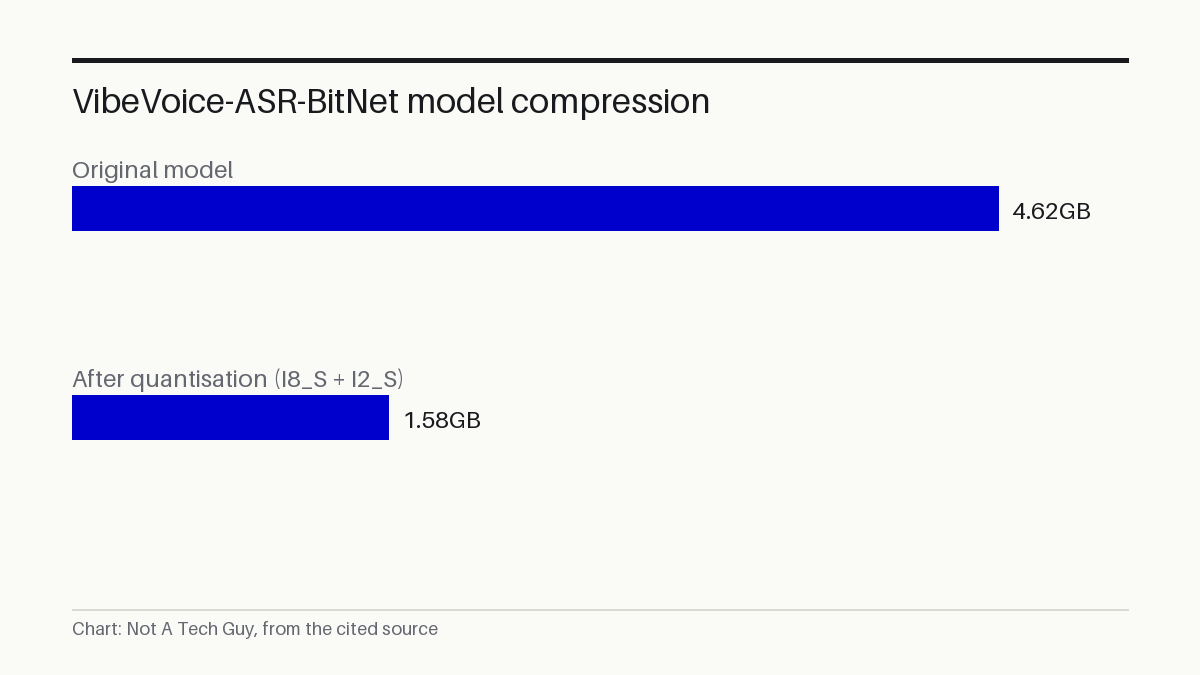
For a developer running transcription on a laptop rather than a GPU server, that compression is the difference between a tool that ships and one that stays on the bench. VibeVoice-ASR was integrated into Azure AI Foundry Labs on 12 March 2026 S¹ and became part of a Hugging Face Transformers release on 6 March 2026, meaning developers can load it through the standard Transformers library S¹. The maintainers also say finetuning code and vLLM inference are available S¹.
The core technical claim across the project is a pair of continuous speech tokenizers, acoustic and semantic, running at an ultra-low frame rate of 7.5 Hz, combined with a next-token diffusion framework S¹. That frame rate, roughly 7.5 tokens per second of audio, is what the maintainers say lets the system handle long-form audio without the memory blow-up that hits higher-frame-rate tokenizers. None of these capability claims have been independently benchmarked. The README is the maintainers' own description, not an independent review S¹.
The text-to-speech gap
The repo's history tells a more complicated story than the star count suggests. On 25 August 2025, the same day the repo was created, the team open-sourced VibeVoice-TTS. The model could synthesise speech up to 90 minutes long with up to four distinct speakers S¹. The maintainers claim it was accepted as an Oral at ICLR 2026 S¹, though no independent confirmation appears in the available evidence.
Eleven days later, on 5 September 2025, the team removed the TTS code, citing responsible AI as one of Microsoft's guiding principles S¹.
The repo still contains VibeVoice-Realtime-0.5B, a real-time text-to-speech model open-sourced on 3 December 2025, which the maintainers say supports streaming text input and long-form speech generation S¹. Experimental speakers added on 16 December 2025 cover nine languages and 11 English voice styles S¹. This model remains available, according to the release notes S¹.
What a developer should check first
A team evaluating VibeVoice-ASR for transcription workloads, say a medical practice processing 30-minute consultation recordings, should start with the Hugging Face Transformers integration S¹ and test one real audio file against their current pipeline. The number that matters is not the star count but the word error rate on domain-specific audio with accents and background noise, which the maintainers have not published in the evidence provided.
The BitNet compression release S¹ is worth testing on a target CPU, because the jump from 4.62 GB to 1.58 GB is only useful if accuracy holds, and the real-time inference claim has not been independently measured. The broader open-source AI tooling space has been moving quickly, as the Otari LLM gateway routing 40+ providers showed in October, but VibeVoice's single-source claims mean a hands-on test matters more than a README.
The repo's issue tracker shows 204 open issues P², a measure of how actively the maintainers are responding to problems developers actually hit.
Sources: S1 — microsoft/VibeVoice: Open-Source Frontier Voice AI · P2 — microsoft/VibeVoice · P3 — microsoft/VibeVoice · P4 — Introducing VibeVoice ASR: Longform, Structured Speech Recognition At · P5 — Trending repositories on GitHub today · GitHub
Related reading
- doop open-source canvas lets AI agents design live with humans — our technology desk, 2026-11-04
- Cline open-source coding agent hits 70,000 GitHub stars — our technology desk, 2026-10-19
- Open-source LLM gateway Otari routes 40+ providers — our technology desk, 2026-10-20
Written from 5 sourced items, 4 of them primary.