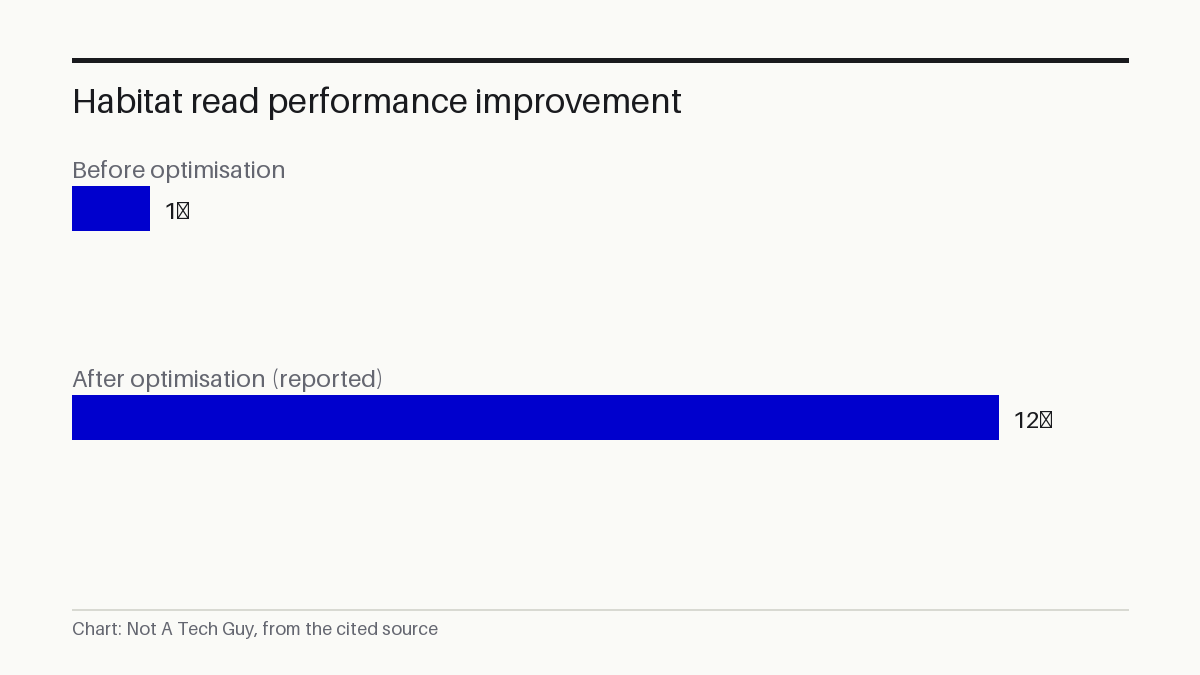

OpenAI published a storage engineering update on October 23, reporting that its internal platform Habitat now delivers 12× faster reads for ChatGPT S¹.
The 12× figure is entirely self-reported. No third party has audited the claim, and OpenAI has not published the benchmark conditions, the prior baseline, or the workload mix that produced it S¹.
My read: This is the kind of infrastructure post that sounds dry but reveals the real bottleneck in serving a billion-user AI product. The model gets the headlines; the storage layer keeps the lights on. I'm skeptical of the 12× number because we don't know what it's measured against. A 2× improvement over a slow baseline would still produce an impressive ratio. What I find more telling is that OpenAI is publishing a second deep dive on the same platform six weeks after the first, which tells me the scaling problem is far from solved.
Part I, published September 11, covered how OpenAI adapted Habitat in Python to handle the initial growth wave, a piece we examined when OpenAI Habitat hit 22M requests per second for 1 billion users. That post, written by Jon Lee, Chaomin Yu, and Ben Ries, framed the challenge as making every OpenAI product's data access fast and reliable P⁴. Part II, by Lee, Hrachya Hakobyan, and Chaomin Yu, shifts focus to the database layer P².
What Habitat actually does
Habitat is OpenAI's application storage platform, the system between ChatGPT's frontend and the databases underneath. When a user opens a conversation, scrolls through history, or pulls up a saved prompt, Habitat fetches that data. At the scale OpenAI describes, over a billion users, a fraction of a second added to each read multiplies across billions of daily interactions into large aggregate time costs.
The October post describes three changes. OpenAI integrated Azure Cosmos DB, Microsoft's globally distributed NoSQL database, as a storage backend S¹. The team built a global caching layer so frequently accessed data stays close to users regardless of geography S¹. And they added reliable multi-tenancy, isolating workloads so one user's traffic cannot degrade another's S¹.
The evidence does not clarify whether Cosmos DB is the sole database or part of a hybrid architecture. OpenAI's own language refers to 'optimizing' Cosmos DB within Habitat, which leaves room for other storage systems to remain in play P².
Why the storage layer matters more than the model
The price of actually running the model dominates most discussions about AI economics. Storage is the hidden tax. Every conversation, every uploaded file, and every custom instruction has to be retrieved before the model can begin generating a response. If retrieval is slow, the model waits. If retrieval fails, the user sees an error.
This is the same tension that surfaced when OpenAI previewed Sponsored Agents in its ChatGPT ads push, where ad delivery and agent responses share the same infrastructure budget. Faster reads change what becomes possible to build on top of ChatGPT, from real-time agent workflows to larger context windows that pull in more stored data per turn. The storage layer also underpins research applications like ChatGPT searching extinct genomes for new antibiotics, where large reference datasets must be served alongside conversation history.
For engineering teams building on Azure OpenAI services, the practical takeaway is that Cosmos DB is now proven at a scale few systems have matched. A team running a multi-region application with millions of users could evaluate Cosmos DB's global distribution and multi-tenancy features against their current setup, using OpenAI's architecture as a reference point rather than a benchmark. The Azure Cosmos DB team maintains a public Python developer guide with integration examples on GitHub P⁵.
The 'over 1 billion users' phrasing describes infrastructure capacity, not an audited active-user count. OpenAI has not disclosed current monthly active users, and the number may reflect the system's design ceiling rather than today's traffic.
If the pattern of this series holds, a Part III would likely address the caching layer in detail. OpenAI has not announced one.
Sources: S1 — Rapidly scaling online storage to serve over 1 billion ChatGPT users ( · P2 — Rapidly scaling online storage to serve over 1 billion ChatGPT users ( · P3 — OpenLMLab/MOSS-RLHF · P4 — Rapidly scaling online storage to serve over 1 billion ChatGPT users | · P5 — AzureCosmosDB/Azure-OpenAI-Python-Developer-Guide
Related reading
- OpenAI Habitat storage: 22M requests/sec for 1 billion users — our technology desk, 2026-09-11
- ChatGPT searches extinct genomes for new antibiotics — our technology desk, 2026-09-10
- OpenAI previews Sponsored Agents in ChatGPT ads push — our technology desk, 2026-09-16
Written from 5 sourced items, 5 of them primary.