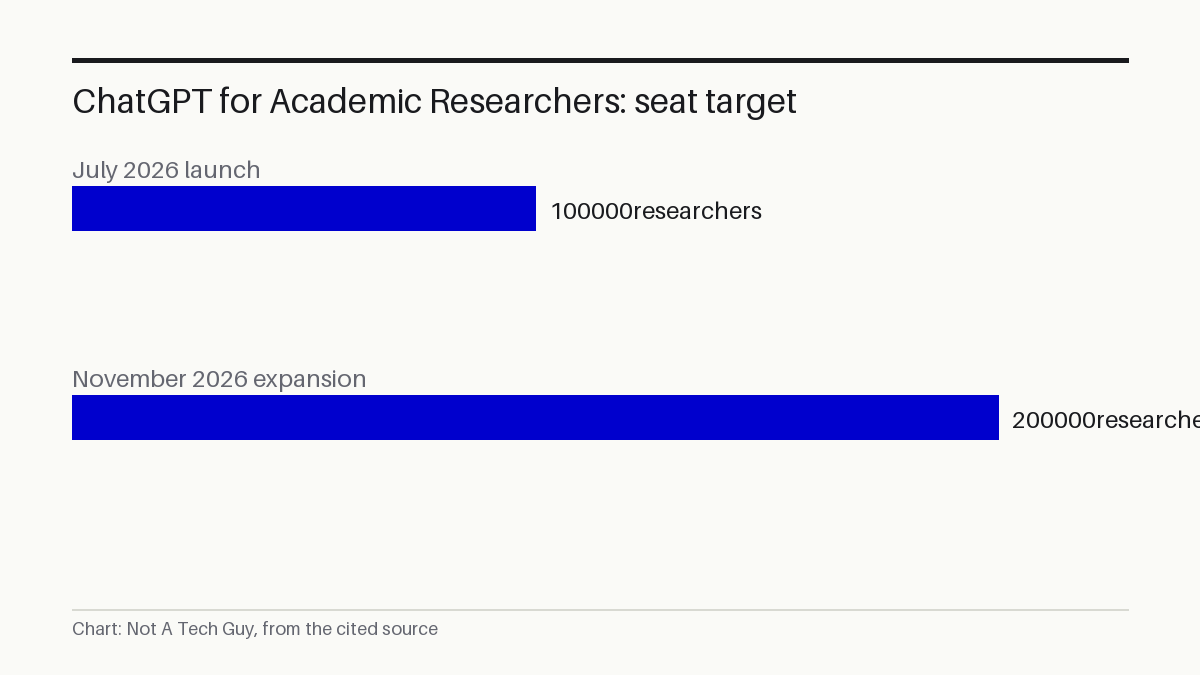
OpenAI will give 200,000 academic researchers worldwide free access to its frontier AI models, doubling the 100,000 seats from its July 2026 launch S¹P⁵. The commitment has no third-party verification, and OpenAI has not named which specific models, rate limits, or tool access the expanded program includes S¹.
My read: The doubling from 100,000 to 200,000 is a corporate pledge, not an achieved milestone. OpenAI's own announcement is the only source, and "frontier models" is vague enough to mean almost anything. The number I would watch is how many of those 200,000 seats are actually filled six months from now, and whether the access matches what paying customers get or sits behind a throttled tier. The companion report on 1,800 scientists' usage patterns P³ is the more interesting signal: it tells us OpenAI is collecting data on how researchers actually use these tools, which matters more for the company's product roadmap than for science itself.
OpenAI also released a report the same day, "Science at the Frontier," drawing on survey data from more than 1,800 scientists who used ChatGPT in their research P³. The report explores what researchers expect AI to mean for scientific discovery. OpenAI has not published the underlying survey methodology or raw data.
From 100,000 to 200,000
The original ChatGPT for Academic Researchers program opened in July 2026, targeting 100,000 scientists, mathematicians, and engineers with free access to OpenAI's models and tools P⁵. The November 16 expansion doubles that target and opens new applications, though the company has not said when the additional seats will be filled or what the selection criteria are beyond "academic researchers" S¹.
The program sits in a competitive market where AI companies are racing to lock in academic mindshare. OpenAI released two open-weight models, gpt-oss-120b and gpt-oss-20b, under an Apache 2.0 licence earlier in 2025; the repository has accumulated over 20,500 stars on GitHub P⁶. Those open weights give researchers a path to run models locally. The academic program offers something different: access to OpenAI's most capable systems without the compute costs that put them out of reach for many labs.
What researchers get, and what they don't
The announcement does not specify which models qualify as "frontier," whether access includes API credits, or whether there are usage caps. No independent outlet has verified the 200,000 figure or the program terms S².
For a computational biology lab running protein-structure predictions, the difference between uncapped access to a frontier reasoning model and a rate-limited chat interface is the difference between a research tool and a demo. A materials science group that needs to process thousands of literature abstracts in batch would hit any per-message cap within hours.
The practical value depends entirely on details OpenAI has not published.
New applications opened on November 16, 2026 P⁵.
Sources: S1 — Broadening access to AI for scientists · S2 — Broadening access to AI for scientists - OpenAI · P3 — Science at the Frontier: How scientists use ChatGPT | OpenAI · P4 — GitHub - rrrrrredy/ai-talent-graph: Academic AI scholar profiling — Op · P5 — Accelerating scientific discovery with ChatGPT for Academic Researcher · P6 — openai/gpt-oss
Written from 6 sourced items, 5 of them primary.