NVIDIA introduced Nemotron for Science on November 16, packaging its Nemotron 3.5 Super VL model with a 50,000-question chemistry dataset and post-training recipes for scientific agents S¹. Every claim in the announcement traces to a single NVIDIA press release, with no independent verification of partner results.
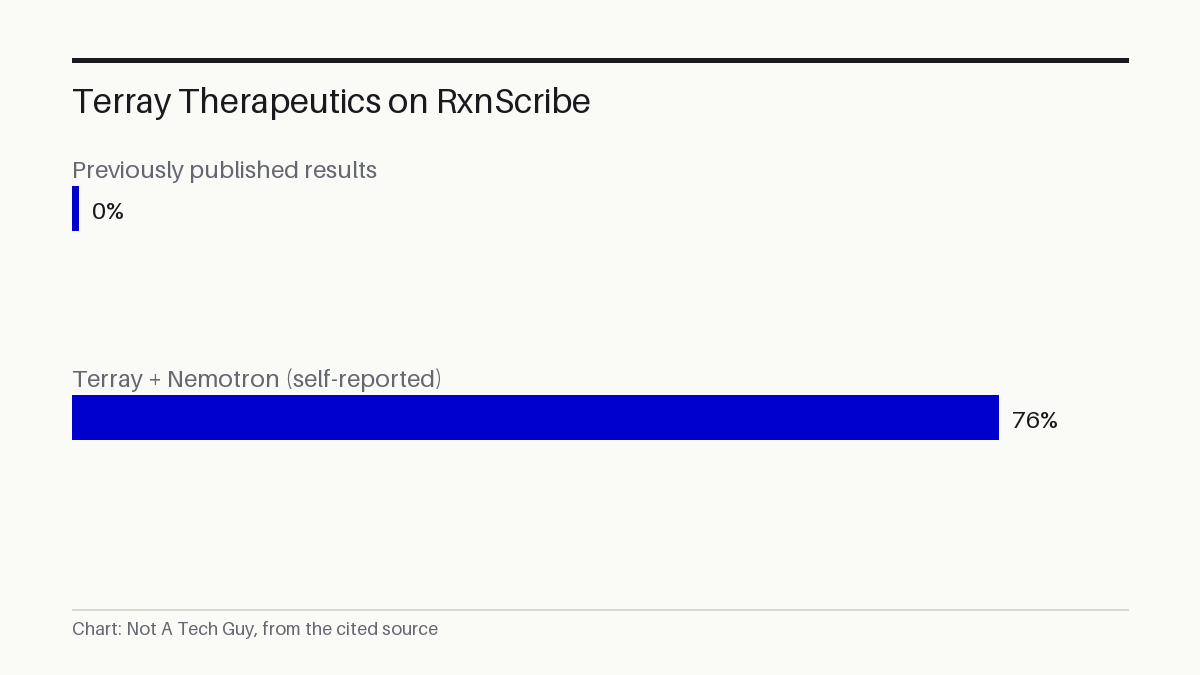
My read: The number worth watching is Terray Therapeutics' 76% reaction recovery on the RxnScribe benchmark. It's a concrete result on a named test, but it's self-reported through NVIDIA's press release, not published in a peer-reviewed paper or reproduced outside the company. The word "open" is also doing heavy lifting, as no specific licence terms are provided for either the model or the dataset. What's genuinely new is LitmusBench v0.2 and the post-training recipes, not the base model, which we already examined when NVIDIA shipped the 120B Nemotron 3.5 Super VL last month.
What's actually in the box
Nemotron for Science is not a new foundation model. It's a package built on the existing Nemotron 3.5 Super VL, which NVIDIA released in October. The new components are LitmusBench v0.2, an open dataset of nearly 50,000 questions for training and evaluating language models on chemistry reasoning, and a set of post-training recipes that let researchers adapt the model to specialised tasks like chemistry experiments and protein design S¹.
LitmusBench draws on molecular properties and experimental drug discovery data to help models predict how molecules behave, including solubility and how the human body processes them S¹. The dataset is described as open, but NVIDIA has not specified the licence terms, so researchers would need to verify usage rights before integrating it into commercial workflows.
The one benchmark that matters
Terray Therapeutics post-trained Nemotron to extract reactants, products, and reaction conditions from scientific diagrams. The resulting model surpassed previously published results on two benchmarks, according to NVIDIA's press release S¹. On the RxnScribe test, it recovered about 76% of annotated reactions under the benchmark's matching criteria S¹.
That 76% figure is the most specific performance claim in the announcement, but it comes with caveats. Nobody outside Terray and NVIDIA has reproduced it. The benchmark covers a narrow task, extracting chemical reactions from diagrams, and the result is measured under specific matching criteria rather than as a broad chemistry capability.
Lila Sciences, another named partner, used Nemotron to design execution-ready laboratory protocols for its automated labs S¹. Therna is also listed as a customiser, though no specific use case or result is attributed to it S¹.
Who would use this first
The target users are computational chemists and drug discovery teams who already work with language models but need them to reason about molecular structures and laboratory procedures. Argonne National Laboratory and Jülich Supercomputing Centre are integrating Nemotron into their drug and scientific discovery AI agents, according to NVIDIA S¹, though the depth of that integration is unspecified.
The package runs on NVIDIA DGX Spark desktop systems through to data center infrastructure, and agent workflows can call NVIDIA CUDA-X accelerated tools for scientific computation S¹. NVIDIA also expanded its CUDA-X libraries on the same day, adding cuPhoton, cuPotential, and cuSpa for research spanning astrophysics, materials science, and drug discovery P⁵. This follows the BioNeMo Agent Toolkit NVIDIA announced in June, which drew partners including Lilly, Schrödinger, and OpenAI P⁴, and the broader open-models push we tracked when NVIDIA joined an EU science initiative with 250 open models in October.
Ian Buck, NVIDIA's vice president of hyperscale and high-performance computing, said the package gives researchers open models, scientific data, and post-training recipes to build specialised agents that reason through scientific problems S¹.
A research team evaluating Nemotron for Science should first check the LitmusBench licence terms on NVIDIA's release page, then run the RxnScribe benchmark against their own data to see whether the 76% recovery rate holds outside Terray's setup. The same day also brought expanded CUDA-X libraries, which we noted when NVIDIA's Agent Toolkit grounded AI agents in enterprise data earlier this month.
Sources: S1 — NVIDIA Introduces Nemotron for Science to Accelerate Discoveries With · P2 — NVIDIA Corporation - NVIDIA Introduces Nemotron for Science to Acceler · P3 — Nemotron Models, Datasets and Techniques Fuel AI Development | NVIDIA · P4 — NVIDIA Corporation - NVIDIA Announces BioNeMo Agent Toolkit — Tools fo · P5 — NVIDIA CUDA-X Libraries Give Agents the Tools to Accelerate Scientific
Related reading
- NVIDIA ships 120B Nemotron 3.5 Super VL, 5x faster than rivals — our technology desk, 2026-10-15
- NVIDIA joins EU science initiative with 250 open models — our technology desk, 2026-10-18
- NVIDIA Agent Toolkit grounds AI agents in enterprise data — our technology desk, 2026-10-23
Written from 5 sourced items, 5 of them primary.