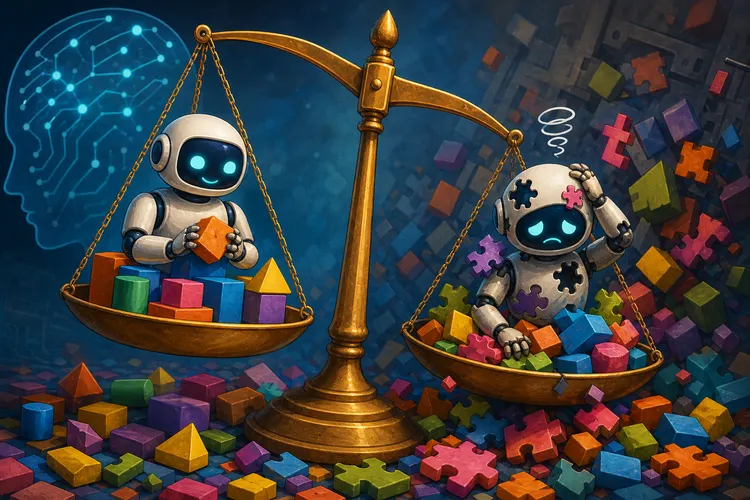

AI uncertainty measures unified in new risk decomposition paper
A July 2026 arXiv preprint reframes how AI systems measure their own uncertainty, deriving competing measures from one mathematical framework. Here is what

The top 0.01% of AI knowledge, and what it changes for your work
A July 2026 arXiv preprint reframes how AI systems measure their own uncertainty, deriving competing measures from one mathematical framework. Here is what
Free briefing · the top 0.01% of AI knowledge
A practical briefing for business owners and professionals: what changed, where it could help, and what to check before you use it. Read a sample issue.
Google is letting U.S. users link services like Instacart, Canva and YouTube Music directly in Search's AI Mode, turning answers into actions. Here's what
A black-box audit swaps predicates in chain-of-thought to expose when GPT-4o reaches correct answers through reasoning that ignores its stated premises.
New arXiv paper finds automatically evolving agent scaffolding doesn't consistently outperform test-time scaling, with limited generalization to new tasks.
IRT rankings of AI models are unreliable when few systems are tested, 18,000 simulations show, threatening how the industry compares models.
A new preprint tested 327 real-world agent skills and found vulnerabilities across the entire skill lifecycle, from admission to evolution.
arXiv paper explains why vulnerability scanners give different results for the same software, tracing inconsistency to a distributed ecosystem.
A new arXiv preprint shows LLMs can read threat reports, generate attack playbooks, and self-correct failures, reaching 84% with Claude Sonnet 4.5.
An arXiv preprint shows an RL agent using a Lyapunov exponent reward found the Kapitza pendulum and a new upright state, with implications for robotics.