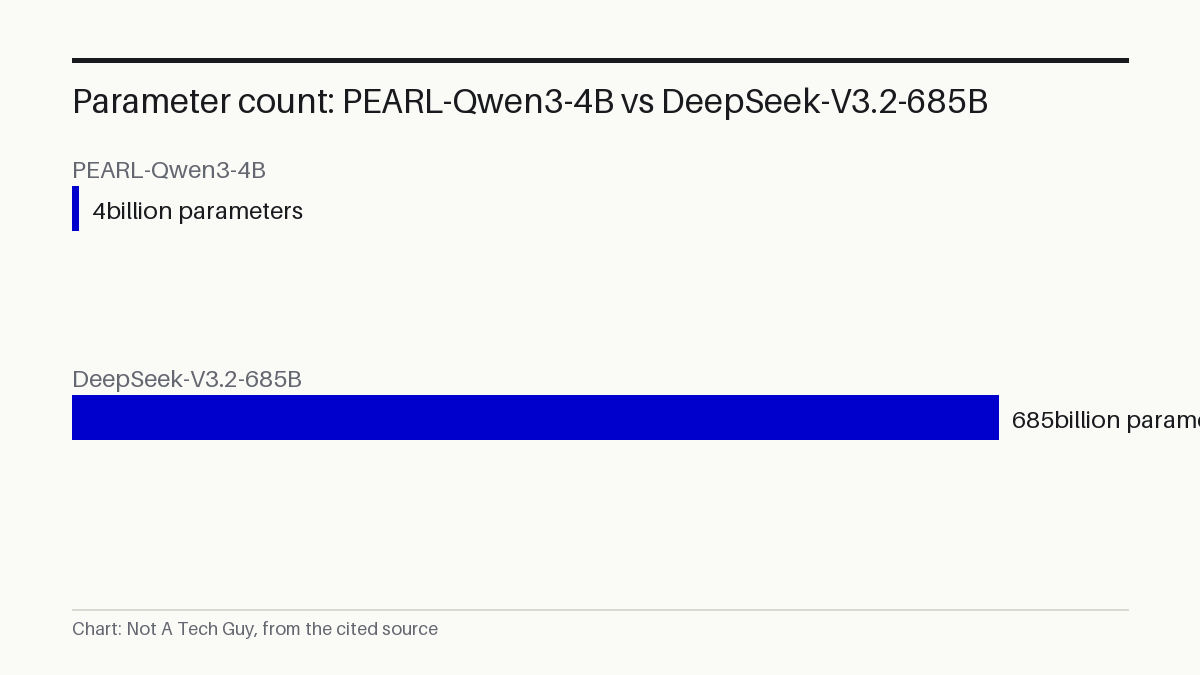

A 4-billion-parameter model called PEARL-Qwen3-4B has beaten DeepSeek-V3.2-685B, a model 170 times its size, at turning clear decision problems into working mathematical code S¹. The gap that should be impossible to close was closed not by adding parameters but by adding a loop. What PEARL does differently, and why it works when every one-shot approach fails, is the part worth paying for.
My read: This is the first optimization-modeling paper I've seen that treats the solver as a teacher rather than a judge. Most LLM approaches to optimization are like a student who writes an exam answer and never checks it. PEARL writes the answer, runs it, reads the error message, and tries again. I'm skeptical of the "substantially improves" framing because it's the authors' own characterisation and this is an unreviewed preprint S¹. But the 4B-versus-685B result, if it holds up, tells you the bottleneck in optimization modeling was never model size. It was feedback.
Why one-shot optimization modeling breaks
Optimization modeling means taking a decision problem described in everyday language and converting it into the formal equations and program code that a mathematical solver can execute S¹. Think of a logistics manager who says "minimise delivery costs across 50 warehouses without exceeding truck capacity" and needs that sentence turned into a linear program.
Most existing LLM approaches to this task are one-shot S¹. The model produces a mathematical formulation once. It never runs the code. It never checks whether the solver flags the problem as infeasible. It never revises errors. It is like writing software and refusing to compile it.
PEARL, posted to arXiv on 22 July S¹, takes a different approach: it puts the solver inside the modeling loop.
The solver inside the loop
PEARL integrates Python execution and mathematical programming solvers directly into the modeling process S¹. The model drafts a formulation, passes it to a solver, receives execution outcomes and feasibility indicators, and then uses that feedback to refine both the mathematical model and the solver code before producing a final version S¹.
The system acquires three capabilities: knowing when to evaluate partial formulations, how to adjust based on solver diagnostics, and when to halt S¹. That last one matters more than it sounds. A model that never stops revising is as useless as one that never starts.
This places PEARL in a growing cluster of solver-in-the-loop research. ORLoopBench, a 2026 benchmark from Ruicheng Ao, David Simchi-Levi and Xinshang Wang, tests self-correction and behavioral rationality in operations research with similar principles P⁴. ReLoop, a GitHub project created in November 2025, offers a RetailOpt-190 benchmark for structured modeling and behavioral verification P³. Solver-Informed RL, from researchers at Cardinal Operations and partner institutions, grounds LLMs for optimization modeling with reinforcement learning and solver feedback P². The field is converging on the same idea: let the solver teach the model.
The 4B model that punched up
The headline result: the authors' PEARL-Qwen3-4B model outperforms DeepSeek-V3.2-685B in both macro- and micro-averaged accuracy on optimization modeling tasks S¹. That is a 4-billion-parameter model beating a 685-billion-parameter model, a 170× size gap, on a specific class of work.
Two caveats matter. First, this is an unreviewed arXiv preprint; all performance claims are author-reported S¹. Second, the comparison is strictly limited to optimization modeling tasks. The paper does not claim PEARL-Qwen3-4B matches DeepSeek on general reasoning, and the claim that it outperforms DeepSeek across all tasks is not supported S¹.
What to do about it
If you run a supply chain analytics team, this is your signal to stop treating LLMs as one-shot translators. Consider a freight forwarding company where a planner types "schedule 12 trucks across 30 routes, minimise fuel, respect driver hours-of-service rules." A one-shot model might produce a formulation that looks right but fails silently because a constraint is missing or a variable is misbounded. A solver-in-the-loop system catches that. It runs the code, reads the solver's infeasibility report, then fixes the gap before it reaches the planner.
The practical step this week: if your team uses an LLM to draft optimization models, run the output through an open-source solver like CBC or HiGHS before trusting it. If the solver returns infeasible or unbounded, feed that error back to the model and ask for a revision. You do not need PEARL to get most of the benefit. You need the loop.
What we don't know yet
The paper has not been peer-reviewed, and the authors' claim of "substantially" improved solve rates is their own framing S¹. We do not have independent benchmark numbers. We do not know how PEARL performs on problems outside its tested benchmarks, or whether the solver-in-the-loop approach scales to very large industrial problems with thousands of variables. The 4B-versus-685B comparison covers optimization modeling tasks only, and the paper does not report general reasoning benchmarks.
The next signal: whether PEARL's code appears on GitHub and gets independent reproduction attempts by September. If it does, we will check the 4B-versus-685B claim against it.
Sources: S1 — PEARL: Solver-in-the-Loop Interactive Optimization Modeling from Natur · P2 — Solver-Informed RL: Grounding Large Language Models for Authentic Opti · P3 — junbolian/ReLoop · P4 — ORLoopBench: Solver-in-the-Loop Benchmarks for Self-Correction and Beh · P5 — kitft/natural_language_autoencoders
More from Not A Tech Guy
- DBMol designs drug molecules using AI structure prediction
- AI safety paper: the quiet failures nobody measures
- Text-prompted visual similarity metric exposes AI blind spot
Generated from an audited evidence pack with primary-source research. Social-media items are discussion signals, not verified facts. Nothing here is financial, legal or medical advice.