
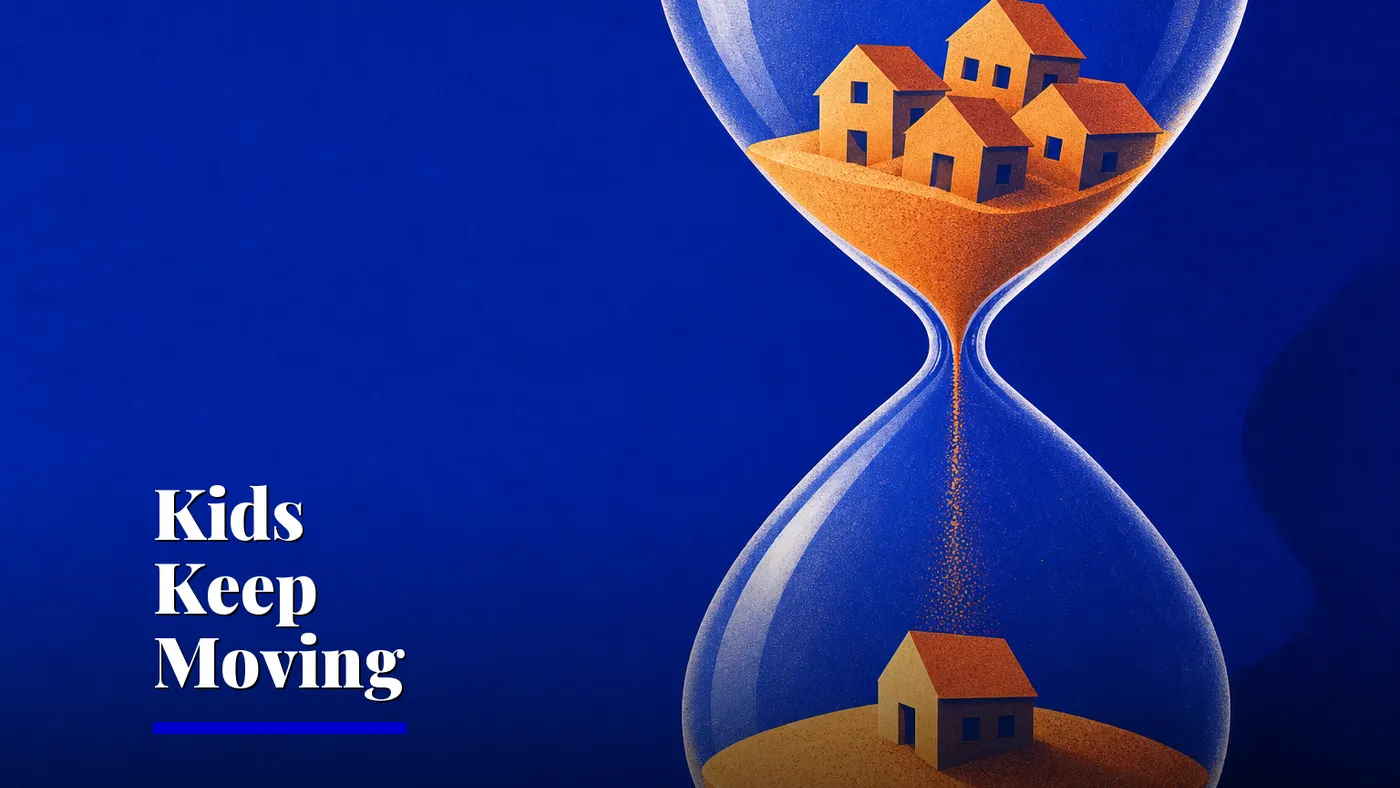
Australian children growing up in rental properties change homes every 2.3 years on average, according to new research from the Australian Housing and Urban Research Institute S¹. More than 30% of Australian households rent S¹, which means the housing crisis is reshaping childhoods for well over a million kids. The ABS released its own deep dive into child mobility on July 28, 2026 P², and what both datasets expose is a generation of children whose sense of safety, friendship networks and school continuity are being disrupted at a pace developmental researchers find alarming. The question is whether anyone is listening.
My read: This is the first time I've seen the rental crisis framed through child mobility data rather than adult affordability metrics, and it changes the conversation. The 2.3-year figure is specific to rental households, not all families, so it should not be generalised. But for the one in three Australian households who rent, this is the lived rhythm. I'm skeptical of how much the Defence Force parent survey (41 families) can tell us about the broader renting population, because military families move on orders, not by choice. The overlap is the frequency, not the cause. What I'd watch is whether the ABS child mobility data P² gets picked up in housing policy debates, or gets filed and forgotten.
The rental crisis is a childhood crisis
Cost-of-living pressures and the worsening rental shortage are pushing families to move more often S¹. The AHURI research, published in August 2026, puts a number on what that looks like for children: every 2.3 years, on average, a child in a rental home packs up and starts again S¹. The ABS built a dedicated child mobility indicator using its Life Course Dataset, released the same month P²P⁴, tracking residential moves for children across Australia from 2006 to 2021. The two datasets together paint a picture of housing instability as a routine feature of Australian childhood, not an exception.
For children in early childhood and primary school years, the disruption hits hardest S¹. Research shows relocation can affect children's wellbeing and development, and can unsettle their sense of safety and belonging S¹. Each move distances them from the people and places that anchor their daily life: friends, neighbours, sport coaches, babysitters, familiar schools and local services S¹. The more often a child moves, the greater the cumulative impact S¹.
What the stress actually looks like
A survey of 41 parents from Australian Defence Force families, published this year, examined what frequent relocation does to children S¹. One parent reported their child became emotionally out of control, had tantrums, and developed a stutter from the stress of moving S¹. Another said their eldest child regularly asks to return to their previous posting location and tells them he "just really misses" his old friends S¹.
The survey is small and specific to military families, who relocate on orders rather than by choice. But the developmental patterns it documents align with broader research findings. Some children show temporary regression during moves, including changes in concentration, sleep, eating, toileting, emotional states, difficulty with routines, trouble separating from parents, and friction playing with other children S¹. The key word is temporary. The evidence does not show permanent developmental damage. It shows a period of adjustment that can be made harder or easier depending on how adults handle it.
What to do about it
For property managers, agents and landlords, this data reframes what a "routine" lease ending means. A family receiving a notice to vacate loses a roof, and the children lose a school zone, a friendship circle, a bedroom they know in the dark. Agents who work with renting families could build referral information into their vacate process: school enrolment timelines for the new area, local council childcare waitlists, community sport registration dates.
For parents facing a move, the research points to several practical steps. Choose the timing of when to tell children carefully, and hold adult conversations about the move privately if you are not ready to share the news yet S¹. When you do tell them, having trusted family members or friends present can give children extra support S¹. Talk through what will stay the same and what will change, so children know what to expect S¹. Give them space to express negative emotions before pivoting to the positives S¹. Looking at photos and information about the new house and community online together can make the unfamiliar feel less abstract S¹.
A family relocating from Melbourne's eastern suburbs to Geelong, for instance, could sit down with their seven-year-old and show them the new school's website, the nearest park, and the local footy club registration page. That 15-minute conversation turns an abstract threat into a concrete picture.
One practical thing to check this week: if you are a renting parent, look up the school enrolment cut-off dates and childcare waitlist timelines for your current area and one alternative area. Knowing the timeline removes one variable from a move you may not choose but can prepare for.
What we don't know yet
The AHURI figure of 2.3 years applies to rental households specifically, not to owner-occupier families, and the Defence Force survey of 41 parents cannot be generalised to all Australian families S¹. The ABS child mobility data P² covers 2006 to 2021, so it does not yet capture the full intensity of the post-2022 rental crisis. We do not have a current national figure for how many children moved in the past 12 months, nor data on whether the 2.3-year average is shortening as evictions rise and rents climb.
The ABS Life Course Dataset methodology paper P⁴ was released alongside the child mobility article on July 28, 2026, but the full dataset has not yet been updated to reflect 2022 to 2026 moves. The practical advice in the research is drawn from qualitative insights and parent reports, not from clinical intervention trials, so we know what parents observe but not what has been formally tested.
The next signal: the ABS is scheduled to release its next round of housing mobility data, which should include more recent moves. We'll check whether the 2.3-year average has changed, and whether child-specific outcomes appear in the release notes.
If this story helped you think differently about what the housing crisis costs, subscribe for more reporting that connects the data to the people living inside it.
Sources: S1 — Moving houses can be especially stressful for kids. Here’s how to supp · P2 — Understanding child mobility in Australia, 2006-2021 | Australian Bure · P3 — Housing Mobility and Conditions, 2019-20 financial year | Australian B · P4 — Creating a child mobility indicator using the Life Course Dataset | Au · P5 — Lending indicators methodology, June Quarter 2025 | Australian Bureau
More from Not A Tech Guy
- ABS housing finance falls 5.4% as investors retreat
- ABS building approvals rebound 7.2% but units still fall
- RBA survey: most Australians get interest rates backwards
Generated from an audited evidence pack with primary-source research. Social-media items are discussion signals, not verified facts. Nothing here is financial, legal or medical advice.


