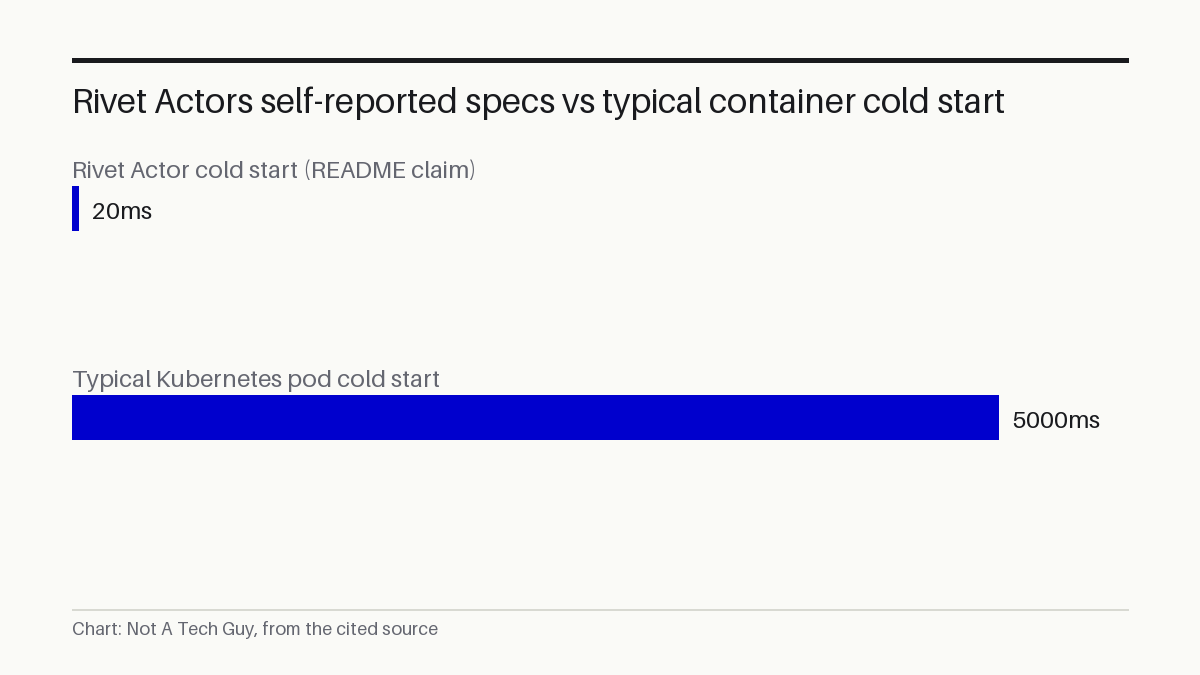
Rivet-dev's open-source actor framework hit GitHub's daily trending list with 6,186 stars and a 20-millisecond cold-start claim for AI agents S¹. That figure comes from the maintainers' own README comparison table, not from an independent benchmark, and the daily gain was a modest +7 stars S¹.
My read: This is the first stateful-actor project I have seen that frames itself specifically around AI agents rather than general distributed systems. The 20ms cold start and 0.6KB-per-instance memory claims are eye-catching, but they are self-reported with no error bars, no published test harness, and no third-party replication. I would want to see a production AI team adopt this and publish their own measurements before treating those numbers as real.
What Rivet Actors actually are
The project, written in Rust and released under Apache License 2.0, describes Rivet Actors as long-running, lightweight processes that keep state in memory with automatic persistence S¹P². The idea is straightforward: when an AI agent crashes or gets rescheduled, its state survives because the actor model persists it behind the scenes. The repo was created in June 2023 and has been under active development since, with the latest tagged release, v2.1.9, published in March 2026 P⁴.
The README positions Rivet Actors against Kubernetes pods and virtual machines, claiming a cold start of roughly 20ms and memory usage of about 0.6KB per instance S¹.
Nobody outside the project has verified those benchmarks.
Why state matters for agents right now
AI agents that do real work, like coding assistants that edit files across a session or research agents that accumulate findings over multiple steps, need to hold state between calls. When that state lives only in a process's memory and the process dies, the agent starts from scratch. This is the same problem we saw when LoopX added durable memory to Claude Code and Codex agents earlier in September, and it is part of why OpenAI says coding agents are reshaping its own research workflow. The agent ecosystem is converging on the idea that durability is not optional.
Rivet's pitch is that actors, not containers, are the right unit of isolation for this workload.
A Kubernetes pod cold-starts in seconds. The README claims a Rivet Actor starts in 20ms. If that holds, it changes the economics of running thousands of short-lived agent processes. If not, the architecture is promising but the numbers are unproven.
What you can actually check
The repo is at github.com/rivet-dev/rivet, with 231 forks and 258 open issues as of the deep-research snapshot P². The code is Rust, the licence is Apache 2.0, and the homepage is rivet.dev P². A team evaluating this for agent infrastructure should clone the repo, run the actor benchmark locally, and compare cold-start times against their existing container setup on the same hardware. The open-issues count, 258, signals active development but also unfinished edges.
The v2.1.9 tag shipped in March 2026 P⁴. The repo's 258 open issues and the absence of any published third-party benchmark are the two gaps a prospective user would need to close before betting agent infrastructure on it.
Sources: S1 — rivet-dev/rivet: Rivet Actors are the primitive for stateful workloads · P2 — rivet-dev/actors · P3 — rivet-dev/actors · P4 — 2.1.9 · P5 — Tenormusica2024/huggingface-daily-insights-api
Related reading
- LoopX adds durable memory to Claude Code and Codex agents — our technology desk, 2026-09-05
- OpenAI says coding agents reshape its own AI research — our technology desk, 2026-09-06
- OpenAI previews Sponsored Agents in ChatGPT ads push — our technology desk, 2026-09-16
Written from 5 sourced items, 4 of them primary.