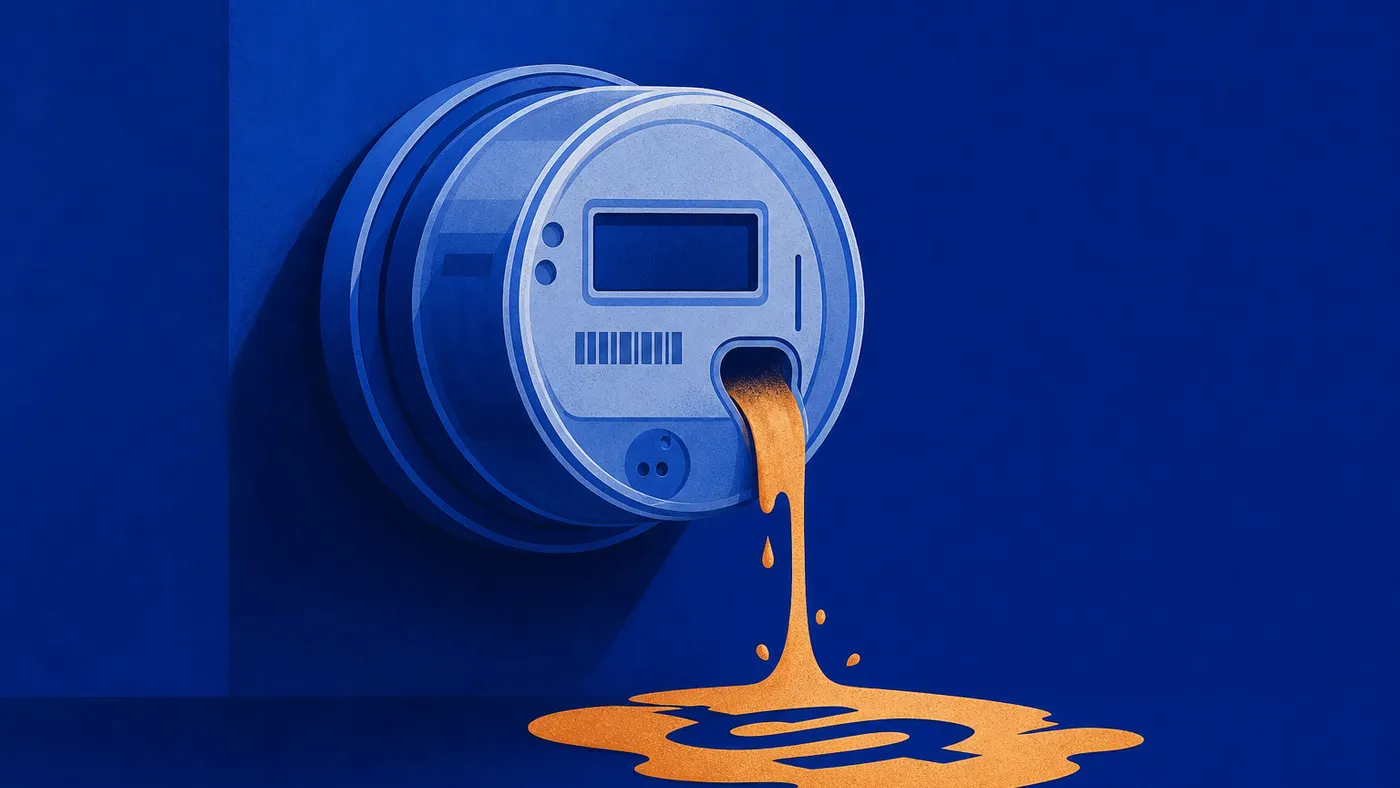
A simulated cyberattack on 10,000 smart meters could cost energy markets up to $5,097 a day during high-price events, according to a new arXiv preprint S¹. The attack doesn't cut power or tamper with a single meter reading. It simply delays the data, and that delay is enough to skew the forecasts that grid operators use to buy electricity.
My read: This is the first study I've seen that puts a dollar figure on the downstream cost of smart meter network delays, rather than just measuring latency or packet loss in isolation. I'm skeptical of the precision. The $1,009 to $5,097 range comes from a Mininet simulation using US pricing data from ISO-NE, not a live incident. But the mechanism is sound: if your load forecast is wrong because meter data arrived late, you buy power at the wrong price. The five-fold gap between normal and high-price days tells me the real risk isn't the attack itself but when it coincides with market stress.
How a half-second delay becomes a $5,000 bill
AMI systems supply grid operators with up-to-the-minute consumption figures to help them plan operations and estimate load S¹. When that data arrives late or not at all, the operator's picture of demand goes blurry. A blurry demand forecast means buying too much or too little power. In wholesale electricity markets, the gap between the right price and the wrong one can be enormous.
The study, published as a preprint on 10 August 2026, simulated two attack types: denial-of-service (DoS), which floods or blocks the communication channel, and time-delay attacks, which slow data delivery S¹. Both target the communication layer between smart meters and the utility's data collection points.
What the simulation measured
To emulate networks, the authors used Mininet, setting up a communication model based on the DNP3 power-system protocol S¹. They tested four scenarios: communication delay, packet loss, combined degradation rate, and concentrator failure S¹.
The results were stark. A 500-millisecond injected delay pushed the average round-trip time from 0.22 ms to 69.5 ms, more than 300 times the baseline S¹. A 50% packet loss scenario produced 87 timeout events and a 5.31% communication degradation rate S¹.
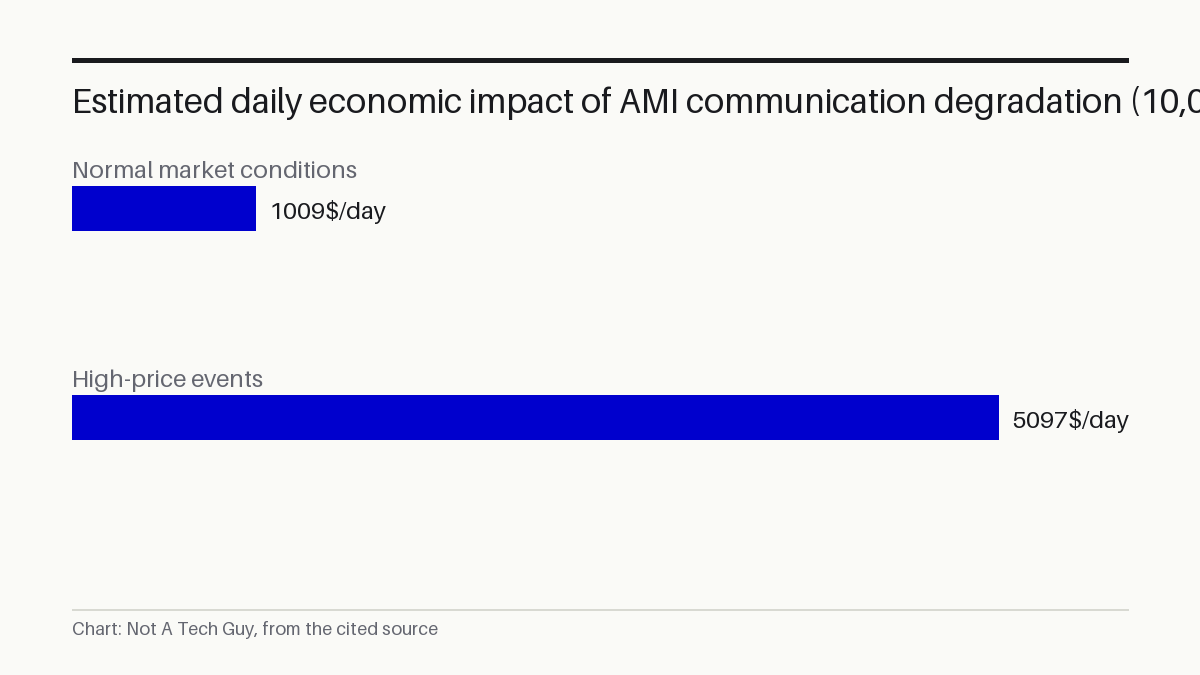
The simulation found that attacks led to longer delays, more network downtime, and less dependable data S¹. They linked this drop in communication quality to possible errors in energy demand forecasts, and calculated the monetary cost using price information from ISO-NE, a US grid operator S¹.
For a regional deployment of 10,000 smart meters, the estimated economic impact was $1,009 per day under normal market conditions, rising to $5,097 per day during high-price events S¹.
Why timing attacks are hard to catch
This isn't a new class of threat. A separate analysis of the German smart metering infrastructure examined delay attacks on CLS channel timing constraints, showing the problem extends across different national systems P³. Detection research exists too. One GitHub repository implements a learning-based method for detecting and characterising time-delay attacks in cyber-physical systems P⁴. But most prior work focuses on the technical impact: latency, packet loss, protocol violations. This study's contribution is translating those technical metrics into money.
The connection to broader infrastructure security is direct. A small communication failure can cascade into a much larger operational one when the downstream system trusts the data it receives without checking how fresh it is.
What to do about it
For a mid-sized electricity retailer running 40,000 smart meters across a regional network, the study's numbers scale linearly. A 5% communication degradation rate could mean roughly $4,000 a day in mispriced energy procurement during normal conditions, and north of $20,000 during a price spike. The attack doesn't need to be sophisticated or alter data. It just needs to slow it down.
The practical takeaway for utilities and grid operators: check whether your AMI data pipeline has timeout thresholds that would flag a 500 ms delay, and whether your load forecasting system has a fallback when meter data is stale rather than missing. If the forecast silently uses yesterday's data when today's is late, that's where the money leaks.
What we don't know yet
The study is a preprint and has not been peer-reviewed S¹. The financial estimates come from simulation, not observed real-world incidents. The pricing data is from ISO-NE, a US market, so the numbers would differ in Australia's National Electricity Market or any other jurisdiction with different price structures and volatility. An Australian economic impact assessment tool exists (AURIN's EIAT on GitHub) P², but this study didn't use it. The Mininet simulation may not capture the full complexity and defensive measures of a real AMI network. The attack parameters (500 ms delay, 50% packet loss) are synthetic inputs chosen for the experiment, not measured from an actual attack.
The next signal: whether peer review validates the simulation methodology and whether a follow-up study tests the economic model against live AMI data or a different market's pricing. We'll watch for a published version and any replication in an Australian or European market context.
If this story was useful, subscribe to get the next one in your inbox.
Sources: S1 — Economic Impact Assessment of Denial-of-Service and Time-Delay Attacks · P2 — GitHub - f-fof/eiat-app: AURIN Economic Impact Assessment Tool · P3 — Delay Attacks on the German Smart Metering Infrastructure: A Security · P4 — prakharg24/tda · P5 — California-Data-Collaborative/ami-connect
More from Not A Tech Guy
- Google puts AI agent Ask Advisor inside Ads and Analytics
- NVIDIA Magpie TTS expands to 12 languages with open weights
- KnowPlan AI agents plan degrees with 99.5% certified accuracy
Generated from an audited evidence pack with primary-source research. Social-media items are discussion signals, not verified facts. Nothing here is financial, legal or medical advice.