
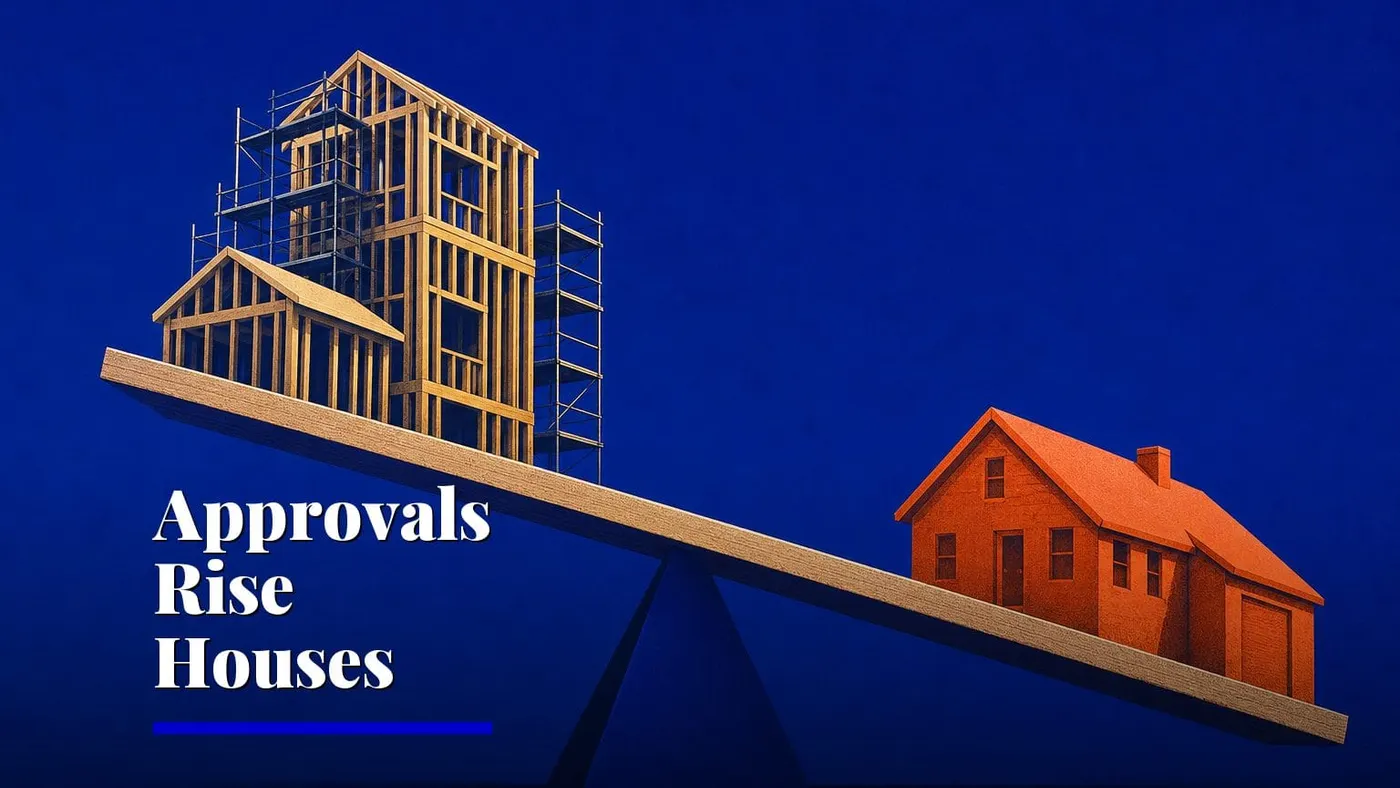
The Australian Bureau of Statistics counted 17,948 dwelling approvals in September 2026 — a 5.1 per cent monthly increase that still left the total 0.8 per cent below its year-earlier level, in seasonally adjusted figures published on 2 November S¹P². That headline rise papers over a stark divergence: approvals for private sector houses slipped 5.3 per cent to 10,432, while private sector dwellings excluding houses, the bucket that captures apartments and townhouses, climbed 16.6 per cent to 6,579 S¹. The ABS publishes these as point estimates without confidence intervals or sampling error margins, so the precision of month-to-month movements cannot be independently gauged.
My read: The number I would watch is the trend series, not the seasonally adjusted one. The trend measure for total dwellings sits at 18,705, up 10.6 per cent on the year S¹, which tells a more consistent story than the SA figure's 0.8 per cent yearly decline. The two estimates diverge because the SA series swings more violently month to month, and a single month's jump in the higher-density component can drag the yearly comparison around. I would not call this a housing recovery or a housing slump until the trend and SA series agree on direction.
Houses and higher-density approvals diverge sharply
The seasonally adjusted data puts private houses at 10,432 — 5.3 per cent below August but still 9.6 per cent above September 2025 S¹. Private sector dwellings excluding houses paint the opposite picture: 6,579 approved, up 16.6 per cent on the month yet down 20.5 per cent on the year S¹. A builder reading this would see detached housing still above its year-ago level even after a soft month, while the higher-density pipeline is recovering from a much lower base.
The trend series smooths the volatility. Trend total dwellings reached 18,705, up 1.3 per cent on the month and 10.6 per cent on the year S¹. Trend private houses edged up 0.1 per cent to 10,687, up 13.4 per cent annually S¹. Trend dwellings excluding houses rose 3.5 per cent to 7,708, up 8.5 per cent on the year S¹. Both private components are growing on the trend measure, which is the more reliable guide to direction. The ABS has not released the code or detailed smoothing parameters behind its trend estimation, so the method cannot be independently replicated.
One gap worth noting: the two private sector components sum to 17,011 on the trend measure, below the 18,705 total. The ABS methodology covers new construction, alterations and renovations P⁴, and the difference reflects a public sector or revision component the key figures do not itemise.
Brokers and builders face opposite signals from the latest numbers
For a mortgage broker or land estate agent, the detached house number matters most. A 5.3 per cent monthly dip in private house approvals, even with the yearly figure still positive, means fewer new lots moving through council in the near term. That feeds into land supply months before it reaches settlement. A builder running a medium-density project, by contrast, sees the 16.6 per cent monthly jump in non-house dwellings as a signal that apartment and townhouse approvals are finding their way through the system again, though the 20.5 per cent yearly decline shows how far that segment had fallen. For a conveyancer handling off-the-plan apartment contracts, the 16.6 per cent monthly lift in non-house approvals points to more presale paperwork arriving in coming weeks, while the 20.5 per cent annual drop signals a thinner queue of new projects behind those.
The transmission from approvals to construction is not instant. A dwelling approval is a council sign-off, not a start. Commencements and completions, which the ABS tracks separately, come later. The September approval figures tell you what is in the pipeline, not what is rising from the ground.
The ABS does not provide state-level breakdowns or commentary on causes in the key figures, so the national numbers may mask very different conditions across markets.
The next ABS building approvals release, covering October 2026, is scheduled for 1 December 2026 P³.
Sources: S1 — ABS Building Approvals — 2026-09 release · P2 — Total dwelling approvals rise 5.1% in September | Australian Bureau of · P3 — Building Approvals, Australia | Australian Bureau of Statistics · P4 — Building Approvals, Australia methodology, September 2026 | Australian · P5 — Latest releases | Australian Bureau of Statistics
Written from 5 sourced items, 5 of them primary.