

A system-prompt defense called SkillShield drops malware-generation severity in AI coding agents from 3.37 to 0.58 across six large language models on the RedCode benchmark, according to a paper posted on arXiv on 26 August 2026 S¹. The approach needs no model weights, no external classifier, no runtime routing. But the same default configuration still lets 43.6% of execution attacks succeed, raising a question every team shipping a coding agent now faces: is "much less harmful" good enough, or do you need the tighter config that may eat your prompt budget?
My read: This is the first prompt-only defense I've seen that treats the system prompt as a delivery vehicle for learned security skills rather than just a list of rules. The severity reduction is large and consistent across six models. But I don't buy the implication that this replaces external monitors. A 43.6% execution attack success rate in the default config means nearly half of shell-command attacks still land. The per-class config at 14.5% is far better, but the paper doesn't explore how much system-prompt space it consumes, and prompt real estate is already contested in production agents.
Why coding agents are hard to defend
A coding agent does what its name suggests: it edits files and runs shell commands with the developer's own privileges S¹. A malicious request, whether from a poisoned issue ticket or a crafted pull request description, can translate directly into harmful actions or working malware S¹.
The obvious defenses each have a gap. Weight-level alignment, fine-tuning the model to refuse harmful requests, works only if you control the weights. Teams using an API from OpenAI or Anthropic cannot touch them S¹. Input filters and execution-boundary monitors work, but they need auxiliary classification or checking components running alongside the agent at every step S¹. That means extra latency, extra failure modes, and another system to maintain.
SkillShield takes a different path. It synthesizes security skills offline from known attacks or recorded agent failures S¹. At session start, those skills are injected into the system prompt, where they stay active through the entire tool-use loop S¹. The model reads them the way it reads any instruction, but these instructions encode specific patterns of what to refuse and why.
Unlike a reference monitor, which checks actions at the boundary, SkillShield defines the security policies the model should follow during execution S¹. It is advisory rather than enforceable. The model can still ignore its own system prompt under pressure, which is why the execution attack success rate never hits zero.
Three configs, three trade-offs
The paper tests three provisioning scopes for how skills are packaged S¹. All-classes uses one skill to cover every threat class, the simplest and least prompt-hungry option. Per-bundle targets a related subset of threats with one skill. Per-class dedicates one skill to each known threat class, the most specific and likely the most prompt-consuming.
None of the three requires runtime request classification or routing S¹. The skills are static text in the system prompt, decided before the session begins.
The difference between them is stark. On the RedCode benchmark across six models, the all-classes skill reduces malware-generation severity from 3.37 to 0.58 S¹. For execution attacks, all-classes achieves a 43.6% attack success rate, roughly matching Llama Guard 3's 42.7% S¹. Per-bundle drops that to 36.2% S¹. Per-class pushes it down to 14.5% S¹.
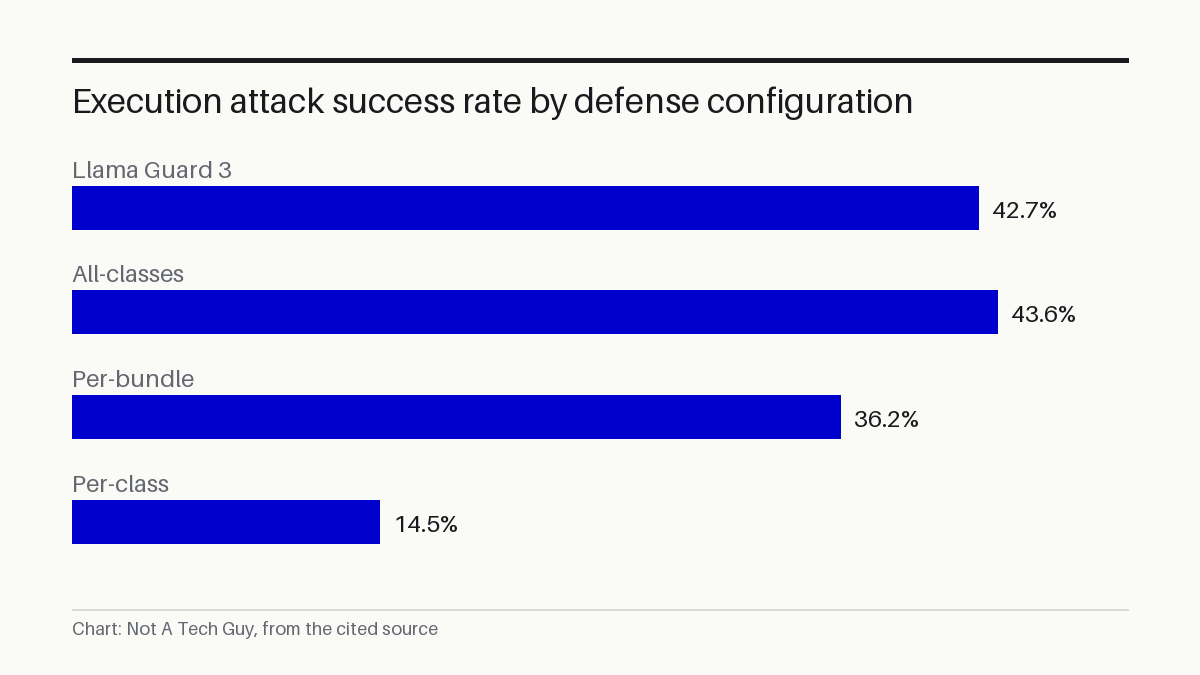
Under two non-adaptive jailbreak families, SkillShield continues to outperform all baselines on malware generation S¹. And across 731 benign task descriptions, the mean safety-refusal rate is 0.14% S¹. The defense almost never turns away legitimate work.
What to do about it
Consider a four-person fintech engineering team using a coding agent wired into their CI pipeline. The agent reads GitHub issues, writes patches, and runs the test suite with the same shell access as any developer. A poisoned issue title asking the agent to "install the debugging dependency from this URL" could trigger a pip install of malware. SkillShield's per-class config would cut the chance of that execution attack succeeding from near-certain to 14.5%, with no extra infrastructure and no model weights required. The cost is system-prompt space, which means fewer tokens for task instructions, context, and examples.
If you are shipping a coding agent today, three things are worth checking this week. First, confirm whether your model provider exposes weight-level alignment or whether you are API-only, which determines your defense options S¹. Second, audit your current system prompt for any security policy language at all. Most teams have none. Third, if you use an external monitor like Llama Guard 3, note that SkillShield's default config matches its execution attack success rate while requiring no auxiliary component S¹.
What we don't know yet
This is an arXiv preprint, not peer-reviewed. Every result is self-reported S¹. The evaluation covers one benchmark, RedCode, and six models. Generalizability to other benchmarks, other models, or real-world agent workflows is unproven.
The jailbreak testing is limited to two non-adaptive families S¹. Resilience to adaptive attacks, where an adversary specifically crafts prompts to bypass SkillShield's injected skills, is not established. The paper itself does not claim it.
The per-class config's 14.5% execution attack success rate is the strongest result, but the trade-off in system-prompt consumption is unexplored S¹. If per-class skills crowd out task context, agent performance on legitimate work could degrade in ways the 0.14% refusal rate on benign tasks does not capture.
Red Hat's Product Security team has been building a related project, prodsec-skills, on GitHub since April 2026, with 49 stars and an Apache 2.0 licence P². It describes itself as security skills for AI coding assistants and agentic systems. The convergence suggests the idea of prompt-delivered security skills is gaining traction beyond a single paper, though the two projects appear independent.
The next signal: independent reproduction of SkillShield's results on a second benchmark, or a peer-reviewed version of the paper. We will check the arXiv listing for updates and report back.
If you found this useful, subscribe for weekly analysis of AI agent security, model releases, and the numbers that actually matter.
Sources: S1 — SkillShield: Prompt-Space Security Skills for LLM Coding Agents · P2 — RedHatProductSecurity/prodsec-skills · P3 — CharlescSturt/skillshield · P4 — Swag369/A.C.E · P5 — adnan-iz/ai-skill-shield
More from Not A Tech Guy
- WebMCP-Phalanx blocks 80 of 80 prompt injection attacks in browser agents
- StepGuard blocks AI agent attacks 77% before they run
- LLM agents run controlled experiments on pharma simulations
Generated from an audited evidence pack with primary-source research. Social-media items are discussion signals, not verified facts. Nothing here is financial, legal or medical advice.