

WebMCP-Phalanx, a dual-layer agent runtime described in an arXiv preprint on 25 August 2026, blocks all 80 prompt-injection attempts embedded in tool descriptions and cuts revocation attacks from a 100% success rate to zero S¹. The architecture targets a gap that could let any web page hijack the AI agents browsers are about to host. What remains unclear is whether a defense built for the lab holds when attackers can see its code.
My read: This is the first architecture I've seen that treats browser-integrated agents as a security problem requiring browser-native trust anchors instead of prompt-level filtering. The 2-of-80 tool-return success rate and the white-box bypass via malicious tool names tell me the authors are honest about limitations. I don't buy the "statistically indistinguishable task utility" claim at face value yet, because the paper is a preprint with no peer review and the attack suite is necessarily finite. What I'd watch is whether the call-timing gate they propose as a fix for the white-box bypass actually closes that gap or just delays it.
Why browser agents are exposed
The W3C WebMCP proposal, under development in the webmachinelearning GitHub group with 3,231 stars P³, would let LLM agents invoke tools exposed by web pages S¹. A page could offer a "summarise this article" tool, a "book a flight" tool, or a "transfer funds" tool, and an agent embedded in the browser could call it.
Browsers currently rely on the Same-Origin Policy, a framework meant for human-driven interactions across different websites, rather than automated agent requests S¹. This system lacks the ability to monitor tool registration, detect mid-session overwrites by malicious scripts, or spot hidden hijacking commands within tool descriptions. The research highlights three main vulnerabilities: tools falsely claiming a different origin (subject-attribution spoofing), tools being revoked or replaced during an active session (uncontrolled tool lifecycles), and malicious commands hidden inside tool descriptions or outputs (semantic prompt injection) S¹.
A related paper by the same author, Lin-Fa Lee at National Yang Ming Chiao Tung University, documented tool-surface poisoning attacks on WebMCP agents earlier this year P⁴.
How Phalanx works
Phalanx adds two layers on top of the browser's existing security model.
The initial layer establishes a trust anchor directly within the browser. Upon tool registration by a webpage, the browser cryptographically links the tool to its creator or origin using capability credentials S¹. Provenance tags, which track tool ownership and registration timing, remain attached throughout the tool's lifespan. Any attempt by a script to revoke or replace a tool it did not originally create is blocked by the browser.
The subsequent layer divides the agent into two distinct components. A Quarantine Agent (Q-LLM) examines tool metadata, outputs, and webpage content for signs of prompt injection, but lacks the power to execute any tools S¹. Its internal state is concealed from webpage scripts, preventing malicious pages from reading its analysis. Data that successfully passes this inspection is then sent to the Privileged Agent (P-LLM), which holds the actual capability to invoke tools S¹.
Think of it as a customs checkpoint. The Q-LLM inspects the cargo while the P-LLM drives the truck, and the customs officer never holds the keys.
The numbers that matter
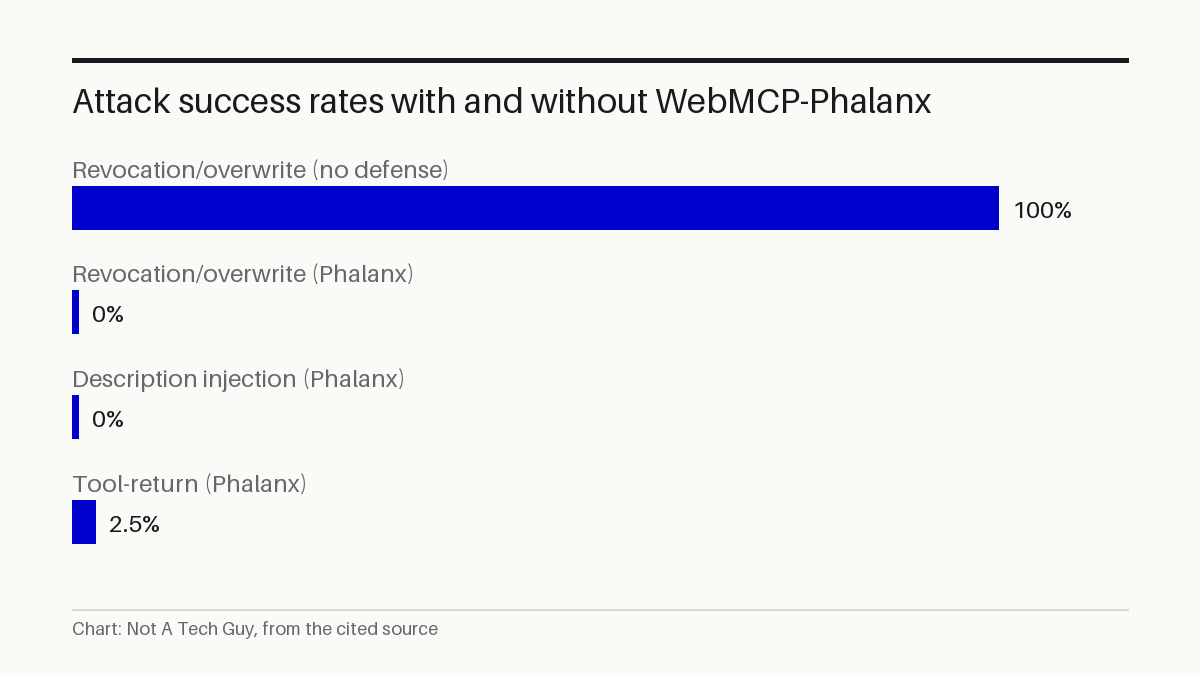
The browser-native ownership mechanism drops revocation and overwrite attack success from 100% to 0% S¹. The dual-agent runtime blocks all 80 prompt-injection attempts embedded in tool descriptions S¹. Tool-return attacks, where malicious instructions hide in the data a tool sends back, succeed in 2 of 80 cases S¹. Across all experiments, task utility stays statistically indistinguishable from the no-attack baseline S¹. The defense does not break normal functionality.
The crack in the wall
When facing an adaptive white-box attacker who has knowledge of the system's internal workings, the description-based filtering can be evaded using malicious tool names that are called before the Q-LLM completes its inspection S¹. To counter this, the researchers suggest a call-timing gate that postpones tool execution until all metadata visible to the agent has been checked S¹. However, this remains a proposed solution rather than an empirically tested one.
What to do about it
If you're building browser-integrated agents, the architecture worth studying is the separation of inspection from execution. A travel-booking startup that lets its agent call third-party tools (airline APIs, hotel parsers, payment widgets) should not give the same model that reads untrusted page content the authority to move money. Run a quarantine pass first. Log which origin registered each tool. Reject any tool whose provenance chain breaks.
This week, audit your agent's tool registry. For each tool your agent can call, check whether you can verify who registered it, when, and whether a page script could overwrite it between registration and invocation. If the answer is "I don't know," that's the gap Phalanx is trying to close.
What we don't know yet
The paper is a preprint and has not been peer-reviewed S¹. The attack suite is finite: 80 description injections and 80 tool-return attacks is a meaningful sample but not an exhaustive one. The white-box bypass via malicious tool names is identified, but the proposed call-timing gate is untested against it. Task utility is reported as "statistically indistinguishable" but the paper does not specify the confidence interval or effect size in the evidence we reviewed.
The broader W3C WebMCP proposal is still under development, with 109 open issues on its GitHub repository P³. Whether browser vendors adopt any trust-anchor mechanism for agent tools, and in what form, remains undecided.
The next signal: the W3C WebMCP working group's next published draft, or Lin-Fa Lee's follow-up testing the call-timing gate against the white-box bypass. We'll check both. If you want that follow-up in your inbox, subscribe and we'll send it the day it lands.
Sources: S1 — WebMCP-Phalanx: Enforcing and Characterizing Trust Boundaries for Brow · P2 — WebMCP-Phalanx: Enforcing and Characterizing Trust Boundaries for Brow · P3 — webmachinelearning/webmcp · P4 — WebMCP Tool Surface Poisoning: Runtime Manipulation Attacks on LLM Age · P5 — notyorch/Trust-Boundary-Mapper
More from Not A Tech Guy
- StepGuard blocks AI agent attacks 77% before they run
- LLM agents run controlled experiments on pharma simulations
- TradingAgents nears 100,000 GitHub stars with AI trading desk
Generated from an audited evidence pack with primary-source research. Social-media items are discussion signals, not verified facts. Nothing here is financial, legal or medical advice.