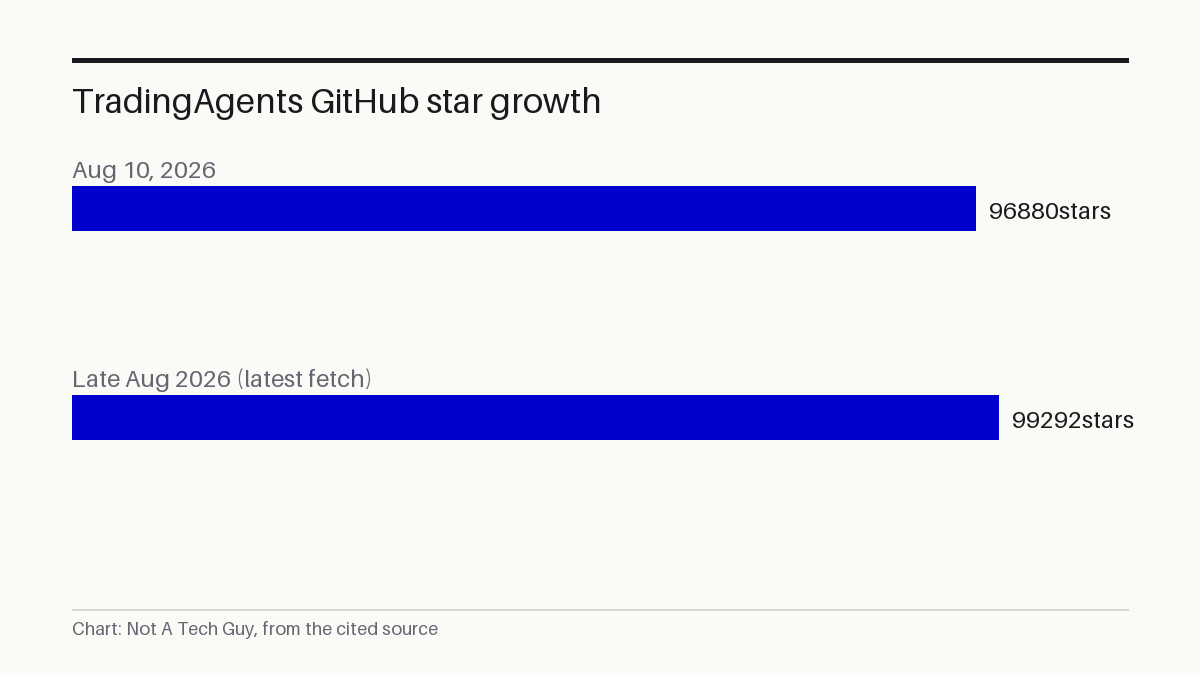
TradingAgents, an open-source framework from Tauric Research that turns a trading desk into a committee of arguing LLM agents, has collected 99,292 GitHub stars P⁵ since its December 2024 launch S¹, topping GitHub trending this week. The framework does not connect to any broker, and approved orders go to a simulated exchange S¹. So what is drawing nearly 100,000 developers to a system that cannot place a single real trade?
My read: This is the most interesting multi-agent design I have seen in finance because it does not try to build one super-agent that does everything. It builds a committee with built-in dissent. A bullish researcher and a bearish researcher are forced to disagree, a risk team exists to poke holes, and a portfolio manager decides. That adversarial structure mirrors how real trading desks operate. What I am skeptical about: 99,000 stars does not mean 99,000 working deployments. The repo sends orders to a simulated exchange with no broker connection S¹, and the disclaimer is explicit that performance varies with model choice, temperature, period and data quality S¹. This is a research scaffold, not a money printer.
How the desk argues with itself
TradingAgents splits the investment process into a sequence of distinct AI roles S¹. Four analysts evaluate market data. A bull and a bear researcher then argue over these findings. Next, a trader drafts a plan based on the discussion. A risk management squad scrutinizes the plan. Finally, a portfolio manager either authorizes or declines the trade S¹.
This is not one model calling a function. It is a structured argument. The design assumes that disagreement produces better decisions than consensus, which is a bet on adversarial reasoning rather than monolithic prediction.
When an order is approved, it goes to a simulated exchange. There is no broker connection anywhere in the repository S¹. The framework is Apache-2.0 licensed S¹ P⁵, and the associated paper is arXiv 2412.20138, titled "TradingAgents: Multi-Agents LLM Financial Trading Framework" S¹ P⁵.
Why 99,000 stars for a simulator
The star count tells a story of rapid growth. The repository went live on December 28, 2024 S¹ P⁵. The latest deep-research fetch shows 99,292 stars and 19,140 forks P⁵. That is roughly 2,400 new stars in about two weeks.
The latest release, version 0.3.1 from July 5 S¹, added Alpha Vantage look-ahead filtering S¹. Look-ahead filtering is a guard against a classic backtesting error: accidentally feeding the model data from the future, which inflates performance. The fact that this was added in a point release suggests the project is actively maintained and responding to real research concerns.
Model support is broad. The framework works with OpenAI, Anthropic, Google, xAI, DeepSeek, Qwen, GLM, MiniMax, Groq, Mistral, NVIDIA, Bedrock, OpenRouter, Ollama, or any OpenAI-compatible endpoint S¹. That provider-agnostic design means a researcher can swap models without rewriting the agent pipeline, which matters because the disclaimer is explicit that results change with model choice S¹.
What to do about it
The framework is a research tool, not a trading system. The repo's own disclaimer states that trading performance varies with model choice, temperature, period and data quality, and that it is not intended as financial, investment or trading advice S¹.
For a quant research team at a mid-tier asset manager, the value is in the architecture, not the output. The agent chain (analysts, debaters, risk, approver) is a template for structured decision-making that can be adapted beyond finance. A team could prototype an internal investment committee simulation, test how different LLMs perform in the bull and bear roles, or use the look-ahead filtering as a baseline for their own backtesting hygiene.
For an individual developer curious about multi-agent systems, TradingAgents is a readable, open-source example of adversarial agent design. The code is Python, the license is permissive, and the agent roles are clearly separated. It is a better starting point for understanding multi-agent coordination than most academic papers, because you can run it.
One practical thing to check this week: clone the repository, read the agent role definitions in the source, and trace a single decision from analyst input to portfolio manager approval. You will learn more about multi-agent design from that 30-minute exercise than from any framework overview.
What we don't know yet
By August 10, 2026, it had 96,880 stars S¹.
If this was useful, subscribe for more analysis of multi-agent AI systems and the open-source frameworks shaping them.
Sources: S1 — TradingAgents: A Multi-Agent LLM Trading Desk | MoClaw Blog · P2 — Tauric-Research-Trading/TradingAgents · P3 — architpandita/zero-trust-trading-desk-mulit-agent · P4 — ElMoorish/TradingAgents · P5 — TauricResearch/TradingAgents
More from Not A Tech Guy
- LanceDB: 11,000-star vector database trends on GitHub
- Vibe coding: security prompt halves AI app flaws
- Google Gemini CLI hits 106,000 stars with free 1,000-request daily tier
Generated from an audited evidence pack with primary-source research. Social-media items are discussion signals, not verified facts. Nothing here is financial, legal or medical advice.