

Google's Gemini CLI, an open-source AI agent that runs inside the terminal, appeared on GitHub's daily trending chart on August 24 with roughly 106,640 stars S¹. The maintainers say anyone with a personal Google account gets 1,000 free requests a day S¹, a ceiling high enough to make paid coding subscriptions look expensive. What happens when a million-token context window meets a free tier that generous is unclear. So is whether Google can sustain it.
My read: This is the most aggressive free-tier play I've seen from a major AI lab. Google is handing out 1,000 daily requests to Gemini 3 models with a 1M token context window S¹, and that is enough for a full day of serious coding work. I don't buy that this is purely generous. Google wants developers living inside its ecosystem, and a terminal agent that can read an entire codebase at once is a strong hook. The thing I'm watching is whether the free tier holds, or quietly tightens once adoption scales.
What the tool actually does
Gemini CLI is a terminal-based AI agent written in TypeScript S¹. Google introduced it on June 25, 2025, providing a free, open-source way to access Gemini models directly from developers' terminals P². The repository was created on April 17, 2025 P³ and has since accumulated 14,467 forks and 797 open issues P³.
The maintainers note that the tool offers access to Gemini 3 models, featuring improved reasoning and a 1 million token context window S¹. That context window means the model can hold roughly 750,000 words of text in working memory at once, enough to load a large codebase and reason across it without splitting it into chunks.
The built-in tool set is where it gets practical. The maintainers list Google Search grounding (the model can pull real-time web results), file operations, shell commands, and web fetching S¹. In plain terms, the agent can read your files, run commands on your machine, and look things up online, all from a single terminal prompt. It also supports MCP, or Model Context Protocol, a standard for connecting AI models to external tools and data sources S¹. Because Gemini CLI's built-in tools give it file and shell access plus web fetching by default, the permissions model matters.
Installation is broad. The maintainers say you can install it via npx, npm, Homebrew, MacPorts, or Anaconda S¹, covering most major operating systems.
The free tier is the story
The standout detail is the pricing. The maintainers state that a personal Google account unlocks a free tier of 60 requests per minute and 1,000 requests per day S¹. No credit card and no usage-based billing. For a developer who currently pays $20 a month for a coding assistant subscription, 1,000 daily requests to a Gemini 3 model is a serious alternative.
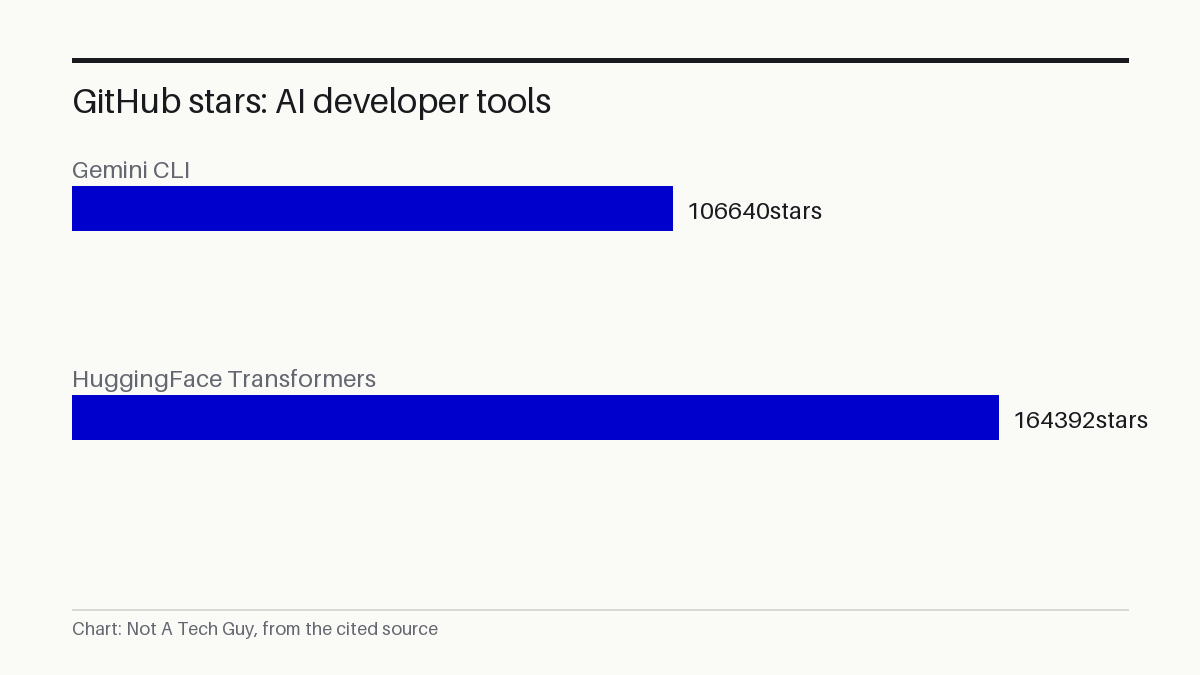
The project is licensed under Apache 2.0 [S1, P3], which means the code is free to use and modify. That puts it in the same licensing family as HuggingFace's Transformers library, which has 164,392 stars P⁵ and is one of the most widely used open-source machine learning frameworks. Gemini CLI is not at that level of adoption yet, but it has crossed 106,000 stars in roughly 16 months since the repository was created P³.
The release cadence is aggressive. Stable releases are published weekly at UTC 20:00 on Tuesdays, preview releases at UTC 23:59 on Tuesdays, and nightly releases daily at UTC 00:00 S¹. That suggests active development, but it also means the tool you install today may behave differently next week.
What to do about it
Consider a two-person dev shop in Brisbane maintaining a legacy Node.js codebase with 200,000 lines spread across 1,800 files. Today, understanding a single feature means tracing calls across dozens of files by hand. With Gemini CLI's 1M token context window, they could load the relevant subset of the codebase into a single prompt and ask the agent to explain how a specific payment flow works, run a test suite via the built-in shell command tool, and then have the agent draft a fix. All of that fits inside the free tier's 1,000 daily requests.
The GitHub Action integration is the sleeper feature. Gemini CLI can be wired into GitHub workflows to automate pull request code reviews S¹. A small team could set that up once and get an AI review on every pull request without paying per review. The tool also supports conversation checkpointing, which lets you save a complex session and resume it later S¹, useful when a debugging session spans multiple days.
One practical step this week: install it with npx (the maintainers list this as the quickest method S¹), point it at a real codebase, and see how many of your 1,000 daily requests a typical session actually consumes. That tells you whether the free tier is a genuine replacement or a teaser.
What we don't know yet
Every capability claim here comes from the maintainers' own README S¹. No third party has independently reviewed or audited the tool. The free-tier rate limits are self-reported and could change or vary by region without notice. The source does not disclose paid tier pricing or enterprise licensing terms, so we don't know what happens when a team outgrows 1,000 requests a day.
The "Gemini 3 models" claim is stated by the maintainers but not independently verified S¹. We don't know which specific model versions are available, whether they differ from the Gemini models available through Google's API, or whether the 1M token context window applies to all request types or only some.
The 797 open issues on the repository P³ are a signal worth watching. A high issue count can mean active community engagement, or it can mean bugs are piling up faster than maintainers can close them.
The next signal: the next stable release drops at UTC 20:00 on the coming Tuesday S¹. We'll check the release notes for any changes to the free-tier limits or model access, and report back here. Subscribe below to get that update.
Sources: S1 — google-gemini/gemini-cli: An open-source AI agent that brings the powe · P2 — Google announces Gemini CLI: your open-source AI agent · P3 — google-gemini/gemini-cli · P4 — README.md · P5 — huggingface/transformers
More from Not A Tech Guy
- LLMs hallucinate more under strict EU rules, study finds
- SRPO trains Qwen3-8B to fix its own errors, hits 73.3% on AIME'24
- Distilled AI safety guard runs on CPU in 24ms, matches teacher
Generated from an audited evidence pack with primary-source research. Social-media items are discussion signals, not verified facts. Nothing here is financial, legal or medical advice.