

The encoder student in a new arXiv preprint classifies a prompt's safety in roughly 24 milliseconds on a standard CPU S¹. That is a fraction of the time current open guard models take: existing models pack between 1 billion and 9 billion parameters, are designed for GPUs, and slow to multiple seconds per request when run on a CPU instead S¹. The question is whether a model that small and that fast can still catch what an 8-billion-parameter teacher catches.
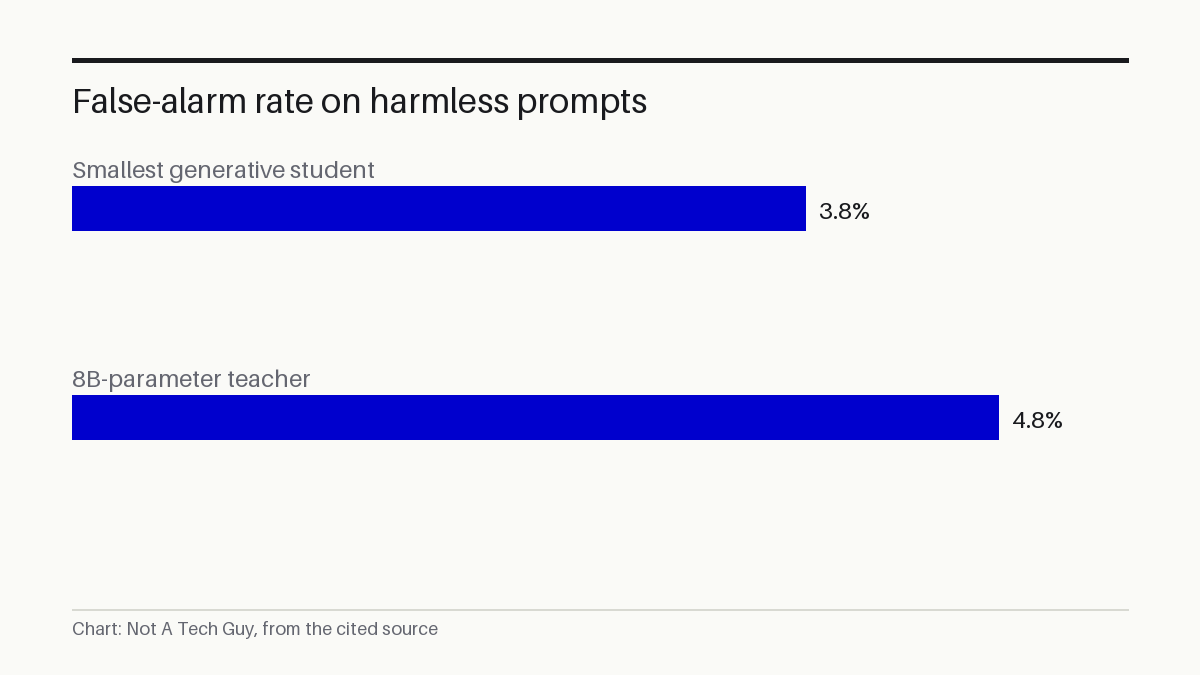
My read: This is the first distillation recipe I've seen that partitions training data at the license boundary and then measures what that restriction costs you. Most safety-guard papers either ignore licensing or hand-wave it. The false-alarm number is the one to watch: 3.8% for the smallest generative student against 4.8% for the teacher S¹ is a real result if it holds up, but the authors themselves say they make no superiority claim and that the teacher stays ahead on clean text S¹. I'd want to see independent validation before trusting these numbers, and the abstract doesn't name the teacher model, which makes reproduction harder.
A 97,000-prompt corpus feeds four tiny students
The recipe starts with a strong open guard model that labels a corpus of roughly 97,000 prompts sourced from 24 public datasets, sorting each into one of seven safety categories that map to a publicly available hazard taxonomy S¹. That labeled corpus becomes the training data for a fleet of small student models spanning four architectures: lexical, shallow, encoder, and generative S¹. Each student learns to reproduce the teacher's safety signal without the teacher's parameter count or GPU dependency.
The dataset behind this work, published on HuggingFace as "safety-classification-v0" by Quickium, contains 75,112 training prompts from 15 public safety datasets, normalized to a single schema and silver-labelled into a 7-category taxonomy P⁴. The gold benchmark used for evaluation is separate: 6,361 rows across four slices, labeled independently from the teacher, including a slice of harmless prompts that makes over-defense measurable S¹.
The license partition makes the trade-off measurable
The corpus is split at the license boundary. The deployable variant and the research variant are identical except for which training data they use, which means the accuracy cost of the licensing restriction can be directly quantified S¹. This is unusual. Most distillation work optimizes for performance and treats licensing as a footnote. Here, the authors make the trade-off explicit: if you can only train on permissively licensed data, how much accuracy do you give up?
24 milliseconds and a lower false-alarm rate
The distilled students match the teachers on adversarial text within overlapping confidence intervals S¹. On harmless prompts, the smallest generative student reaches a 3.8% false-alarm rate, compared with 4.8% for the 8-billion-parameter teacher S¹. Lower false alarms mean the guard blocks fewer legitimate prompts, which is the metric that determines whether a safety layer is usable in production or just a nuisance.
The encoder student classifies in roughly 24 milliseconds per request on CPU S¹. Current open guards, built for GPUs, take seconds per request on the same hardware S¹. For a service handling thousands of prompts per minute, that gap is the difference between a guard you can actually deploy and one you cannot afford to run.
The authors single out per-class rebalancing as the one factor that mattered most S¹. Not architecture choice, not model size, not training duration. Rebalancing the class distribution in the training data so that rare safety categories get enough representation is what made the students work.
The authors are explicit about limitations. They do not claim their distilled guards are better than the teacher, and on the clean reference slice the teacher models still outperform the students S¹.
What to do about it
Consider a mid-sized legal-tech startup that runs a chatbot for client intake. Every prompt passes through a safety guard before reaching the model. Today, that guard likely runs on a GPU instance, costing several hundred dollars a month and adding latency to every request. A CPU-deployable guard classifying in 24 milliseconds changes the economics: the same safety check runs on infrastructure the startup already has, with no GPU rental and no added latency the user can feel.
The practical step this week: check whether your current safety guard is GPU-bound. If it is, look at the HuggingFace dataset published by Quickium P⁴ and the distillation recipe in the preprint S¹ to see whether a CPU-class student could replace it for your traffic profile. The recipe is reproducible by design, and the license partitioning means you can pick the version that matches your deployment constraints.
What we don't know yet
The performance numbers, 24 milliseconds on CPU and the 3.8% versus 4.8% false-alarm rates, are self-reported by the authors S¹. The abstract does not specify the CPU hardware, the confidence intervals around the adversarial-text comparison, or the specific teacher model used. Overlapping confidence intervals on adversarial text do not prove statistical equivalence; they mean the students were close, not that they are the same.
This is a single arXiv preprint with no peer review or independent verification. The broader research direction, though, is real: a separate paper asks directly whether you need a GPU to guard an LLM and argues for CPU-class classifiers and multi-stage pipelines P⁵. The distillation technique itself builds on prior work on cross-tokenizer distillation for language models P³.
The next signal: whether independent teams reproduce the 24-millisecond and false-alarm numbers using the Quickium dataset on HuggingFace over the coming weeks. We will check those claims against any reproduction results.
If you want this kind of decode delivered weekly, the subscribe button is right there.
Sources: S1 — A Reproducible, License-Aware Distillation Recipe for CPUDeployable Sa · P2 — examples/diffusers/distillation/README.md · P3 — Towards Cross-Tokenizer Distillation: the Universal Logit Distillation · P4 — quickium/safety-classification-v0 · Datasets at Hugging Face · P5 — Do You Really Need a GPU to Guard Your LLM? CPU-Class Classifiers and
More from Not A Tech Guy
- MiroFish: 71,000-star AI prediction engine hits GitHub trending
- NVIDIA Groq 3 LPX hits full production at 3,400 tokens/second
- TokEval: tokenizer metrics predict AI model performance
Generated from an audited evidence pack with primary-source research. Social-media items are discussion signals, not verified facts. Nothing here is financial, legal or medical advice.