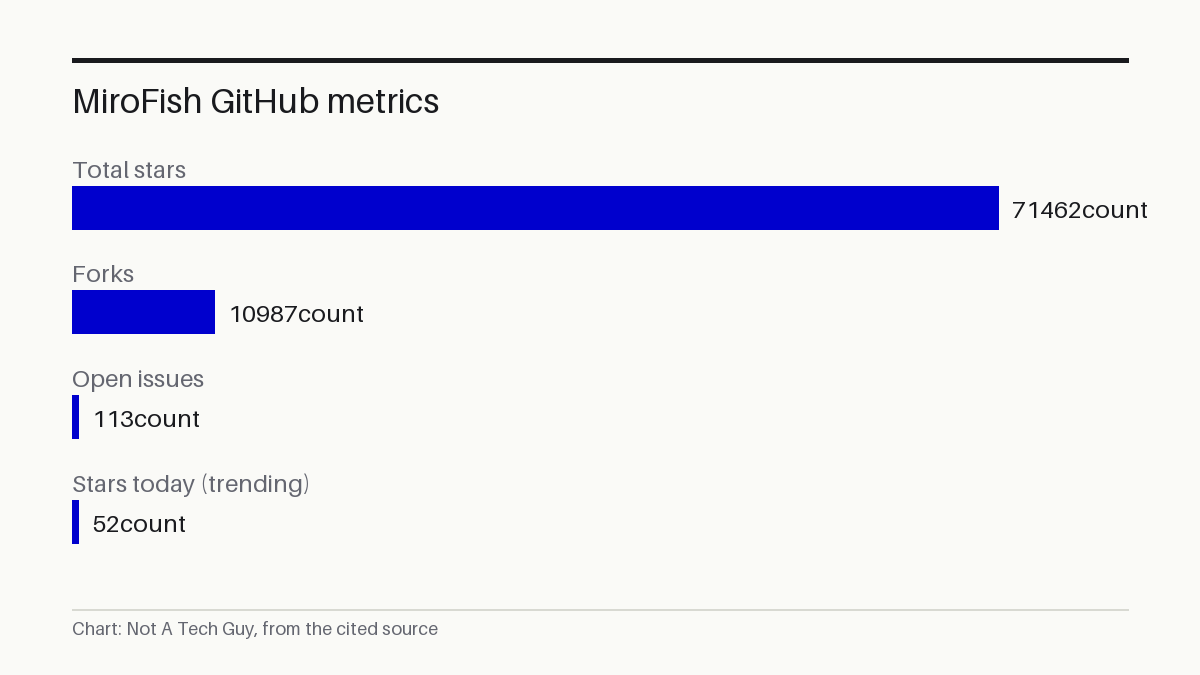
A Python project called MiroFish, which claims to be a swarm intelligence engine that can predict anything by simulating thousands of AI agents inside a digital world, landed on GitHub's daily trending list on 24 August with 71,462 total stars S¹. The repository makes some of the grandest claims on GitHub right now. None of them have been independently verified.
My read: This is the most star-heavy "predict anything" project I've seen surface on trending, and I'm immediately skeptical of the framing. 71,000 stars in under ten months (the repo was created on 26 November 2025 P²) is explosive growth, but GitHub stars measure attention, not accuracy. The README describes a system that builds a parallel digital world from real-world seed data and lets thousands of agents interact inside it S¹. That is a compelling vision. It is also a marketing claim until someone runs it against held-out data and publishes the results. I would watch whether any independent lab reproduces a prediction benchmark before taking the "predicting anything" tagline seriously.
What the project claims to do
According to its own README, MiroFish is a "next-generation AI prediction engine powered by multi-agent technology" S¹. The description says it extracts seed information from the real world and automatically builds a "high-fidelity parallel digital world" where thousands of intelligent agents interact freely S¹. The idea, as described, is that emergent behaviour from those agents produces predictions about real events.
The repo lists two demo videos: a "Wuhan University Public Opinion Simulation" and a "Dream of the Red Chamber Lost Ending Simulation" S¹. The first simulates how public opinion might spread through a university community. The second attempts to generate a plausible lost ending for the classic Chinese novel. Both are listed as demonstrations, not validated predictions.
An online demo environment is referenced at "mirofish-live-demo" S¹, though the evidence pack does not confirm whether it is publicly accessible or what it actually shows.
What is actually verifiable
The repository was created on 26 November 2025 P². It is licensed under the GNU Affero General Public License v3.0, which requires anyone running a modified version as a service to publish their source code P². The codebase spans Python, JavaScript, Vue, HTML and Dockerfile P², suggesting a full-stack web application rather than a pure library. Deployment requires Node.js 18+ and Python 3.11 to 3.12 S¹.
The repo carries 10,987 forks and 113 open issues P². The fork count is high relative to most projects, which could indicate genuine community engagement, but could also reflect automated cloning or star-farming patterns that trending repos sometimes attract.
The homepage is listed as mirofish.ai P².
Why the star count tells you less than you think
71,462 stars S¹ puts MiroFish in the upper tier of GitHub repositories by raw count. For context, that is more stars than many widely used production frameworks. But stars measure attention, not validation. The evidence pack explicitly flags that the README is the maintainers' own description, not an independent review S¹. No source in the pack confirms that MiroFish has been tested against real-world outcomes by anyone outside the project.
Prediction accuracy is a hard, measurable thing. A project that claims to predict "anything" needs to show its work on specific benchmarks. A vision statement is not a substitute.
The unsupported angles are blunt: no independent verification exists for the prediction claims, no evidence shows government or corporate adoption, and the demo videos do not constitute proof the system works as advertised.
What to do about it
If you work in a field where prediction matters, say a logistics company trying to forecast supply chain disruptions, the appeal of a universal prediction engine is obvious. But the practical move right now is to treat MiroFish as a research artefact, not a production tool.
Clone the repo, check the licence (AGPL v3.0 means any service you build on it must be open-sourced P²), and run one of the demo simulations against data you already hold. If the agents produce a prediction you can check against a known outcome, you have your first signal. If the demo only runs on its own bundled data, that tells you something too.
One thing to check this week: visit the mirofish.ai homepage P² and see whether the live demo is publicly accessible. If it is, try feeding it a simple scenario with a known historical outcome and compare.
What we don't know yet
No independent benchmark exists for MiroFish's prediction accuracy. The README does not specify what "high-fidelity" means in measurable terms, how many agents the system actually runs, or what the computational cost looks like at scale. The connection between agent interactions and specific prediction outputs is described in vision terms but not documented as a tested pipeline.
The "Wuhan University Public Opinion Simulation" demo S¹ raises questions about what data the system uses to model public opinion and whether the simulation reflects real events or hypothetical ones. The evidence pack does not clarify this.
The next signal: watch for any independent reproduction or benchmark paper citing MiroFish. If a research group runs the engine against held-out data and publishes results, that would be the first real test of the "predicting anything" claim. We'll check the repository's issues and academic citations against it. If you want that follow-up in your inbox, the subscribe button is right there.
Sources: S1 — 666ghj/MiroFish: A Simple and Universal Swarm Intelligence Engine, Pre · P2 — 666ghj/MiroFish · P3 — GitHub - hejing/MiroFish: A Simple and Universal Swarm Intelligence En · P4 — README.md · P5 — Abel-ai-lab/predict-anything
More from Not A Tech Guy
- NVIDIA Groq 3 LPX hits full production at 3,400 tokens/second
- TokEval: tokenizer metrics predict AI model performance
- Vite still trending on GitHub with 82,454 stars
Generated from an audited evidence pack with primary-source research. Social-media items are discussion signals, not verified facts. Nothing here is financial, legal or medical advice.