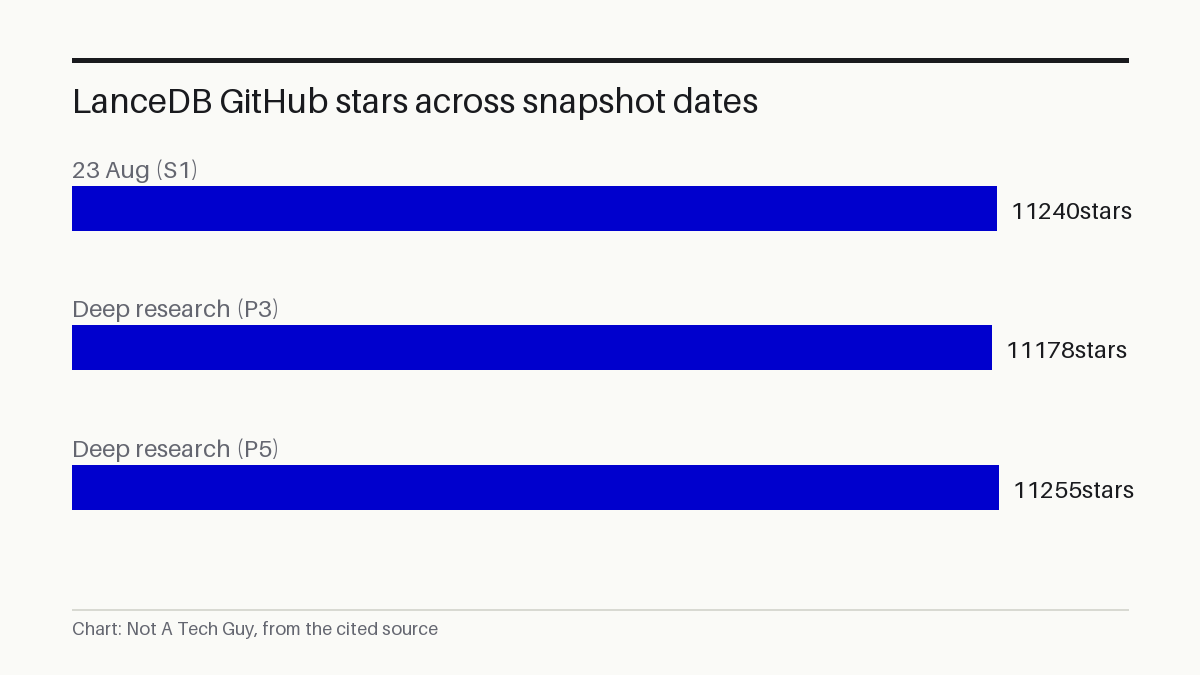

LanceDB, an open-source vector database written in Rust, landed on GitHub's daily trending list on 23 August 2026 with 11,240 stars S¹. The project describes itself as a retrieval library built for developers that handles multimodal AI S¹, and it sits at a strange intersection: the storage layer that makes AI search work, built to run inside your application rather than as a separate server. What that embedded design changes about how developers build AI apps, and whether the maintainers' performance claims hold up, is the part worth watching.
My read: This is the first embedded vector database I've seen gain real traction on GitHub trending. The embedded model, the same approach SQLite uses for relational data, makes sense for AI apps that don't want to run a separate database server just to do similarity search. I don't buy the claim of querying billions of vectors in milliseconds yet, because the source explicitly flags the README as the maintainers' own description, not an independent review S¹. What I'd watch is whether third-party benchmarks appear, and whether the commercial Cloud and Enterprise tier S¹ signals the project is heading toward an open-core model where the free version becomes a funnel for paid features.
Why embedded vector search matters
Most vector databases run as separate services. Your application sends queries over the network. LanceDB takes a different path: it runs inside your application process, reading from local files in the Lance columnar format S¹. Think SQLite versus PostgreSQL. For a developer building a retrieval pipeline, that means no database server to provision, no network latency on every query, and no separate bill for infrastructure.
The question is whether the embedded approach can handle the scale, or whether it works only for smaller workloads.
The project was created in February 2023 P³ and has grown to over 11,000 stars with roughly 1,000 forks and 620 open issues P⁵. It is licensed under Apache 2.0 P³, one of the most permissive open-source licences, which means companies can embed it in commercial products without releasing their own source code.
What the README claims, and what is verified
The maintainers make several bold claims. They assert that LanceDB is capable of querying billions of vectors in milliseconds using advanced indexing techniques S¹. They also claim the system can manage petabytes of varied data types, such as text, images, videos, and point clouds S¹. Additionally, they state the platform combines vector similarity search, full-text search, and SQL queries, while offering zero-copy reads, automatic versioning, and GPU-accelerated index creation S¹.
None of these performance claims have been independently benchmarked in the evidence available. The GitHub Trending source itself includes a disclaimer that the README is the maintainers' own description, not an independent review S¹. The 620 open issues P⁵ suggest active development but also unresolved problems.
What is verifiable: the code exists, it is open source under Apache 2.0, it offers Python, Node.js, Rust, and REST APIs S¹, and it integrates with LangChain, LlamaIndex, Apache Arrow, Pandas, Polars, and DuckDB S¹. Those integrations matter because they place LanceDB directly in the path developers already use to build AI applications.
What to do about it
If you are building an AI application that needs similarity search, an embedded vector database is worth evaluating against the hosted alternatives. A media company building a content recommendation system, for instance, could use LanceDB to store article embeddings locally on each recommendation worker, avoiding a round trip to a remote vector database for every similarity check. The trade-off is scale: embedded databases shine on single-node workloads, and the maintainers' petabyte-scale claims remain unverified.
The project also provides a Cloud and Enterprise tier, which it pitches as production-scale vector search without the need to manage servers S¹, which suggests the embedded version is the entry point and the cloud version is where the company expects to make money. If you are evaluating LanceDB for production, check the open issue count and the release cadence on the GitHub repository before committing. The 620 open issues P⁵ are a signal of how much is still in flux.
One practical step this week: clone the repository, run the Python quickstart against a small dataset of your own, and compare query latency against whatever you currently use. The embedded model either fits your workload or it doesn't, and a 15-minute test will tell you faster than any README.
What we don't know yet
The biggest gap is independent performance data. The maintainers claim millisecond search over billions of vectors S¹, but no third-party benchmark in the evidence pack confirms this. We also don't know the project's funding situation, its user base size, or how the commercial cloud tier relates to the open-source version in terms of feature parity.
The 620 open issues P⁵ raise questions about stability and bug-fix velocity that a README cannot answer. And the multimodal claims, handling video and point clouds alongside text, need verification with real workloads rather than documentation examples.
The next signal: watch for a third-party benchmark or a major release from the LanceDB team in the coming weeks. If one appears, we will check the query speed claim against it. Subscribe and we will keep you posted.
Sources: S1 — lancedb/lancedb: Developer-friendly OSS embedded retrieval library for · S2 — lancedb/lancedb: Developer-friendly OSS embedded retrieval library for · P3 — lancedb/lancedb · P4 — Abdrakib/ml-research-assistant · P5 — lancedb/lancedb · P6 — hdong920/LESS
More from Not A Tech Guy
- Vibe coding: security prompt halves AI app flaws
- Google Gemini CLI hits 106,000 stars with free 1,000-request daily tier
- LLMs hallucinate more under strict EU rules, study finds
Generated from an audited evidence pack with primary-source research. Social-media items are discussion signals, not verified facts. Nothing here is financial, legal or medical advice.