
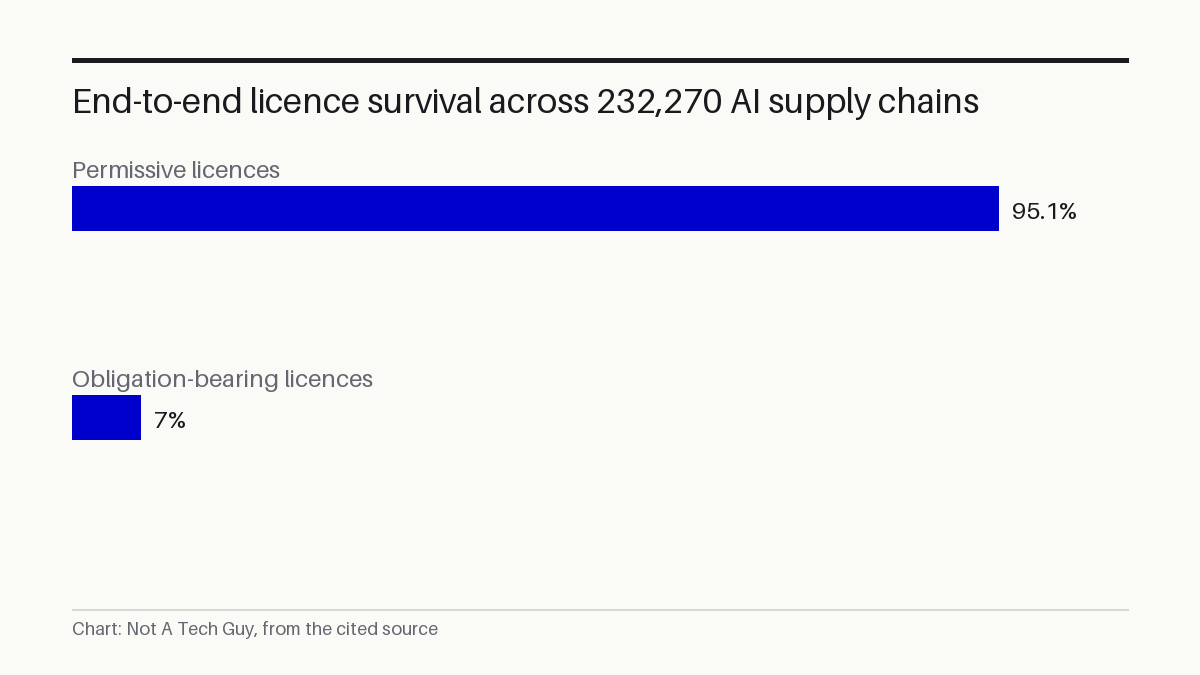
An arXiv preprint posted on 22 July traced 232,270 AI supply chains from dataset to model to application and found that permissive licences survive end-to-end 95.1% of the time S¹. Every licence category that carries obligations, from attribution requirements to non-commercial terms, survives in fewer than 7% of those same chains S¹. The researchers call this gap "licence laundering," and if they are right, the open AI ecosystem has been quietly erasing the conditions creators attach to their work. The question is whether anyone downstream knows what they are actually shipping.
My read: This is the first study I've seen that measures licence survival across the full dataset-to-model-to-application chain, and the 95.1% versus sub-7% split is wide enough to take seriously. But I would separate two findings. The headline contrast is striking but partly mechanical: permissive licences survive because they impose nothing, so there is nothing to strip. The more actionable number is that 62.3% of chains pass through at least one artifact with no declared licence at all S¹. That is where the chain breaks, and where a fix is possible.
How a licence disappears between Hugging Face and GitHub
The supply chain the authors mapped is the one most AI developers already use without thinking about it. A dataset lands on Hugging Face. Someone trains a model on it and posts the model back to Hugging Face. Someone else wraps that model into an application and publishes the code on GitHub S¹. At each hop, the licence label can change.
Two forms of laundering appear in the paper S¹. The first: an artifact with no declared licence acquires a definitive label when it is repackaged downstream. A dataset with no licence terms becomes a model card that says Apache 2.0. The second: one declared licence replaces another during redistribution. A non-commercial dataset becomes a permissive model, which becomes a permissive application. The obligations vanish somewhere in between.
According to the authors, no prior study has measured whether licence obligations survive the dataset-to-model-to-application chain S¹. Their earlier work, published as a 2025 preprint, traced licence drift from Hugging Face to GitHub P³. A separate 2025 study by different researchers documented documentation and licensing gaps on Hugging Face itself P⁴. This new preprint connects the full chain for the first time.
Why 62.3% of chains have a hole in them
More than six in ten of the 232,270 traced chains pass through at least one artifact with no declared licence S¹. These unlabelled artifacts are not scattered randomly. They are concentrated in a small set of foundational datasets S¹, the kind that thousands of models are trained on. One missing label at the base of the chain creates ambiguity for everything built on top.
The survival numbers tell the rest of the story. Permissive licences, which ask nothing of downstream users, reach 95.1% end-to-end survival S¹. Obligation-bearing licences, which require attribution, share-alike, or non-commercial use, all fall below 7% S¹. A related audit by the same research group examined how permissive labels spread through the chain P². The picture is consistent. Terms that cost nothing to honour survive, and terms that impose obligations do not.
What to do about it
Consider a pathology lab that pulls a diagnostic model from Hugging Face. The model card says Apache 2.0. The lab's engineering team integrates it into a patient screening tool and ships it. What the model card does not say is that the dataset the model was trained on carried a non-commercial licence, or no licence at all. The lab is now running a clinical tool on terms it never saw, and may be bound by obligations it never agreed to.
The practical step is simple but rarely taken: trace the lineage. Before shipping a model, check the dataset it was trained on, rather than relying on the model card alone. Hugging Face model pages often link to source datasets. If that dataset has no declared licence, or one that conflicts with how you plan to use the model, you have found the gap this study describes. The authors offer recommendations for practitioners, model publishers, rights holders, and platform owners S¹, but until platforms enforce licence propagation, the checking falls to you.
What we don't know yet
Every number in this story, from the 232,270 chains to the 95.1% and sub-7% survival rates, comes from a single preprint that has not been peer-reviewed S¹. The authors are clear that their scope is limited to traced chains on Hugging Face and GitHub, not all AI platforms or all artifacts S¹. The term "licence laundering" is their framing, not an established legal category, and the paper does not claim that the drift is intentional or illegal S¹. Two days before this preprint appeared, on 20 July, we looked at how AI trust tools favour fairness over security. Licence integrity is the other half of that question.
The next signal: the peer-reviewed version of this paper, which will either confirm or revise the survival rates. We will check the published numbers against these preprint figures when it appears. Subscribe and we'll check them for you.
Sources: S1 — Don't Trust the Label: License Laundering in AI Supply Chains · P2 — Permissive-Washing in the Open AI Supply Chain: A Large-Scale Audit of · P3 — From Hugging Face to GitHub: Tracing License Drift in the Open-Source · P4 — An Empirical Analysis of Machine Learning Model and Dataset Documentat · P5 — huggingface/transformers
Related reading
- Cortex framework chains 32 robot skills for long-horizon tasks — our technology desk, 2026-07-07
- AI trust tools favour fairness over security, arXiv study finds — our technology desk, 2026-07-20
- Language models don't just measure culture — they shape it — our technology desk, 2026-07-08
Generated from an audited evidence pack with primary-source research. Social-media items are discussion signals, not verified facts. Nothing here is financial, legal or medical advice.