

The open-source repository ruvnet/ruflo, a TypeScript project that wraps Anthropic's Claude Code and OpenAI's Codex into what its maintainers call an "agent meta-harness," landed on GitHub Trending daily this week with roughly 69,000 total stars and 130 to 140 new stars per day across two snapshots S¹S². The project claims to give a single coding agent a "nervous system" of more than 100 specialised agents, memory that persists across sessions, and secure communication between agents on different machines S¹S². None of those capabilities have been independently verified, and the project has no affiliation with Anthropic. What the code actually does, versus what the README claims, is the question anyone running npx ruflo init needs answered before they hand it their codebase.
My read: This is the first Claude Code wrapper I've seen that claims enterprise-grade federation and self-learning swarms in the same README, and I'm skeptical of both. The star count is real and impressive, but stars measure attention, not capability. The release notes for v3.32.35 P⁵ suggest the adaptive learning piece is genuine new work rather than rebranding. What I'd watch is whether anyone outside the project's own community can reproduce the federation and memory claims, because those are the features that would matter to a real engineering team.
What ruflo actually is
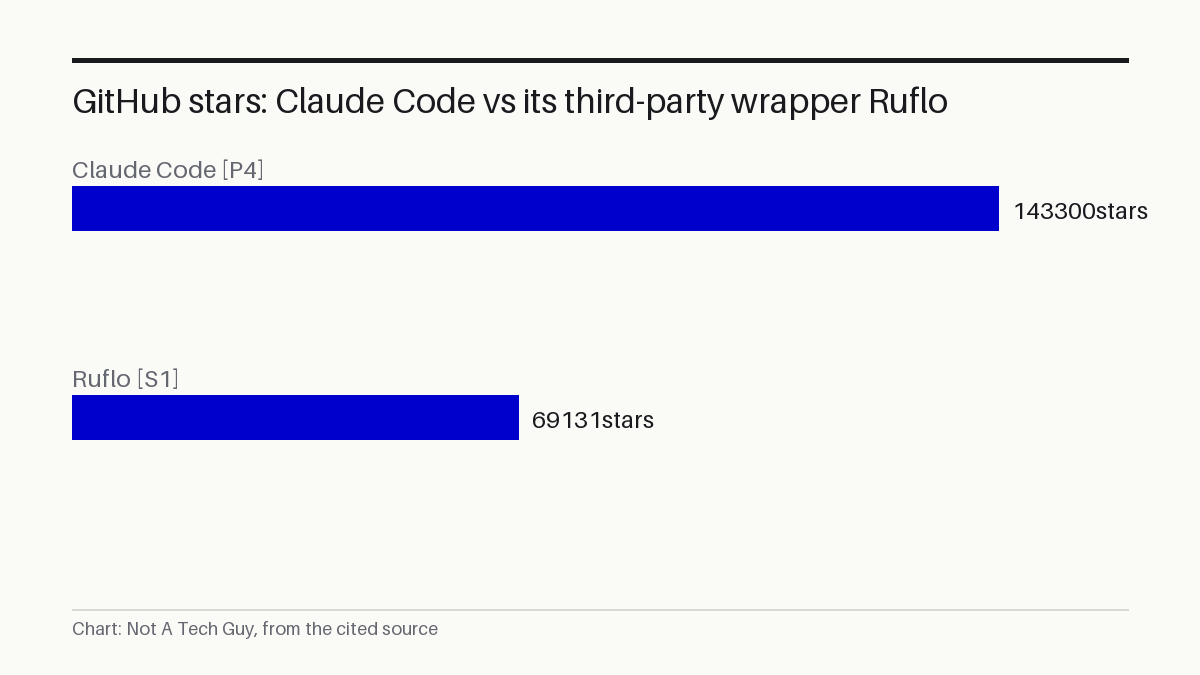
The repository, formerly named "Claude Flow" and renamed "Ruflo" by a user identified as rUv S¹S², is an MIT-licensed TypeScript project P³ that sits on top of Claude Code, Anthropic's terminal-based coding tool which itself has 143,300 stars on GitHub P⁴. Ruflo's pitch is that one command, npx ruflo init, extends Claude Code with a layer of agent coordination and memory that works across machines S¹S².
The maintainers describe two install paths S¹S². The first is a Claude Code Plugin that adds slash commands and agent definitions. The second is a full CLI install that the maintainers say includes 98 agents, over 60 commands, 30 skills, an MCP server, hooks, and a daemon S¹S². On install, the core module registers its own MCP server, the protocol that lets AI tools call external functions, with tools callable via prefixed names like mcp__plugin_ruflo-core_ruflo__memory_store S¹S².
The claims and what backs them
The README makes large promises. The maintainers say ruflo adds more than 100 specialised agents to Claude Code, along with swarm coordination and memory that learns across sessions. They also claim federation that lets agents on separate machines communicate securely S¹S². Enterprise security guardrails are also claimed S¹S². They describe the project as "powered by Cognitum.One agentic architecture, running a Rust-based AI engine" S¹S², though the repository is tagged as TypeScript, and the Rust engine is an underlying component claim, not the repo's primary language.
The most recent release, v3.32.35, published on 29 July 2026 P⁵, adds what the maintainers call a "pheromone-adaptive" topology that gives long-running agent teams a controlled way to learn which workers should receive future tasks, combining outcome and latency signals P⁵. This is the kind of concrete mechanism that is checkable in the code, unlike the broader marketing claims.
Ruflo's claim of self-learning memory that persists across sessions S¹S² sits squarely in an active research area, but the README provides no benchmark scores, no comparison data, and no security audit to support it.
Why 69,000 stars matters and doesn't
Two GitHub Trending snapshots from 22 and 24 August S²S¹ show the repository at 68,703 and 69,131 total stars respectively, gaining 140 and 131 stars on those days. The deep research fetch of the repository page P³ shows 68,360 stars, 8,206 forks, and 846 open issues.
Those numbers tell a story of rapid attention. They do not tell a story of proven capability. The 846 open issues are worth noting: a project claiming enterprise security and federated communication across machines has a substantial backlog of unresolved problems. The star-to-issue ratio is roughly 80 to 1, which is normal for a popular open-source project but not what you'd expect from something running production-grade agent swarms.
What to do about it
If you're an engineering team already using Claude Code and curious about agent coordination, the plugin install path is the low-risk entry point. It adds slash commands and agent definitions without the full CLI daemon, so you can evaluate whether the agent definitions are useful without committing to the broader system.
Consider a team at a mid-sized fintech that uses Claude Code for routine code review and git workflows. The appeal of ruflo is obvious: instead of one agent reviewing a pull request, a swarm could review, test, and document in parallel. But the federation claim, agents on different machines securely talking to each other, is exactly the kind of feature that sounds useful in a financial services context and is also exactly where unverified security claims become a liability. Until there is an independent security review of the federation layer, treating it as anything more than a local experiment is premature.
One practical thing you can do this week: clone the repository, run the plugin install path only, and inspect the agent definitions and MCP tool names in the source code. The MCP server registration is verifiable in the code. If the tools are well-structured, the project has real engineering value even if the swarm claims are aspirational.
What we don't know yet
No independent review has confirmed the self-learning memory, federated communication, or enterprise security claims. The README is the maintainers' own description, not a third-party assessment. We do not know whether the "Cognitum.One agentic architecture" is a separate project with its own documentation or a name used only within ruflo. We do not know the real-world failure modes of the pheromone-adaptive topology introduced in v3.32.35, as the release is less than a month old.
The next signal: watch for ruflo's next release or a community security audit. If the project's federation and memory claims hold, someone in the open-source community will attempt to reproduce them and publish results. We'll check this claim against whatever surfaces next. Subscribe if you want that follow-up landed in your inbox.
Sources: S1 — ruvnet/ruflo: 🌊 The original agent meta-harness. Deploy intelligent mu · S2 — ruvnet/ruflo: 🌊 The original agent meta-harness. Deploy intelligent mu · P3 — ruvnet/ruflo · P4 — anthropics/claude-code · P5 — Ruflo v3.32.35 — Adaptive Swarms and Safer Learning Loops · P6 — labrat-0/ai-ml-scraper
More from Not A Tech Guy
- New system spawns Claude Code agents with pre-loaded memory
- wayfinder: map AI projects too big for one session
- New STAR metric catches AI translations that drop sentences
Generated from an audited evidence pack with primary-source research. Social-media items are discussion signals, not verified facts. Nothing here is financial, legal or medical advice.