

Hugging Face's open-source datasets library, carrying roughly 21,900 GitHub stars, appeared on the platform's daily trending list this week S¹S². The Python library gives developers one-line access to public datasets spanning 467 languages and dialects, and its maintainers claim a new streaming mode is "up to 100x faster" with a backend called Xet S¹. Whether that speed claim holds up under independent testing is an open question, and the answer matters for every team whose AI pipeline starts with loading data.
My read: This is a mature library, not a viral newcomer. It was created in March 2020 P³, and a +5 star day on a 21,900-star repo tells you this is steady infrastructure that developers keep returning to, not a flash trend. The Xet speed claim is the part I would treat with caution. "Up to 100x faster" is the kind of ceiling figure that sounds great in a README but could mean very different things depending on dataset size, network conditions, and file format. What is verifiable and genuinely useful: the format coverage, the 467-language breadth, the Apache Arrow backend, and the Apache 2.0 licence. Those explain the staying power.
What the library actually does
The maintainers describe it as "the largest hub of ready-to-use datasets for AI models" S¹. That is a self-description, not an independent ranking. What the code does, according to the project's own README, is provide one-line dataloaders that pull datasets from the Hugging Face Datasets Hub, a platform where, as of mid-2024, the community had shared more than 180,000 public datasets P⁵.
The format support is broad. The library handles CSV, JSON, JSONL, Parquet, Apache Arrow, XML, plain text, and Webdataset files natively S¹. It also has built-in readers for text, audio, image, video, PDF, and NIfTI, a format used for 3D medical imaging S¹. That last one matters: if you are training a model on MRI scans, you can load NIfTI files without writing a custom parser.
Under the hood, the library uses Apache Arrow with zero-copy memory-mapped storage S¹. In practice, that means it can read data from disk into memory without copying it, which cuts the overhead of loading large datasets. It converts natively to and from NumPy, Pandas, Polars, PyTorch, TensorFlow, JAX, and Spark S¹, so a team can pull a dataset once and feed it into whatever framework they are using.
The library also ships with built-in FAISS and Elasticsearch index support for similarity search S¹. That is the kind of feature that usually requires a separate integration. Having it in the same library means a team can build a retrieval pipeline, the kind that lets a language model search through documents before answering a question, without stitching together multiple tools.
Why a 2020 library is trending now
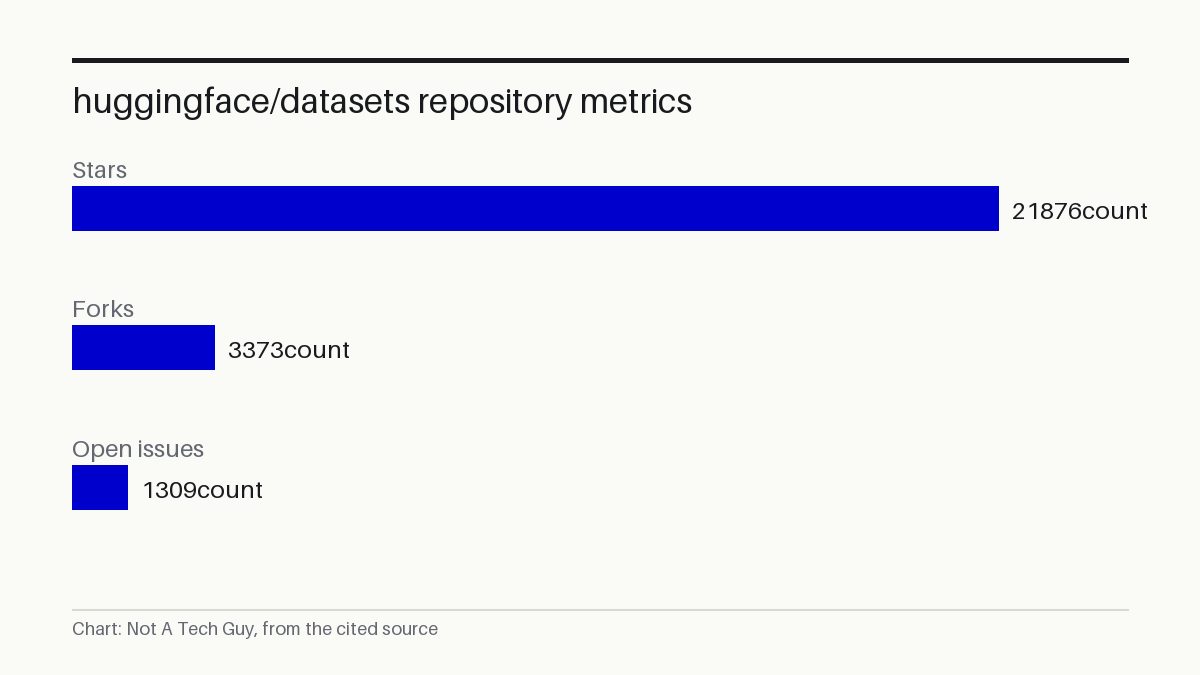
The repository was created on 26 March 2020 P³. It has accumulated 21,876 stars, 3,373 forks, and 1,309 open issues under an Apache 2.0 licence P³. A +5 star day is modest by trending standards, but the appearance on GitHub's daily list points to sustained interest rather than a spike.
The timing fits a broader pattern. Data preparation is where AI teams spend their time, and the tools that make it faster keep drawing attention.
Hugging Face's datasets library sits at the start of that pipeline. The Hub already hosts datasets like HuggingFaceFW/fineweb, with 52.5 billion tokens, and Anthropic's hh-rlhf, with 169,000 examples P⁶. A library that can stream those datasets without downloading them first, if the Xet claim holds, changes the calculus for teams working with terabyte-scale training data.
What to do about it
If you are building an AI pipeline and not already using this library, the practical entry point is simple: install it with pip install datasets or conda install -c huggingface -c conda-forge datasets S¹, then try loading a dataset from the Hub with a single line of Python. The one-line dataloaders work with any of the 180,000-plus public datasets on the Hub S¹P⁵.
Consider a speech recognition startup that needs to train on audio data in 12 languages. Without this library, the team would write custom loaders for each dataset, handle format differences between WAV and MP3 sources, and manage memory manually for files too large to fit in RAM. With the library, they can stream audio datasets directly, convert to PyTorch tensors natively, and switch between languages by changing one argument. The 467-language coverage means the same code path works whether the dataset is in English, Yoruba, or Breton S¹.
One practical thing to check this week: pick a dataset from the Hub at huggingface.co/datasets, install the library, and test the streaming mode on a dataset larger than your available RAM. If the Xet backend delivers on the speed claim, you will feel it immediately. If it does not, the open issues list, with 1,309 entries, is where to look for known limitations P³.
What we don't know yet
The "up to 100x faster" streaming claim comes from the maintainers' README, not from an independent benchmark S¹. The evidence pack flags this explicitly as unverified. The phrase "up to" leaves room for the real-world improvement to be much smaller, depending on dataset size, format, and network conditions.
The star count and trending status are snapshots from 6 to 7 September 2026 S¹S². GitHub trending is ephemeral, and the +5 star day suggests the ranking may reflect algorithmic factors beyond raw growth.
We also do not know how the Xet backend compares to alternatives like DVC or standard HTTP streaming in production conditions. The library's built-in FAISS and Elasticsearch support is documented, but there is no independent assessment of how it performs at scale against dedicated vector databases.
The next signal: watch the Hugging Face blog and the repository's release history for a Xet backend benchmark or case study. If one appears, we will check the 100x claim against it. If you want that follow-up in your inbox, subscribe and we will send it the moment it lands.
Sources: S1 — huggingface/datasets: 🤗 The largest hub of ready-to-use datasets for A · S2 — huggingface/datasets: 🤗 The largest hub of ready-to-use datasets for A · P3 — huggingface/datasets · P4 — README.md · P5 — Announcing New Dataset Search Features · P6 — Datasets – Hugging Face
More from Not A Tech Guy
- OpenWhispr: free voice dictation app hits GitHub trending
- Google Pics: AI image editing inside Docs and Slides
- Qwen, Mistral and Llama verify fake developer identity, study finds
Generated from an audited evidence pack with primary-source research. Social-media items are discussion signals, not verified facts. Nothing here is financial, legal or medical advice.