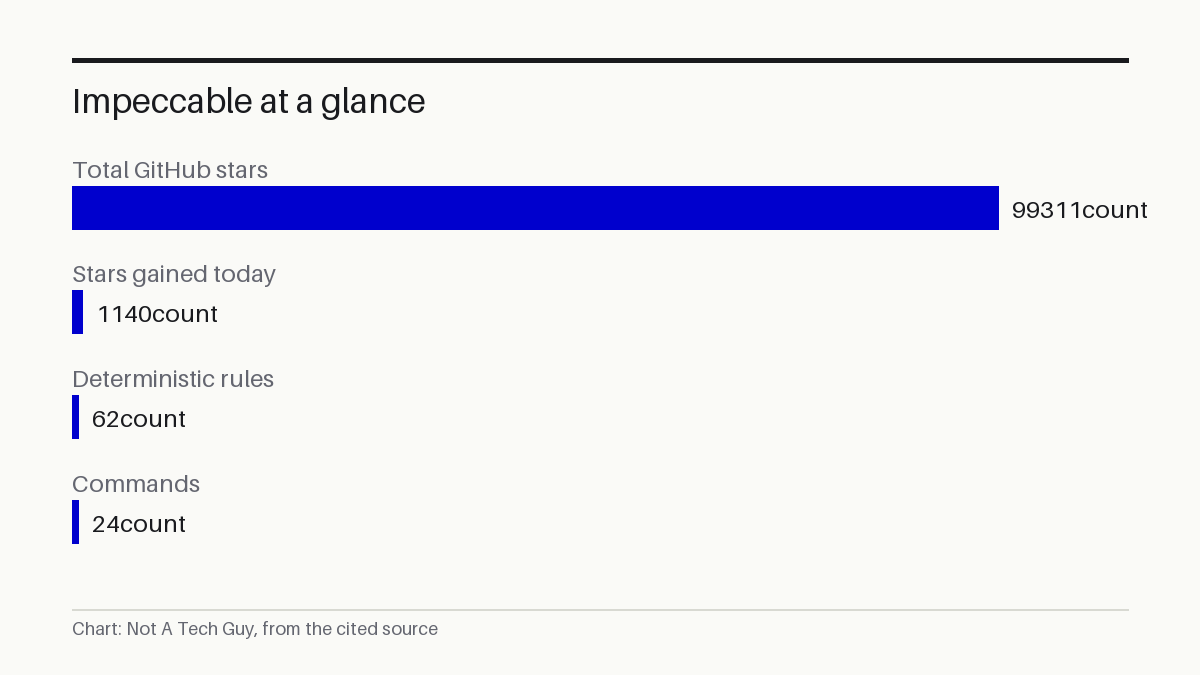

Developer pbakaus pushed the Impeccable repository past 99,311 GitHub stars today, adding 1,140 in a single day to reach GitHub's daily trending list S¹. The Rust-based linter targets design mistakes that AI coding agents leave behind — what the README labels "AI slop", using 62 deterministic rules rather than a language model or API key S¹. That runs against the grain of a market where the default fix for bad AI output is another AI layer.
My read: The appeal is obvious: a rule-based linter for design quality costs nothing to run and adds no latency. But the 62-rule count and the broad compatibility claim across 20-plus agents are both self-reported by the maintainer — no independent audit has been published, no error bars or test suites are available, and the star count is GitHub's own metric with no verification of unique users S¹. The Fable 5.1 before-and-after comparison in the README is a marketing example the maintainer chose, not a benchmark. The number I would watch is whether the rules hold up against real agent output from tools like Cursor or Claude Code, not the curated demo.
Impeccable ships 24 commands and two context files
Impeccable installs via npx impeccable install from a project root, then runs /impeccable init inside a coding agent S¹. It writes a PRODUCT.md file to capture project context and can snapshot an existing visual system into DESIGN.md S¹. From there, 24 commands steer the agent's output: polish and bolder push designs in specific directions, critique scores the design, audit checks accessibility, distill strips what the page doesn't need S¹.
The compatibility list is long: Claude Code, Cursor, Codex CLI, GitHub Copilot, Devin, Replit Agent, Gemini CLI, and more than a dozen others S¹. The latest release, skill-v4.8.0 on 26 October, added Devin and Replit Agent support and accepts windsurf as an alias P⁴. None of these integrations have been independently verified — the claims rest on the maintainer's own testing, with no released test harness or third-party reproduction.
Deterministic rules cost zero inference and no API dependency
The tool's core bet is that AI-generated interfaces have tells: cramped padding, skipped headings, generic colour palettes. Sixty-two deterministic rules flag those patterns directly, without calling a model S¹. That means zero inference cost and no dependency on an API that could rate-limit or change pricing.
This lands at a moment when coding agent adoption is accelerating. Cline, an open-source coding agent, hit 70,000 GitHub stars last month, and enterprises are routing agent traffic across models to cut spend. A design-quality linter that runs locally in Rust S¹ fits the same cost-conscious pattern.
A frontend engineer running Cursor or Claude Code could install Impeccable, run audit on generated components, and get a rules-based pass on accessibility and spacing before code reaches review — the tool flags missing heading hierarchy or tight padding without a second model call, so the engineer's review queue shrinks by one automated pass per component S¹. Whether the 62 rules cover enough ground to catch real-world slop, or just the curated examples in the README, is the open question. The Neo Mirai case study and the Fable 5.1 comparison are maintainer-selected examples, not independent evaluations S¹.
Full documentation is hosted at impeccable.style/docs S¹. The skill-v4.8.0 release on 26 October is the latest checkpoint P⁴.
Sources: S1 — pbakaus/impeccable: The design vocabulary for your coding agent. Steer · P2 — README.md · P3 — narunraman/STEER · P4 — Releases · pbakaus/impeccable · GitHub · P5 — huggingface/faq
Written from 5 sourced items, 4 of them primary.